Scripps Research’s Skaggs Graduate School awards doctoral degrees to 34th graduating class
May 21, 2026
Credit: Scripps Research
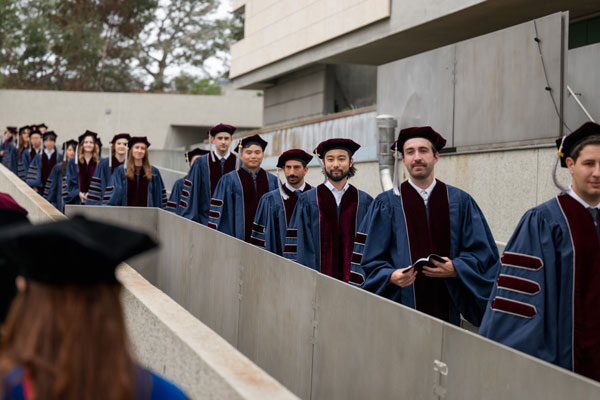
Scripps Research’s Skaggs Graduate School of Chemical and Biological Sciences awarded doctoral degrees to 49 graduate students during the institute’s 34th commencement on May 15, 2026. The ceremony also featured the conferral of honorary degrees to two notable researchers who have left an indelible mark on their fields of study and the training of generations of scientists.
Opening the ceremony and welcoming the assembled graduates, faculty and supporters, Keary M. Engle, PhD, the John and Susan Diekman Dean of Graduate and Postdoctoral Studies, framed the day’s celebration in the context of the Skaggs Graduate School’s recent top rankings by U.S. News & World Report.
“Rankings are not our goal, however they do reflect our mission, which is to recruit, train, mentor and launch the best young scientists in the world who will go on to shape a new era of science,” said Engle. “Collectively, we’re changing what is possible in science and medicine through a commitment to basic science research in an environment that encourages and accelerates translation. The students whose stories you’ll hear about today stood at the bench alongside us over the last several years working tirelessly toward this goal.”
After describing many of the skills that graduates were required to master and hurdles overcome on their path toward a doctoral degree, Engle concluded his remarks by encouraging the 49 new alumni to apply their talents toward making a positive impact in areas of great need.
“Right now, more than ever, the world needs people who are trained to ask hard questions, demand rigorous evidence and remain curious and optimistic,” said Engle. “As you leave here today, carry this with you. You are trained at one of the finest scientific institutions in the world. You’ll now join the ranks of hundreds of alumni who are leading drug discovery programs, founding biotech companies, shaping science policy, teaching at universities around the world, and so much more. The problems worth solving ahead of you won’t be easy, but you are not here because you’ve chosen an easy path. You’re here because you’re exactly the type of scientist the world needs to solve hard problems.”
Before introducing the ceremony’s keynote speaker, Scripps Research President and CEO Pete Schultz, PhD, the L.S. “Sam” Skaggs Presidential Chair, addressed the graduating students with several words of advice. Among his encouragements, he urged the graduates to use their training and talent to leave a positive impact on the world.
“I’ve been doing science for quite some time, and I never viewed it as a job. I actually view it as a privilege,” said Schultz. “Our privilege is to explore science and the world around us. But with that privilege comes a huge obligation to give back to the society that enables us to do what we love.”
Prior to the introduction of the graduating students, Schultz welcomed the ceremony’s guest speaker, noted chemist Peter Dervan, PhD, an emeritus faculty member at the California Institute of Technology (Caltech) and pioneer in the field of chemical biology, who gave the keynote address. After Schultz’s introduction, Dervan shared his confidence in the assembled graduates.
“A commencement speaker often gives a few bits of wisdom collected along the way, but I don’t have to worry about this group, Pete, because I think they’ve figured it out,” said Dervan, turning to the graduates. “Work on important problems. Swing for the fences. Take risks, and as Pete said, failure is great. It teaches us, it makes us stronger, refines us. Be a nice person in the lab. Collaboration accelerates the journey. Be a learner, and then pay it forward; be a mentor to others. But, this is the most important one, and it’s going to be the most important one now—ethics are important. Integrity of self and data are sacred.”
After the conferral of the graduating students’ doctoral degrees, Schultz returned to the stage to grant two honorary degrees: one to Dervan and another to Scripps Research faculty member and noted structural biologist Professor Ian Wilson. Wilson has been an active participant in the institute’s graduate program since its inception in 1989, and worked closely with the institute’s then-president Richard Lerner, MD to design and launch the program. Wilson served as advisor and mentor to the first graduate student to receive a doctoral degree from Scripps Research.
“Ian has contributed enormously, not only to Scripps, but also to science and to medicine, and it’s a real pleasure to confer upon him an honorary degree,” said Schultz.
With Friday’s commencement, the number of alumni of Scripps Research’s doctoral program increased to nearly 1,100. Many of this year’s graduates are extending their doctoral training into new research areas as postdoctoral scholars at universities while others are launching their careers with positions at pharmaceutical and biotechnology companies. Others will apply their knowledge and experience to different career paths entirely, including public policy, venture capital, patent law and education.
Profiles of many of this year’s graduates and a recording of the full ceremony can be viewed on the institute’s 2026 Graduation webpage, scripps.edu/graduation.
About the Skaggs Graduate School
Ranked among the top 10 doctoral programs of its kind in the nation by U.S. News & World Report, the Skaggs Graduate School of Chemical and Biological Sciences at Scripps Research offers rigorous training in chemistry, chemical biology, neuroscience, immunology, computational biology, and numerous other biomedical research disciplines. The program immerses students in intensive laboratory research while offering a customizable course curriculum that allows students to match individual research interests while exploring multidisciplinary topics at the interface of chemistry and biology.
Skaggs Graduate School of Chemical and Biological Sciences 2026 Graduating Class
-
Lauren Alysse Alexandrescu, PhDAdvisors: Danielle Grotjahn, PhD and Gabriel Lander, PhDDissertation: Macromolecular Machines In Motion: Insights from Long-Timescale Molecular Dynamics and Time-Resolved Cryo-EM
-
Rubens Almeida Tavora, PhDAdvisor: Susana Valente, PhDDissertation: Efforts Towards the “Block-and-Lock” Strategy for Curing HIV
-
Eric Michael Bilotta, PhDAdvisor: Michael Erb, PhDDissertation: Small Molecule Discovery to Modulate Transcriptional Co-Regulatory Proteins
-
Sharidan Brown, PhDAdvisor: Andrew Ward, PhDDissertation: Identification and Characterization of Anti-Immune Complex Antibodies Elicited by HIV Env Immunogens
-
Niccolò Bruciaferri, PhDAdvisor: Stefano ForliDissertation: Drug Discovery Towards Uncharted Targets: A Computational Framework
-
Trever R. Carter, PhDAdvisor: Michael Erb, PhDDissertation: Chemical Reprogramming of Ligand Function: High-Throughput Diversification Toward Neopharmacology
-
Ya-Ting Chang, PhDAdvisor: Danielle Grotjahn, PhDDissertation: Quantitative Cellular Cryo-ET Reveals Stress-Dependent Remodeling of Mitochondrial Protein Import and Defines New Membrane Microenvironments
-
Chu-Ting Chang, PhDAdvisor: Kirill Martemyanov, PhDDissertation: Defining Extracellular Interactions of Metabotropic Glutamate Receptors
-
Chia-Yu Chen, PhDAdvisor: Jin-Quan Yu, PhDDissertation: Proximity-Induced C(sp3)–H Activation Mediated by Hydrogen Bonding and Conformational Control
-
Tzu-Yuan Chiu, PhDAdvisor: Christopher Parker, PhDDissertation: Chemoproteomic Development of Small Molecule Modulators of Inflammatory Cytokines
-
Tiffany Chu, PhDAdvisors: Luke Lairson, PhD and Ryan Shenvi, PhDDissertation: I. Butenolide Heterodimers in Synthesis and cGAS-STING Pathway Inhibition; II. Target Identification of cGAS-STING Pathway Inhibitors Using Chemical Biology Approaches
-
Christina Megan Clark, PhDAdvisor: Michael Petrascheck, PhDDissertation: Investigations into the Metabolic Side-Effects of Approved Drugs Using Caenorhabditis elegans as a Model
-
Jessica N. Coppola, PhDAdvisors: Dennis Burton, PhD and Joseph Jardine, PhDDissertation: Optimizing Antibody-based Prophylaxis through Immune Synergy and Engineering
-
Sarah R. Dallo, PhDAdvisor: Luiz Pedro Sorio de Carvalho, PhDDissertation: Ligand Engagement in Mycobacterial Enzymes that Inactivate Small Molecules
-
Mario de Leon, PhDAdvisor: John Yates III, PhDDissertation: PicoPODS: High-throughput Single-Cell Encapsulation Technology for Proteomic Analysis
-
R. Justice Fleischmann III, PhDAdvisor: Travis Young, PhDDissertation: Design, Engineering, and Advancements in T cell-Centric Cancer Immunotherapy
-
Lucas Leo Fluegel, PhDAdvisor: Ben Shen, PhDDissertation: Exploring Natural Product Biosynthesis Across Scales: From One Biosynthetic Pathway to Many
-
Kaushik Ram Ganapathy, PhDAdvisors: Ali Torkamani, PhD and Chunlei Wu, PhDDissertation: Computational Frameworks for Improved Interpretability of Allele Specific Expression Data
-
Kefei Gao, PhDAdvisor: Peng Wu, PhDDissertation: Pro-Tumorigenic Immature and Transitional NK Cells Drive Tumor Progression in a TNF-α-Dependent Manner
-
Patricia Ann Hahn, PhDAdvisor: Mauricio Martins, PhDDissertation: Immune Activation in HIV Pathogenesis and Cure: From Risk Factors to Barriers in Therapeutic Intervention
-
Janet Joy, PhDAdvisor: Andrew Su, PhDDissertation: Integrative Approaches for Biomedical Discovery using Gene Expression Complementarity and Knowledge Augmented AI Models
-
Robin Russo Kobylski, PhDAdvisors: Kendall Nettles, PhD and Laura Solt, PhDDissertation: Ligand Modulation of Steroid Receptor Signaling: Mechanisms of Allostery, Crosstalk, and Selectivity
-
Kuang-Ting Kuo, PhDAdvisor: Patrick Griffin, PhDDissertation: Next Generation PPARγ Modulators: Therapeutic Potential and Structure-Function Insights in Metabolic Disorders
-
Hao Li, PhDAdvisor: Michael Farzan, PhDDissertation: Enhancing the Immunogenicity of HIV-1 Envelope Glycoprotein Trimers via Cytoplasmic Modifications
-
Zhongrui Li, PhDAdvisor: Chi-Huey Wong, PhDDissertation: 2-Deoxyglycosylations with Controllable Reactivity and Stereoselectivity
-
Daniel Maria Lima Vilela Bader, PhDAdvisors: William Schief, PhD and Andrew Ward, PhDDissertation: An HIV Vaccine Design Strategy for Priming Class-Specific Broadly Neutralizing Antibodies Targeting the CD4-binding Site
-
Xiaohe Lin, PhDAdvisor: Ian Wilson, DPhil., DSc., FRS, FRSEDissertation: Structural and Computational Strategies for Vaccine Immunogen Validation and Monoclonal Antibody Discovery Against HIV and Influenza
-
Garrett L. Lindsey, PhDAdvisor: Benjamin Cravatt, PhDDissertation: Remodeling Transcriptomes with Covalent Small Molecules Targeting the RNA-Binding Protein NONO
-
Matthew David Mann, PhDAdvisor: Patrick Griffin, PhDDissertation: Integrative Structural and Functional Analysis to Dissect Progesterone Receptor Regulation and Chromatin Engagement in Breast Cancer
-
Abeera Mehmood, PhDAdvisors: Howard Hang, PhD and Alejandra Mendoza, PhDDissertation: T-bet Expressing B cells are Key Determinants of Protective Immunity Against Norovirus Infection
-
Kenna Kelley Nagy, PhDAdvisor: Luc Teyton, MD, PhDDissertation: Therapeutic Anti-Glycan Antibodies for Antibiotic Resistant Staphylococcus aureus
-
Changran Niu, PhDAdvisor: Baoji Xu, PhDDissertation: Regulation of Protein Synthesis in Glial Cells and its Role in Sexual Dimorphism of Autism
-
Sarah May Norman, PhDAdvisor: Jeffery Kelly, PhDDissertation: Electrophiles as Tools for Protein Targeting: Applications in Inverse Drug Discovery and 19F NMR Studies
-
Yuxin Ouyang, PhDAdvisor: Jin-Quan Yu, PhDDissertation: Enantioselective C–H Functionalization of Native Amides: Construction and Diversification of Chiral Methyl Stereocenters
-
Ryan Andrew Pak, PhDAdvisor: Ardem Patapoutian, PhDDissertation: An Unexpected Journey: CRISPRa Screening for Novel Sensory Receptors Reveals Complex Tannins Inhibit PIEZO2
-
D. Quang Phan, PhDAdvisor: Jin-Quan Yu, PhDDissertation: Enantioselective C(sp3)–H Functionalizations of Native Amides and Free Carboxylic Acids
-
Grace Ann Pixton, PhDAdvisors: William Schief, PhD and Dennis Burton, PhDDissertation: Initiating Glycan-Promiscuous Broadly Neutralizing Antibody Precursors to Advance the Development of a Protective HIV Vaccine
-
Tianbo Qi, PhDAdvisor: Li Ye, PhDDissertation: Top-Down Regulation of Feeding Microstructure
-
Abigail Emma Reeves, PhDAdvisor: Mia Huang, PhDDissertation: Capturing the Dynamic Placental Proteome and Galectin-3 Interactome Using Proximity Labeling
-
Alex Lynne Rerick, PhDAdvisor: Phil Baran, PhDDissertation: Radical Strategies to Enable the Convergent Syntheses of Cyclodammaranes and Serratenes
-
Yanmeng Nina Shi, PhDAdvisor: Xiaohua Wu, PhDDissertation: Mechanism and Regulation of Alternative DNA Double-Strand Break Repair
-
Juntao Sun, PhDAdvisor: Keary Engle, PhDDissertation: Generation and Functionalization of C(sp2)–Palladium and Copper Intermediates: Catalysis and Organometallic Study
-
Ishan Taneja, PhDAdvisor: Stefano Forli, PhDDissertation: Computational Methods for Sampling Alternative Protein Conformations and Modeling Desolvation Upon Protein-Ligand Binding
-
Eileen Tang, PhDAdvisor: Luke Lairson, PhDDissertation: Chemical Biology Approaches to Target Tumor Cells Through Drug Combination and Cancer Immunotherapy-Based Systems
-
Ana P. Verduzco Espinoza, PhDAdvisor: Hollis Cline, PhDDissertation: On the Impact of APOE4 and Inflammation in Microglia-Neuron Signaling
-
Nicholas William Villarino, PhDAdvisor: Ardem Patapoutian, PhDDissertation: FM 1-43-Guided Identification of the First Natural and Synthetic PIEZO2 Modulators
-
Xinpei Yue, PhDAdvisor: Baoji Xu, PhDDissertation: Neural Circuits of BDNF-Expressing Paraventricular Hypothalamic Neurons in the Regulation of Energy Balance
-
Zijun Zhang, PhDAdvisor: Jin-Quan Yu, PhDDissertation: Cu-catalyzed Redox-Neutral Transformations Based on Radical Relays of Amidyl Radicals Generated from N-methoxyamides
-
Chuanping Zhao, PhDAdvisor: Kirill Martemyanov, PhDDissertation: Defining the GPCR Landscape of Photoreceptors