
Chemists snap together complex 3D molecules from highly reactive ‘radicals’—without losing their shape
June 10, 2026
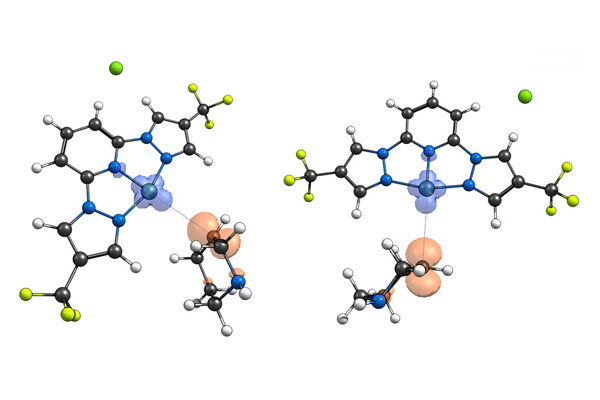
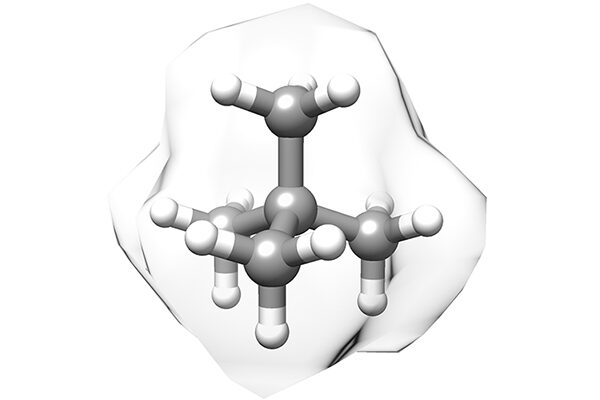
The radical rebound. Computational visualization showing the carbon-centered radical (orange spin density) binding to the nickel-centered radical (blue spin density). Two perspectives are shown. Credit: Scripps Research
LA JOLLA, CA—Building the complex 3D molecules needed for new medicines has always been a bit like assembling a puzzle with pieces that keep trying to flip over. Now, chemists at Scripps Research have found a way to snap two such molecular pieces together while keeping their original 3D shapes intact, even when using some of the most reactive molecules in chemistry: free radicals.
In a study published in Science on June 4, 2026, the research team reports a new cross-coupling reaction—a way to join two carbon-based fragments into one molecule while keeping the starting 3D arrangement intact. This 3D maintenance is called stereoretention, and the method to retain it uses a simple nickel catalyst. The new reaction works across a wide range of pharmaceutically relevant molecules, offering a useful new tool for drug discovery.
“Organic chemistry is fundamentally about forming carbon–carbon bonds, and doing so with control over 3D structure is one of the most important obstacles to overcome,” says senior author Phil Baran, a professor and the Dr. Richard A. Lerner Endowed Chair at Scripps Research. “Our approach lets us connect the most reactive pieces and still get precise results.”
Many drugs work because their molecules have a specific 3D “handedness” (chirality) that allows them to fit into biological targets, much like a left hand only fits a left glove. The mirror-image version often does nothing—or worse, it can bind differently and cause unwanted side effects. Yet creating chiral centers while linking carbon atoms has been notoriously difficult, especially when using highly reactive radicals that normally lose their orientation almost instantly.
Traditional solutions either require many synthetic steps or expensive shape-controlling catalysts, or they force chemists to build molecules in a more linear, less efficient way. The research team’s new method bypasses these limitations by letting chemists take two pre-assembled, complex fragments and join them directly.
 The moment after homolysis. Nitrogen gas (blue) departs from the molecule, generating the nickel-based radical complex (dark green) and the alkyl radical fragment (white and dark gray), poised for rebound. Two perspectives are shown. Credit: Scripps Research
 Click here for a high-resolution image.
This new reaction couples a sulfonyl hydrazide (a compound that carries the desired 3D information) that’s already left- or right-handed with a common type of molecule in organic chemistry called an alkyl halide. Both generate short-lived carbon radicals, but the nickel catalyst carefully times their encounter. One radical is briefly “caged” on the nickel in a protected environment, allowing it to snap back and form the new bond before it can escape and scramble its handedness. This “caged radical rebound” is the key to preserving stereoretention while maintaining 80–96% enantiospecificity, meaning the product usually keeps its starting handedness, and producing practical yields between 40–90%.
The process is redox-neutral, so there’s no need for extra chemicals to move the reaction forward. This approach also doesn’t require specialized additives or shape-directing helper molecules (called chiral ligands), and it runs under standard lab conditions. Plus, it tolerates the kinds of chemical parts drug chemists rely on to build and fine-tune medicines—including free amines, olefins, heterocycles, aryl bromides and more—without unwanted side reactions.
The team demonstrated the method on dozens of starting materials, focusing on piperidine and pyrrolidine scaffolds: chemical structures commonly found in pharmaceuticals. After testing roughly 1,000 conditions, the optimized protocol proved effective across a broad set of examples. For instance, a medicinally relevant piperidine building block previously made in seven steps (including a step to separate the molecule’s left- and right-handed forms) was prepared in one coupling step in 60% yield with 95% stereoretention. Furthermore, the researchers built a natural product called stenusine—which certain beetles excrete from their feet to glide across water quickly—using fewer steps than previous techniques. The reaction also scales to gram quantities and can even couple two secondary radicals to create molecules with adjacent chiral centers.
This work extends Baran’s earlier advances in radical-based cross-coupling, which have already begun changing how industry designs molecules. By making stereoretentive alkyl–alkyl bond formation as straightforward as many aryl couplings (well-established bond-forming reactions), the method could shorten synthetic routes, reduce waste and accelerate the exploration of chemical space—especially when paired with artificial intelligence to map out new routes for creating drugs.
“Our goal is to make it easier to build the kinds of molecules that matter in medicine,” adds Baran. “If we can simplify how those structures are assembled, it changes how chemists approach synthesis from the ground up.”
In addition to Baran, authors of the study “Stereoretentive radical-based alkyl-alkyl cross-coupling,” include Yu Wang, Jiawei Sun, Yin Li, David A. Cagan, Oliver T. Ring, Xin Zeng, Jet Tsien, Luca Massaro, Jillian E. Smith, Brandon J. Orzolek and Yu Kawamata of Scripps Research; and Michael R. Collins of Pfizer Inc.
This work was supported by funding from the National Institutes of Health (GM-118176) and the National Science Foundation MPS-Ascending postdoctoral fellowship (NSF 2500003).