Scripps Research establishes endowed chair honoring Peter K. Vogt, influential pioneer in cancer research
Michael Erb to be inaugural chairholder
August 12, 2026

Scripps Research has established the Peter K. Vogt Endowed Chair, a new faculty chair honoring the impactful scientific career of Peter K. Vogt, professor emeritus in the institute’s Department of Molecular and Cellular Biology.
The chair recognizes Vogt’s career-long commitment to unraveling the genetic mechanisms that drive cancer while also providing flexible support for a mid-career faculty member at Scripps Research. Vogt is credited with transforming cancer research in the early 1970s when he collaborated with scientists at UC Berkeley and UC San Francisco to discover the first oncogene, src. Subsequent studies with his colleagues determined that oncogenes are cellular rather than viral genes, a finding that is considered one of the most influential in the history of cancer research.
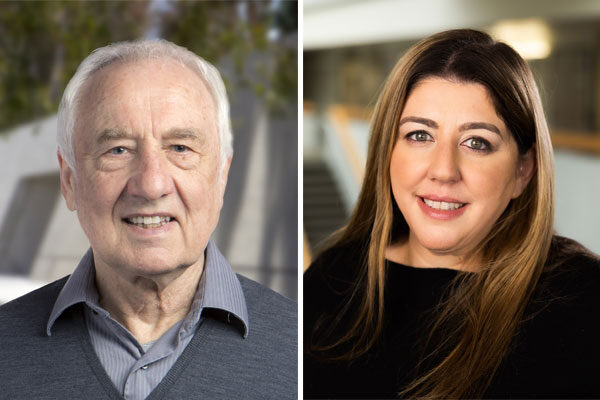
Two Scripps Research professors, Paul Schimmel and Andrew Ward, initiated the chair and made significant gifts toward funding it. They were joined by numerous institute alumni who have built successful careers following Vogt’s training and mentorship.
“Peter is an icon,” says Schimmel. “His seminal studies launched much of the field of molecular cancer research and have since pointed the way toward many targeted therapies. Andrew and I are pleased to have played a role in establishing this chair.”
Michael Erb, an associate professor in the Department of Chemistry, has been selected as the inaugural holder of the Vogt Endowed Chair. The chair will rotate to a new faculty member every four years.
Like Vogt, Erb has centered his career on cancer research, specifically on developing chemical tools to target the transcriptional programs that drive cancer.
“We chose Michael for his exceptional creativity and for the translatable potential of his research,” says Vogt. “Michael works at the leading edge of cancer research today. His innovations are changing the way scientists address cancer and providing a road map for designing new therapeutics. I am thrilled that he is the inaugural holder of this chair.”
An endowed chair is one of the highest honors a research institute can bestow on a faculty member. The permanent funding that comes with the chair frees the scientist to explore bold avenues of research, ones for which it would be difficult to procure a traditional government grant. An endowed chair brings greater visibility to the scientist’s work, while simultaneously elevating the reputation of the institute. And, critically, an endowed chair serves to recruit and retain the very best scientists, ensuring a highly competitive and productive research environment.
“Endowed chairs are powerful tools for driving scientific innovation,” says Pete Schultz, president and CEO of Scripps Research and holder of the L.S. “Sam” Skaggs Presidential Chair. “At a time when federal funding agencies are increasingly constrained and risk-averse, endowed chairs ensure that our scientists can stay focused on the questions that matter most for advancing human health.”
About Peter K. Vogt
The endowed chair Erb will hold serves to recognize the six-decade career of molecular biologist, virologist and geneticist Peter K. Vogt. Born in Broumov, Czechoslovakia (now the Czech Republic), Vogt received his PhD in biology at the University of Tübingen and completed postdoctoral training at UC Berkeley. Following faculty positions at several American universities, he joined Scripps Research in 1993, heading the Division of Oncovirology within the Department of Molecular and Experimental Medicine. He later served as senior vice president for scientific affairs for the institute from 2012 to 2015.
At Scripps Research, Vogt continued studying the genetic and epigenetic mechanisms behind cancer with the goal of identifying targets for intervention. In collaboration with Scripps Research chemists, he challenged the task of identifying a small molecule inhibitor of myc, an oncogene he had discovered that is now recognized as a driving force of most human cancers. His lab also expanded the understanding of the role that the phosphoinositide 3-kinase (PI3K) pathway plays in oncogenesis, and in recent years, in a series of three papers published in the Proceedings of the National Academy of Sciences, Vogt and his coworkers uncovered how the structure of the PI3Kα protein changes in cancer cells. By solving the structures of these mutated versions of PI3Kα, the team paved the way for targeting them with new drugs.
Among Vogt’s many awards are the prestigious Louisa Gross Horwitz Prize and the Paul Ehrlich and Ludwig Darmstaedter Prize. He has been elected to several academies, including the National Academy of Sciences, the National Academy of Medicine, the American Academy of Arts and Sciences, the American Philosophical Society and the German National Academy of Sciences Leopoldina. Additionally, Vogt has served on the editorial boards of a number of scientific journals, including Proceedings of the National Academy of Arts and Sciences, Virology, Current Topics in Microbiology and Immunology, and Frontiers in Molecular and Cellular Oncology.
About Michael Erb

After earning his doctoral degree in biological and biomedical sciences at Harvard University, Michael Erb was invited to skip traditional postdoctoral studies and become an inaugural Scripps Research Fellow in 2018. His investigations of cancer pathogenesis began attracting attention almost immediately and that same year he received the NIH Director’s Early Independence Award from the National Institutes of Health. Two years later, he received a Breakthrough Science Initiative Award totaling over $1 million to support his chemical biology approaches to pinpointing vulnerabilities in cancers. In 2023, he received the Baxter Young Investigators Award and was also promoted to associate professor at Scripps Research.
Currently, Erb and his laboratory team use chemical tools to understand the molecular mechanisms by which gene control programs drive cancer. They prioritize the development of new approaches in proximity pharmacology that can rewire biological circuits, address previously “undruggable” targets and uncover novel therapeutic strategies.