Study shows new drug compounds dial down inflammation without compromising immunity
April 6, 2026
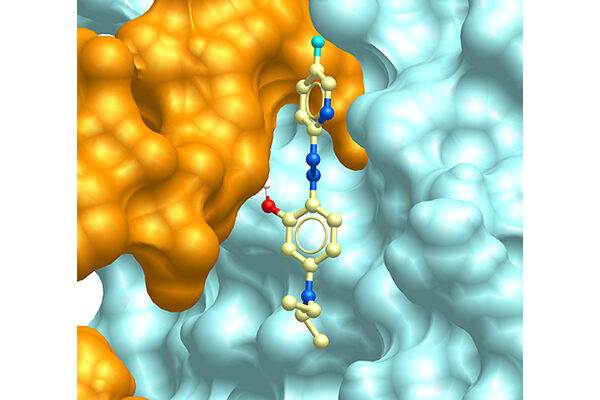
ENDOtollins inhibit Munc13-4-Syntaxin 7 binding and decrease endosomal TLR activation. Credit: Scripps Research
LA JOLLA, CA—Scripps Research scientists have developed a new class of drug compounds that reduce harmful inflammation while leaving the body’s ability to fight infections intact—a long-sought goal in treating autoimmune diseases. The compounds, called ENDOtollins, work by interrupting a “molecular handshake” between two proteins inside immune cells.
The research, published in Nature Chemical Biology on April 6, 2026, could lead to more targeted treatments for conditions like lupus, rheumatoid arthritis and juvenile arthritis, which together affect more than 15 million Americans.
“A key component of our approach is to begin by understanding the biological mechanisms at play,” says Sergio D. Catz, professor at Scripps Research and senior author. “By accomplishing this first, we can more easily target the pathway driving inflammation without affecting other important processes.”
Current autoimmune disease treatments like hydroxychloroquine work by broadly blocking endosomes, the compartments inside cells where incoming materials are sorted and processed, including molecules that trigger immune responses. While effective, this approach can lead to significant side effects—including gastrointestinal problems and, less commonly, vision damage—causing a significant number of patients to stop treatment.
Catz and his team took a different approach: They focused on two proteins, Munc13-4 and syntaxin 7, that must bind together for immune sensors called Toll-like receptors (TLRs) to activate inside endosomes. This “molecular handshake” plays a key role in detecting the foreign DNA and RNA from invaders like viruses and bacteria. However, in autoimmune diseases, TLRs become overactive, detecting self-nucleic acids, for example, from neutrophil-extracellular traps, and trigger chronic, damaging inflammation even without a real threat.
In collaboration with co-author Hugh Rosen, a professor at Scripps Research and the Pearson Family Chair, the team screened roughly 32,000 compounds with the support of the institute’s Molecular Screening Center. The researchers identified molecules that specifically block the Munc13-4–syntaxin 7 interaction without disrupting other cellular functions. Because Munc13-4 is found mainly in immune cells, the compounds offer a targeted way to calm inflammation.
“Most treatments for autoimmune diseases manage symptoms; they don’t change the underlying course of the disease,” says Rosen. “What’s exciting about this approach is its potential to be disease-modifying: targeting the specific molecular machinery that drives inflammation, rather than broadly suppressing the immune system.”
A key innovation was screening compounds in an intact cellular environment. Unlike many drug screening approaches, which extract proteins from the cell, Catz and his team developed an approach that keeps cellular compartments intact.
“By maintaining the proteins in their natural environment, we increase the likelihood that compounds we find will actually work in living cells,” says Jennifer Johnson, first author and senior staff scientist at Scripps Research.
The most potent compound, ENDO12, reduced inflammation in animal models that were also given a TLR-activating molecule. Blood levels of inflammatory markers—including immune system activators IL-6 and IFN-γ, and the enzyme myeloperoxidase—dropped significantly in those that were treated.
Crucially, ENDO12 did not impair the animal models’ ability to fight a real viral infection: they showed a normal antiviral immune response when exposed to a virus. This selectivity addresses a major concern with immunosuppressive drugs: that dampening inflammation might leave patients vulnerable to infections.
The team’s next steps include testing ENDOtollins in models that more closely mimic human autoimmune diseases, as well as further optimizing the compounds’ chemistry for potential clinical use.
Beyond autoimmune conditions, the researchers suggest ENDOtollins might help treat cytokine storms—the dangerous immune overreactions seen in patients with severe COVID-19 and as a side effect of CAR-T cancer therapy. Both involve excessive IL-6 and runaway inflammation.
While translating these findings into treatments for patients remains a long-term goal, Catz emphasizes that the mechanistic insights are valuable in their own right. ENDOtollins can serve as precision tools to probe other cellular processes regulated by endosomes and lysosomes—including pathways implicated in neurodegeneration and immune dysfunction. Understanding the basis of how these compartments become stressed or dysfunctional could have broad implications for understanding and treating human disease.
This study was done in collaboration with Roberto Baccala of San Diego BioMed. Additional authors of the paper, “ENDOtollins, novel small molecule inhibitors of Munc13-4-Syntaxin 7 interaction and endosomal TLR activation, decrease systemic inflammation,” include Elsa Meneses-Salas, Aparna Shukla, Binchu Shaji, Farhana Rahman, Jing He, Steve Brown, Kristi L. Marquardt and John Teijaro of Scripps Research; Evripidis Gavathiotis of the Albert Einstein School of Medicine; Rosana Gonzalez-Quintial of the San Diego BioMed Institute; Hal Hoffman of the University of California San Diego; and Catherine Hedrick of the Medical College of Georgia at Augusta University.
This research was supported by U.S. Public Health Service grants R01HL088256, R01AR070837, P01HL152958 and R01DK110162, and by Cystinosis Research Foundation fellowships.



Hugh Rosen: A physician-scientist’s guide to developing medicines
More than 90% of drugs fail to make it from the lab bench to approval. How, then, has a physician-scientist like Hugh Rosen found so much success in developing medicines? Rosen, who’s the chair of the Molecular and Cellular Biology Department and the Pearson Family Chair at Scripps Research, co-invented the drugs ozanimod (approved for multiple sclerosis and ulcerative colitis) and navacaprant (in Phase 3 trials for major depressive disorder). In this episode of Science Changing Life, listen in as Rosen unveils the success stories behind these groundbreaking treatments—shedding light on the challenges and triumphs shaping modern medicine.

Bringing precision therapy to mental disorders
Mental disorders like depression and schizophrenia affect the lives of millions of people around the world, and yet, available treatment options have remained the same for decades. In this Front Row lecture, Scripps Research professor Hugh Rosen shared how his pioneering research has led to the development of the drug navacaprant, which precisely targets one of the brain’s behavioral circuits and is currently in clinical testing for major depressive disorder. Harnessing his expertise as a physician-scientist, Rosen has discovered and developed multiple other medicines, including ozanimod—a breakthrough treatment approved for multiple sclerosis and ulcerative colitis.
An engine for new medicines: A century of science changing life
Calibr, a nonprofit research institute founded by Scripps Research President and CEO Pete Schultz, joined Scripps Research in 2018 as its drug discovery division. As a world-class nonprofit “bench to bedside” drug discovery engine, Calibr delivers groundbreaking solutions to unmet medical needs by uniting the creativity of fundamental discovery with highly focused R&D capabilities and expertise.