Huntington’s disease may be driven by slowed protein-building machinery in cells
March 5, 2021
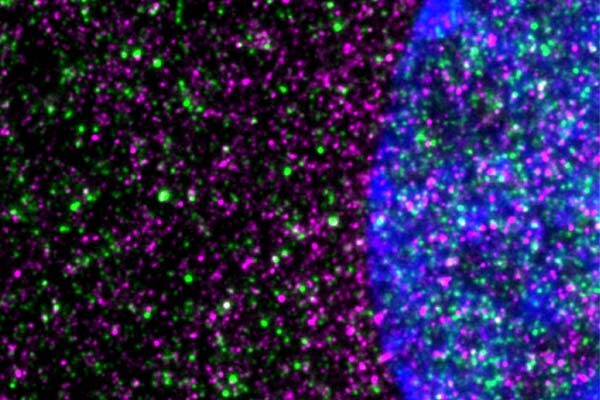
Disease-causing huntingtin, shown in red, interacts with ribosomes, shown in green, in a striatal neuron. The nucleus is blue. Image captured by Nicolai Urban of Max Planck Institute for Neuroscience in Jupiter, Florida.
JUPITER, FL — In 1993, scientists discovered that a single mutated gene, HTT, caused Huntington’s disease, raising high hopes for a quick cure. Yet today, there’s still no approved treatment.
One difficulty has been a limited understanding of how the mutant huntingtin protein sets off brain cell death, says neuroscientist Srinivasa Subramaniam, PhD, of Scripps Research. In a new study published in Nature Communications, Subramaniam’s group has shown that the mutated huntingtin protein slows brain cells’ protein-building machines, called ribosomes.
“The ribosome has to keep moving along to build the proteins, but in Huntington’s disease, the ribosome is slowed,” Subramaniam says. “The difference may be two, three, four-fold slower. That makes all the difference.”
Cells contain millions of ribosomes each, all whirring along and using genetic information to assemble amino acids and make proteins. Impairment of their activity is ultimately devastating for the cell, Subramaniam says.
“It’s not possible for the cell to stay alive without protein production,” he says.
The team’s discoveries were made possible by recent advancements in gene translation tracking technologies, Subramaniam says. The results suggest a new route for development of therapeutics, and have implications for multiple neurodegenerative diseases in which ribosome stalling appears to play a role.
Huntington’s disease affects about 10 people per 100,000 in the United States. It is caused by an excessive number of genetic repeats of three DNA building blocks. Known by the letters CAG, short for cytosine, adenine and guanine, 40 or more of these repeats in the HTT gene causes the brain degenerative disease, which is ultimately fatal.
The more repeats present, the earlier the onset of symptoms, which include behavioral disturbances, movement and balance difficulty, weakness and difficulty speaking and eating. The symptoms are caused by degeneration of brain tissue that begins in a region called the striatum, and then spreads. The striatum is the region deep in the center of the brain that controls voluntary movement and responds to social reward.
For their experiments, the scientists used striatal cells engineered to have three different degrees of CAG repeats in the HTT gene. They assessed the impact of the CAG repeats using a technology called Ribo-Seq, short for high-resolution global ribosome footprint profiling, plus mRNA-seq, a method that allows a snapshot of which genes are active, and which are not in a given cell at a given moment.
The scientists found that in the Huntington’s cells, translation of many, not all, proteins were slowed. To verify the finding, they blocked the cells’ ability to make mutant huntingtin protein, and found the speed of ribosome movement and protein synthesis over all increased. They also assessed how mutant huntingtin protein impacted translation of other genes, and ruled out the possibility that another ribosome-binding protein, Fmrp, might be causing the slowing effect.
Further experiments offered some clues as to how the mutant huntingtin protein interfered with the ribosomes’ work. They found it bound directly to ribosomal proteins and the ribosomal assembly, and not only affected speed of protein synthesis, but also of ribosomal density within the cell.
Many questions remain, Subramaniam says, but the advance offers a new direction for helping people with Huntington’s disease.
“The idea that the ribosome can stall before a CAG repeat is something people have predicted. We can show that it’s there,” Subramaniam says. “There’s a lot of additional work that needs to be done to figure out how the CAG repeat stalls the ribosome, and then perhaps we can make medications to counteract it.”
In addition to Subramaniam, the authors of the paper, “Mutant Huntingtin Stalls Ribosomes and Represses Protein Synthesis in a Cellular Model of Huntington Disease,” include Mehdi Eshraghi, Pabalu Karunadharma, Neelam Shahani, Nicole Galli, Manish Sharma, Uri Nimrod Ramírez-Jarquín, Katie Florescu, and Jennifer Hernandez of Scripps Research; Juliana Blin and Emiliano P Ricci of the RNA Metabolism in Immunity and Infection Lab, Laboratory of Biology and Cellular Modelling of Lyon, France; Audrey Michel of RiboMaps of Cork, Ireland; and Nicolai Urban of the Max Planck Neuroscience Institute in Jupiter, Florida.
The research was supported by the Lottie French Lewis Fund of the Community Foundation for Palm Beach and Martin Counties, the Cure for Huntington Disease Research Initiative foundation, and the National Institutes of Health (R01-NS087019-01A1 and R01-NS094577-01A1).




2025 Year in Review: Five insights we’re still thinking about
In a special year-end episode of Science Changing Life, we’re revisiting five moments from 2025 that continue to shape how we think about science. Featuring insights from Scripps Research experts across genetics, infectious disease, public health surveillance and chronic illness, this episode features some of this year’s most memorable soundbites.


Can AI look at your retina and diagnose Alzheimer’s? Eric Topol hopes so
WIRED

How the nervous and immune systems coordinate inflammation
Just as we can distinguish between the sting of heat and the chill of cold, our immune system is finely tuned to recognize and respond to a wide range of threats, from viruses and bacteria to allergens and injury. This complex sensing relies on communication between diverse cell types, including sensory neurons and immune cells, to ensure responses are tailored to the specific challenge. In this Front Row lecture, Assistant Professor Alejandra Mendoza explored how neuro-immune cellular circuits regulate inflammation, pain, and immunity. By bridging neuroscience and immunology, her research is revealing how our bodies interpret signals from the environment to guide immune decisions, from fighting infections to controlling tumor growth and chronic inflammatory diseases.