Scientists discover a new way that a disease-linked protein comes apart
New findings from Scripps Research and the University of Illinois Urbana-Champaign reveal a previously unknown way that the protein transthyretin can unfold and break down, and how it may contribute to rare forms of amyloid disease.
September 10, 2026
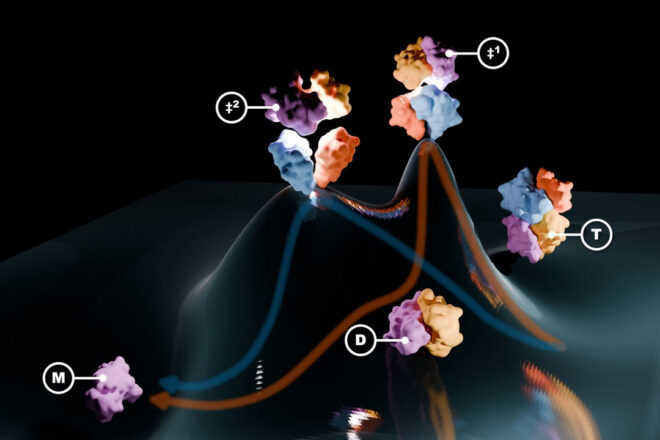
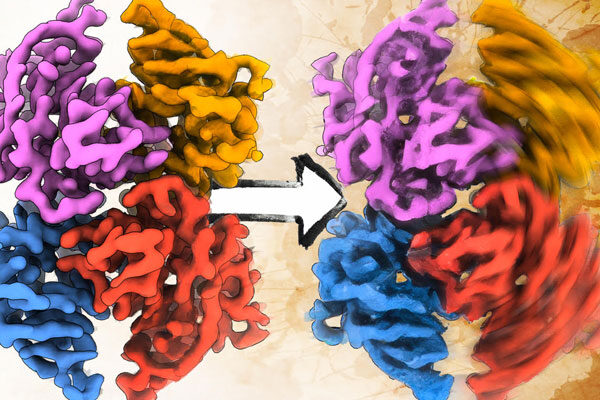
Dissociation of the four-part TTR protein. The energy landscape shows stable states toward the bottom and unstable transition states toward the top. In the canonical pathway (red), the tetramer (T) dissociates via a native-like, compact transition state (‡1) into transient dimer intermediates (D) before full dissociation into monomers (M). In the newly discovered alternative pathway (blue), the tetramer dissociates through a more expanded transition state (‡2) directly into monomers. Credit: Jan-Hannes Schäfer, Scripps Research

LA JOLLA, CA—Transthyretin amyloid disease (ATTR) is a progressive, life-threatening condition caused when the protein transthyretin (TTR) breaks apart and aggregates in the heart and other organs. One of the most common treatments, a drug called tafamidis, works by helping TTR stay intact—slowing how it normally unfolds and aggregates. Now, Scripps Research scientists have discovered a second, previously unknown TTR unfolding pathway that may cause protein aggregation in some rare hereditary forms of the disease.
The study, published in the Proceedings of the National Academy of Sciences on September 8, 2026, may offer new avenues of research to treat a condition that affects tens of thousands of people in the United States.
TTR is a protein that helps transport vitamin A and the thyroid hormone thyroxine in the blood, cerebrospinal fluid and the eye. Over time, its four-unit structure splits into two-unit pieces, which then separate into single units that can misfold and clump together—causing one of the most common forms of systemic amyloidosis in humans, particularly in the heart and nervous system.
To uncover the alternative pathway, the researchers tested more than 100 TTR variants, measuring how quickly each unfolded across a range of urea concentrations and acidity levels. They supported their findings using cryogenic-electron microscopy and previously published X-ray crystal structures.
The results reveal that TTR has a second unfolding route in which the four-unit structure falls apart more directly, without the two-unit intermediates. The alternative pathway is accessible to some TTR variants, particularly those that cause amyloidosis in the brain.
“We need to understand whether this alternative pathway can lead to TTR aggregation in the cerebrospinal fluid, which could potentially translate into worse outcomes for patients carrying these rare mutations who take the current medications,” says senior author Jeffery Kelly, the H. Lutcher Brown Endowed Chair at Scripps Research who co-developed tafamidis.
The alternative pathway is also favored under acidic conditions—the environment found inside lysosomes, the cellular organelles where proteins are broken down and recycled at the end of their life cycle.
“This route probably evolved so TTR can be degraded, which is important, but can also have side effects,” says co-author Martin Gruebele, a professor emeritus of chemistry at the University of Illinois Urbana-Champaign.
For people with the most common types of TTR amyloidosis, the alternative pathway appears too slow under normal conditions to compete with the known pathway. But certain disease-associated mutations appear to make the new pathway more accessible, even at normal acidity levels in the blood.
“More research is needed, but this opens up a new direction in the field of drugs targeting specific amyloidosis pathways,” says Gruebele. “At least we have one of several possible smoking guns to look at.”
Besides possible biomedical implications, this paper also furthers our understanding of protein folding and unfolding. Folding through multiple pathways has been proposed by theorists, but demonstrating the existence of such pathways experimentally has been difficult.
“Transthyretin is the first oligomeric protein for which pathway multiplicity has been shown in solution, and without mechanical pulling,” says Marcus Jäger, the first author.
In addition to Jäger, Kelly and Gruebele, authors of the study “Transthyretin can denature by an alternative pathway,” include Jan-Hannes Schäfer, Gabriel Lander and Evan Powers of Scripps Research.
This work was supported by the National Institutes of Health (grant R01 DK046335) and a postdoctoral fellowship from the German Research Foundation (Project No.: 556478029).
Fixing the misfolded proteins that cause dementia and heart failure
All proteins have a correct way of “folding” themselves into their 3D structures. When this folding process goes awry, including processes leading to protein misassembly, a number of devastating diseases can result. In this Front Row lecture, Scripps Research professor Jeffery Kelly shared how he's developing novel therapeutic strategies to target these protein misfolding diseases, which lead to deterioration of the heart and brain. His multi-disciplinary research has already led to the development of an FDA-approved drug available in the pharmacy called tafamidis (Vyndaqel® and Vyndamax®): a medicine that slows the progression of the neurodegenerative disease familial amyloid polyneuropathy and the degenerative heart disease called TTR cardiomyopathy.
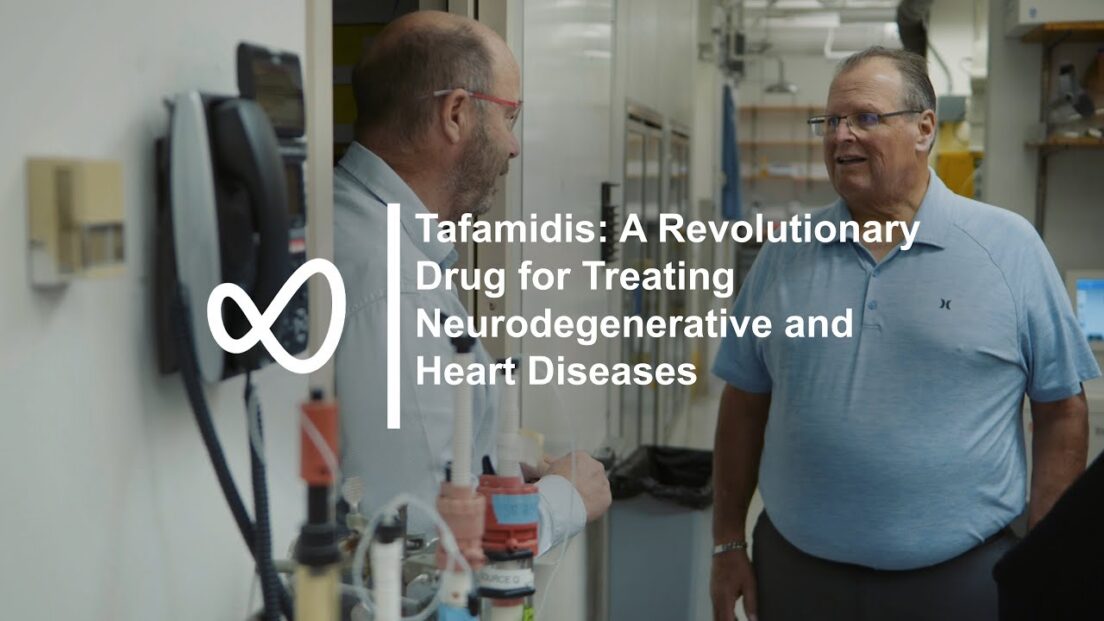
Tafamidis: A revolutionary drug for treating neurodegenerative and heart diseases
Scripps Research professor Jeffery Kelly received an unexpected visit from a patient whose life was dramatically improved by tafamidis—a revolutionary drug for treating neurodegenerative and heart diseases, developed by Kelly himself. Kelly is a leading figure at Scripps Research, spearheading efforts to address some of the most pressing medical challenges, including Alzheimer’s and various amyloid diseases. His cutting-edge research on protein misfolding has not only led to the development of tafamidis but has also broadened our understanding of protein aggregation disorders.
Front Row spotlight with Jeffery Kelly
Scripps Research professor Jeffery Kelly received an unexpected visit from a patient whose life was dramatically improved by tafamidis—a revolutionary drug for treating neurodegenerative and heart diseases, developed by Kelly himself. Kelly is a leading figure at Scripps Research, spearheading efforts to address some of the most pressing medical challenges, including Alzheimer’s and various amyloid diseases. His cutting-edge research on protein misfolding has not only led to the development of tafamidis but has also broadened our understanding of protein aggregation disorders.
An engine for new medicines: A century of science changing life
Calibr, a nonprofit research institute founded by Scripps Research President and CEO Pete Schultz, joined Scripps Research in 2018 as its drug discovery division. As a world-class nonprofit “bench to bedside” drug discovery engine, Calibr delivers groundbreaking solutions to unmet medical needs by uniting the creativity of fundamental discovery with highly focused R&D capabilities and expertise.