

Quest for safer pain medications garners $3.6 million, five-year grant
August 17, 2018
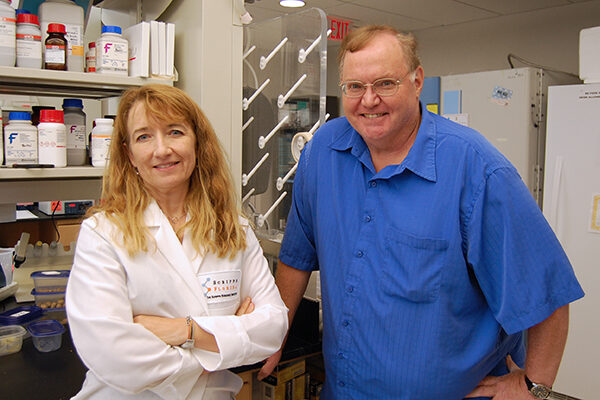
The National Institute on Drug Abuse, part of the National Institutes of Health, has awarded a five-year, $3.68 million grant to two Scripps Research scientists, Laura Bohn, PhD, and Thomas Bannister, PhD, to advance their work developing safer pain medications.
Previously, Bohn and Bannister, based in Jupiter, Florida, had developed new compounds that separate the powerful pain-relieving benefit of opioids from the life-threatening side-effect of decreased breathing rate and lower blood-oxygen levels. The new round of funding enables the team to further improve these compounds while also evaluating the extent to which other common opioid side effects, including constipation, drug tolerance, and especially addiction risk, are inherently altered in these new compounds, with an eye toward further widening the safety margins.
“We want to determine if these compounds produce drug preference, which is a sign of abuse potential, and to make new compounds that have built-in abuse deterrence — to control pain without the risk of addiction,” Bohn says.
People who experience severe pain from cancer, car accidents, surgeries, burns and other traumas frequently require powerful pain relievers, sometimes for sustained periods. Because tolerance develops over time, their physicians often must increase dosage to maintain pain relief, raising the risk of overdose and addiction. New pain medications that diminish pain, minimize risk of overdose and other side effects, and also limit abuse potential, are sorely needed, Bohn says.
An expert in a cell-signaling system called G-protein-coupled receptors, Bohn worked many years with Bannister, a medicinal chemist, to develop compounds that activate a receptor called the mu opioid receptor, which relieves pain, without likewise activating the beta-arrestin pathway, associated with the harmful effects of pain killers. They published their findings in the journal Cell last year.
“Many leaders in the field of pain research have steered away from targeting the mu opioid receptor due to severe side-effects. Knowing that several of these effects can, in fact, be avoided is a finding that could offer hope to people who need effective but safe pain relief,” Bannister says.
The grant number is 2R01DA033073-06.
About Scripps Research
Scripps Research is ranked the most influential scientific institution in the world for its impact on innovation. A nonprofit research organization, Scripps expands basic knowledge in the biosciences and uses these fundamental advancements to develop profound innovations that improve well-being. Scripps researchers lead breakthrough studies that address the world’s most pressing health concerns, accelerating the creation and delivery of medical breakthroughs to better human health across the globe. Our educational and training programs mold talented and committed students and postdocs into the next generation of leading scientists.
For more information about Scripps Research visit www.scripps.edu. Follow @ScrippsResearch on Twitter, Facebook or LinkedIn.
Media contact
Stacey Singer DeLoye, [email protected], 561-228-2551




2025 Year in Review: Five insights we’re still thinking about
In a special year-end episode of Science Changing Life, we’re revisiting five moments from 2025 that continue to shape how we think about science. Featuring insights from Scripps Research experts across genetics, infectious disease, public health surveillance and chronic illness, this episode features some of this year’s most memorable soundbites.


Can AI look at your retina and diagnose Alzheimer’s? Eric Topol hopes so
WIRED

How the nervous and immune systems coordinate inflammation
Just as we can distinguish between the sting of heat and the chill of cold, our immune system is finely tuned to recognize and respond to a wide range of threats, from viruses and bacteria to allergens and injury. This complex sensing relies on communication between diverse cell types, including sensory neurons and immune cells, to ensure responses are tailored to the specific challenge. In this Front Row lecture, Assistant Professor Alejandra Mendoza explored how neuro-immune cellular circuits regulate inflammation, pain, and immunity. By bridging neuroscience and immunology, her research is revealing how our bodies interpret signals from the environment to guide immune decisions, from fighting infections to controlling tumor growth and chronic inflammatory diseases.