Resources for All
We are here to assist with your transition to the U.S.—everything from information regarding the U.S. medical system to instructions for getting a driver’s license.
English Language Resources
Many classes are available to help non-native speakers improve their command of English. These programs provide a variety of courses (such as grammar, vocabulary, pronunciation, writing and conversation) at a variety of levels (such as beginning, intermediate and advanced). Some also offer “English for special purposes” classes, which focus on English as used in specific subject matter areas such as business, science, medicine or engineering. In general, English as a Second Language (ESL) courses aim to prepare individuals for real-life experience in American laboratories, workplaces, classrooms and communities. These programs may also organize events and activities such as conversation partners and trips and may be able to provide tutors for individualized instruction. Below are some examples of ESL courses, and we recommend that you also search online for more options.
Scripps Research Library has a resource page on ESL under “Subject Guides” on the library website. Resources include: American Accent Training, book and CDs, instant immersion English, CDs and DVDs, and more.
Additionally, in partnership with California State University, San Marcos, we offer a free mutual training opportunity to develop oral and written communication skills in American English. Graduate students in speech language pathology from California State University, San Marcos, under the direct supervision of department faculty, provide speech language services to graduate students and research associates. For information, refer here.
Additional local opportunities:
- English Language Institute: University of California, San Diego Extension provides English language courses for a fee
- English Language Centers: EC San Diego offers classes year-round
- San Diego Miramar College: San Diego Miramar College offers English for Speakers of Other Languages (ESOL) classes
Scripps Research Library has a resource page on ESL under “Subject Guides” on the library website. Resources include: American Accent Training, book and CDs, instant immersion English, CDs and DVDs, and more.
- EL Sol Resource Center, Jupiter offers many free English classes (English, Conversational English and Computer Skills). Classes provide an introduction to American culture, healthcare and libraries along with opportunities to socialize, volunteer and garden
- Palm Beach County Adult Education Center offers classes year-round for adults, including English for Speakers of Other Languages (ESOL)
- Palm Beach State College, Palm Beach Gardens Campus offers classes for academic purposes and classes through continuing education
Healthcare & the U.S. Medical System
At Scripps Research, we are committed to providing comprehensive, affordable and customizable benefits for our eligible employees and students. Our total rewards package includes benefits that meet the essential health needs of employees and their dependents, and help secure a strong financial future and enhance wellbeing.
Navigating the healthcare and medical system in the United States can be complicated, but the International Services Office and the Benefits Administration Office at Scripps Research are here to help. For current staff and students, learn more here.
Your insurance should provide a list of doctors and hospitals that your insurance will allow you to use. Please confirm with your insurance where your coverage will be accepted and choose a doctor and a hospital before you get sick. Some insurance does not specify which doctors to use, in which case, you will need to do some research online and ask friends and colleagues for their recommendations. Some insurance will not cover costs if you do not use one of their preferred doctors or hospitals. Most insurance companies have the information online.
To find a doctor, you may want to ask your colleagues and friends what doctor they use. You can also use online search engines to review the backgrounds of doctors in the area by searching for “best doctors in San Diego/Jupiter.”
Most importantly, be prepared. Be sure you understand what to do if you get sick and identify the closest “Urgent Care” (non-life-threatening) or “Emergency Room” (life-threatening) facility near you.
Over-the-counter medicine is also known as OTC or non-prescription medicine. These terms refer to medicine that you can buy without seeing a doctor and without a prescription from a doctor. In the U.S, most pharmacies are found inside common stores, such as Walgreens, Target, Walmart or CVS. OTC drugs are safe and effective when you follow the directions on the label and use as directed. Typically, OTC drugs are used to treat headaches and pain, cold and flu symptoms, seasonal allergies and upset stomach.
If you are taking prescription medications on a regular basis, it might be best to bring as much medication as you can with you to the U.S to help you with the transition, until you are able to establish a physician who can write you a prescription. Some types of medication can be expensive, especially if it is not covered by your insurance. Additionally, medication that is a “controlled substance” will need a prescription from a medical doctor. Medications that are controlled may vary from country to country, so you may need to ask a pharmacist in the U.S if a medication requires a prescription from a doctor.
If you have any questions or concerns about over-the-counter or prescription medicines, you can always speak to the pharmacist on duty in any of these stores at no charge. The pharmacist is typically located behind the counter at the pharmacy. They are able to consult with you on your symptoms and recommend over-the-counter medicines that might help.
If you receive health insurance benefits from Scripps Research, please visit the Benefits webpage for more information, or contact the Benefits Office any time you have questions about health care or other Scripps Research benefits.
If you are not paid by Scripps Research and/or you do not receive health insurance benefits from Scripps Research, there are many health insurance companies and insurance brokers who serve international students and scholars in the U.S. from whom you can purchase insurance. For J-1 scholars, you must meet the health insurance requirements for the J-1 program. However, regardless of your visa status, the ISO strongly recommends that you arrange health insurance coverage for yourself and any dependents while you are in the U.S. For a sample list of health insurance providers, please see our Sample List of Health Insurance Companies. The first company listed—ITG Worldwide Insurance—is an insurance broker that will help you find the best insurance option that fits with your individual situation, and many Scripps Research scholars like their services. However, all of the companies listed on the webpage are worth exploring.
General Doctor Appointments
There are three main ways to get medical attention in the U.S.
- Regular Appointments: If you do not have an urgent situation, you should make an appointment with a doctor for a later date. If you have insurance through Scripps Research, you are often limited to appointments with specific doctors. To find out more, follow the instructions you receive when you sign up for health benefits at Scripps Research; review information on the website of your health insurance carrier (once you have selected a carrier); or contact the Benefits Office for more assistance in determining which doctors you or your family can use with the health plan you have selected.If you come to the U.S. with your own insurance, you will need to select a doctor yourself, considering expertise, location, and/or recommendations from friends or colleagues. It is usually easy to do an online search for doctors in your area with various specialties and see ratings from other patients. Please be aware that you usually need proof of health insurance in English when you make an appointment with a doctor.
- Urgent Care: If you find yourself or a family member feeling ill and feeling you need to see a doctor in the same day, at night or on the weekend, go to Urgent Care. Urgent Care is used when you want to see a doctor in the same day without an appointment or to see a doctor outside normal business hours. Urgent Care is for medical situations that are urgent but not life-threatening. When you have selected your home or apartment after arrival in the U.S., it is important to locate the Urgent Care you will use and keep their phone number in your contacts.
- Hospital Emergency Room: If you have a life-threatening situation (severe illness or accident), call 911 or go to the closest Emergency Room. If you call 911, an operator will ask for more information about your life-threatening situation and your location. He or she will send paramedics, who will help stabilize you at home and then take you to a hospital in an ambulance, if needed.
Healthcare Terminology
Whether you are purchasing insurance or making use of it while ill or injured, it is important you understand what the insurance covers (“coverage” is the list of items for which the insurance company will pay the cost). Most “premiums” (the monthly, semi-annual or annual cost of the insurance) are not refundable if you discover the insurance does not cover what you need. Below are some common health insurance words or phrases that are important to know.
The sharing of certain costs between the insurance company and the insured person, often at the rate of 80 to 20 percent, respectively.
A fixed amount you pay for a healthcare service, usually when you receive the service. The amount can vary by the type of service, such as a primary care doctor appointment, specialist appointment or urgent care visit.
Drugs that are used to treat an illness require a prescription in the U.S. It is important to note that some insurance companies do not cover the cost of all prescription drugs.
The amount of money you must pay, in each case of accident or illness, before the insurance starts paying the rest of the cost. Most policies have a deductible.
Healthcare provided at a hospital emergency room; this is the most costly way to receive healthcare and should only be used in actual emergency situations. Some insurance policies may not cover emergency room treatment if the situation is not an emergency, and emergency room services are extremely expensive. Non-emergency situations should be handled through appointments with physicians or, if the situation is one that cannot wait, but is not life-threatening, at an Urgent Care Facility.
Medical assistance while a person is confined in a hospital for a period of 24 hours or more and is charged for room and board.
Injuries, illnesses or treatments for which the insurance will not pay medical expenses. “Usual Exclusions” normally means pre-existing conditions, eye care, infertility, injuries while playing organized sports or piloting an airplane, cosmetic surgery, experimental treatments, treatments administered by a member of your family, and expenses covered under other insurance policies you may have. This is not a complete list of exclusions. Different policies have different exclusions.
Some companies may not offer insurance for dependents or the rates may be high.
Maternity coverage will often not cover any pregnancy that existed prior to becoming insured.
This a term that means medical services, supplies or treatments authorized by a physician to treat an insured person’s injury or sickness which are: (1) consistent with the symptoms or diagnosis; (2) appropriate and accepted according to good medical practice standards; (3) not primarily for the convenience of the insured person, physician or other providers; and (4) consistent with the most appropriate supply or level of services which can safely be provided to the patient.
Treatment received for an illness or injury at a hospital or another institution that does not require that the patient remain overnight and that does not incur a charge for room and board.
A contract with a health insurance company providing for a broad range of medical treatments and/or payments in case of accidents or illness. Most whole policies usually provide a standard set of benefits, but the provisions, conditions and benefits of different policies can vary widely.
Conditions that you or your family have already been treated for in the past by a medical doctor, such as asthma, cancer, pregnancy, etc., may not be covered.
The monthly, semi-annual or annual cost of the insurance.
A policy providing only very specific, limited benefits (e.g., medical evacuation/repatriation of remains), and whose benefits can supplement benefits by another policy you already have.
Some insurance covers the cost of routine doctor’s appointments and some insurance does not cover this cost.
If you are sick and want to see the doctor the same day without an appointment, seek out the closest “Urgent Care” facility. Urgent care could be used for a visit without an appointment for a bad flu, a migraine headache, etc. It’s important to identify the closest Urgent Care facility you can use with the insurance you have. Services are much more cost-effective than those provided in an emergency room visit (see above) and will ultimately cost you less than care provided at an emergency room.
An expense which: (1) is charged for treatment, supplies or medical services to treat the insured’s condition, which (2) does not exceed the usual level of charges made for similar treatment, supplies or medical services in the geographic area where the expense is incurred.
Most health insurance in the U.S. does not cover vision or dental care, and neither is a requirement for the J-1 visa status. Scholars may choose to purchase additional plans in the U.S. to cover their vision and dental needs.
Local Hopsitals & Additional Resources
San Diego has a tremendous network of exceptional doctors and hospitals. Some of the hospitals closest to Scripps Research are listed below.
Scripps Memorial Hospital La Jolla
9888 Genesee Avenue, La Jolla, CA 92037
(858) 626-4123
UCSD Health System La Jolla
9434 Medical Center Drive, La Jolla, CA 92037
(858) 657-7600
Sharp Memorial Hospital
7901 Frost Street, San Diego, CA 92123
(858) 939-3400
UCSD San Diego Medical Center
200 W Arbor Drive, San Diego, CA 92103
(858) 657-7000
Urgent Care (doctor visits without appointment)
Scripps Clinic Torrey Pines Urgent Care
10710 N Torrey Pines Road, La Jolla, CA 92037
Phone: (858) 554-8438
UCSD Health Urgent Care, La Jolla
8910 Villa La Jolla Drive, La Jolla, CA 32037
(858)249-6800
Partners Urgent Care UTC
4085 Governor Drive, San Diego, CA 92122
(858) 888-7800
Although Jupiter, Florida, is a small town, Jupiter and the surrounding area have excellent doctors and medical facilities. Medical facilities closest to the Skaggs Graduate School are listed below.
Jupiter Medical Center
1201 S. Old Dixie Hwy, Jupiter, FL 33458
(561) 263-2234
Palm Beach Gardens Medical Center
3360 Burns Road, Palm Beach Gardens, FL 33410
(561) 622-1411
Good Samaritan Medical Center
1309 N Flagler Drive, West Palm Beach, FL 33401
(561) 655-5511
St. Mary’s Medical Center
901 45th Street, West Palm Beach, FL 33407
(561) 844-6300
JFK Medical Center, North Campus
2201 45th Street, West Palm Beach, FL 33407
(561) 863-3900
Urgent Care (doctor visits without appointment)
Jupiter Medical Center Urgent Care
5430 Military Trail #64, Jupiter, FL 33458
(561) 263-7010
Med Express Urgent Care
4520 Donald Ross Road, Suite 100, Palm Beach Gardens, FL 33418
(561) 776-3090
Jupiter Medical Center Urgent Care
1335 W Indiantown Road, Jupiter, FL 33458
(561) 263-7010
Scripps Research Counseling and Psychological Services (CAPS) provides free, confidential counseling services to benefits-eligible employees and their family members on the La Jolla, California, campus and at the Skaggs Graduate School’s secondary location in Jupiter, Florida. Non–emergency counseling by licensed professionals is available for issues ranging from job stress to major depression. Clients at CAPS are usually seen in individual counseling, couples counseling or support groups. CAPS also offers guidance and referrals to people requiring longer-term or specialized treatment. For more information about CAPS counselors and services, please visit the CAPS website.
Housing
Depending on what type of housing option most interests you, you can expect to sign a rental agreement (contract) for a month-to-month, 6-month or 12-month lease. Most rentals will ask for the first month’s rent and a security deposit (usually equal to one month’s rent) and some may even ask you for the last month’s rent as well. Please note that most rentals require you to pay an application fee and credit check fee when applying to rent the unit. However, it is risky to pay deposits on housing rentals prior to arrival and we generally recommend against it.
Private room: A private room in an individual homeowner or family’s house is often the most inexpensive option. You can expect to share general living space like the kitchen, living room and bathroom. It is important to communicate with the homeowner about any privileges or limitations before making this type of agreement. This type of housing can often be rented on a short-term basis while you search for a more permanent housing option.
Apartment: The most common type of rental in all areas, an apartment is a unit that contains a set of rooms with separate bedroom(s), bath, kitchen and living room. They are normally located in multi-level buildings and vary in size, age and the amenities included. Some apartment complexes will have swimming pools, parking and laundry rooms, and others will not. Most apartments are rented without furniture. Some apartments are advertised as “furnished.” This means that a minimal amount of furniture is included with the rental.
Studio apartment: Similar to an apartment, a studio apartment is a unit where the living room and bedroom are combined into one room and there is a separate bathroom. Some studios have a separate kitchen, and some do not.
Condominium (Condo): While a condo may look like an apartment, the difference is that each condominium is privately owned. Condos are often larger in size than apartments and may have upgraded amenities. Most condos have patios or balconies, a washer/dryer in unit and parking or carport. Due to the upgraded features, condos can be more expensive than apartments.
Duplex or townhome: A duplex or townhome looks like a single-family home; however, there are two or more units that share common walls. These homes are normally less than 2,000 square feet (about 600 square meters), may have two stories, a small yard or deck and a garage. This type of rental is likely to require you to pay for all utilities, including water and trash.
Single-family home: A single-family home is a stand-alone unit that has a multi-room living area (bedrooms, kitchen, dining room, living room, family room) and often includes a washer/dryer, private yard and garage. When renting a single-family home, prepare to pay for all utilities, including water and trash. Unless you are sharing the cost with roommates, this is usually the most expensive option.
Lease or rental agreement: If you are renting a property, you will be required to sign a lease or rental agreement. This is a legal document in which the tenant agrees to make rental payments for a specified time period. The lease should outline the responsibilities of both the tenant and the landlord and should explain the requirements if you do not renew the lease when it ends and the penalties for breaking the lease. In most cases, it is to your benefit to sign a longer lease. This guarantees that your rent cannot be increased within the agreed time period and the landlord may lower your rent with a longer lease. The lease should define the amount of the rent, required deposits (damage/security deposit and pet deposit, if applicable) and to whom and where the rent is paid.
Sublet apartment or sublease: A sublet apartment (or room) becomes available when someone decides to leave their housing before the end of their rental agreement. When you sublease, you will either be liable for the contract temporarily or until it was set to expire for the original tenant. It is important to review the contract and/or have the expectations, privileges and limitations of the sublease in writing before agreeing to sublet a room or apartment. If the sublease is for a room in an apartment or townhouse, it is also important to understand all details, such as whether there are other roommates; whether laundry and kitchen facilities are available; whether you are expected to pay a portion of the gas, electricity and Wi-Fi, etc. In many cases, summer sublets are common and convenient.
Security deposit: A security deposit, also referred to as a damage deposit, is a specified amount of money that is paid to the landlord at the time you move in and is held until the end of your lease. The purpose of this deposit is to cover any damages caused by the tenant beyond normal wear and tear. Depending on the damages at the end of your lease, this deposit will be refunded to you in part or in full. A pet deposit and pet rent is normally required if you plan on having a domesticated animal in your home and if the landlord allows it. The cost will vary depending on the landlord.
Property management company: A property management company is hired to manage a rental property for the property’s owner. The company finds renters and makes sure the renters follow the lease. The company may also provide basic maintenance services. If your apartment is damaged or in need of repair, in many cases, you should contact the property management company to let them know.
Tenant: The person who rents a house or an apartment.
Landlord or landlady: The property owner who rents houses or apartments to tenants.
Utilities: Include services such as water, gas, electricity and garbage pickup. Your lease will state if utilities are included in rent. If the utilities are not included, it is important to ask for an estimate of the monthly utility costs.
- Cable television and wireless network (Wi-Fi): In most cases, cable and/or Wi-Fi are not included with the rent and if not, this will be an additional cost.
- Telephone: If you want to establish a landline in your home or DSL internet services, or you want to get a U.S. cell phone, you will need to contact one of several providers and choose the best plan for you. Often costs are cheaper if you “bundle” your services (e.g., pay for Wi-Fi, landline and cell phone together, or some other combination). Common phone companies include AT&T, Verizon and T-Mobile. Once you are in the area, these companies have stores where you can talk to someone in person about what you need.
When securing housing, please be prepared to pay expenses such as first and last month’s rent, a security deposit, and internet and cable installation costs.
For many of our international students, scholars and visitors, this is their first time in San Diego and in some cases, the first time ever in the United States. Getting settled into a new place and a new life may be challenging. The following will provide you with the necessary information to get started with living in San Diego.
Rent varies greatly depending on where you live and is particularly high in the neighborhood nearest to the Scripps Research Campus (the La Jolla area). You can view average rental prices per neighborhood on Rent.com. San Diego rentals are usually unfurnished, and utilities are not included unless otherwise specified. Utilities consist of water, electricity, gas and trash. You will likely sign a rental agreement (contract) for a month-to-month, 6-month, or 12-month lease.
Most rentals will ask for the first month’s rent and a security deposit (usually equal to one month’s rent) and some may even ask you for the last month’s rent as well. If you are planning to have a pet, a pet deposit will be required and, in many cases, an additional monthly “pet rent.” Please note that most rentals require you to pay an application fee and credit check fee when applying to rent the apartment. However, it is risky to pay deposits on housing rentals prior to arrival and we generally recommend against it.
Neighborhoods closest to Scripps Research
- La Jolla is often referred to as the jewel of San Diego. It is a world-class tourist destination and a hub for scientific research. La Jolla is home to Scripps Research; the University of California, San Diego (UCSD); Salk Institute for Biological Studies; Sanford Burnham Prebys Medical Discovery Institute; Scripps Institution of Oceanography and its Birch Aquarium; and Scripps Clinic, among many others. Perched at the edge of the Pacific Ocean, La Jolla has an abundance of fine hotels, beach resorts, small expensive shops, and award-winning restaurants and theaters. Nearby are picturesque cliffs and La Jolla Cove, where you can snorkel or watch the seals at rest. There are several parks, as well as great trails for hiking, running and biking. Housing on the coastal side of La Jolla can be limited and extremely expensive. This area offers a blend of old homes and new homes, all with one thing in common—luxury. The different architectural styles include Mediterranean, Spanish, California Contemporary and English Tudor. This neighborhood offers clean streets, well-maintained homes and easy beach access. Even though it is only a few miles from the Scripps Research campus, it can still take some time to get to and from La Jolla central, due to traffic and the busy tourist season.
- University Town Center (UTC), inland La Jolla is primarily a residential area. This neighborhood is popular among Scripps Research students and scholars because it is the closest residential area to the Scripps Research campus—an approximately 5- to 10-minute drive when there is light traffic. Biking is an alternative form of transportation for those living in this area, but you must be in good shape because the hills can be steep. UTC offers apartments, condominiums and townhomes, most of which are in private, gated communities that offer a lot of amenities. Rental prices in this area vary depending on the apartment complex and amenities offered, but housing in this area can be expensive. Throughout this area there are strip malls that offer a variety of grocery stores, shopping, restaurants and movie theaters. A main attraction of the UTC area is the Westfield shopping mall that offers over 200 stores, including 20 different dining options and an indoor ice skating rink.
- Clairemont is one of the bigger neighborhoods in San Diego, situated in a convenient location that allows for easy access to some of the region’s major thoroughfares, including Interstates 5 and 805 and Highway 52. Clairemont is south of Scripps Research and is well-liked by many Scripps Research students and scholars due to the affordable housing it offers. Because it is one of the older neighborhoods of San Diego, there are a lot of single-family houses, and you will find that it is a family-friendly neighborhood. Clairemont does not have the nightlife that the San Diego beaches and downtown communities offer, but there are stores, restaurants, an abundance of strip malls, a bowling alley and some bars scattered throughout the community.
- Pacific Beach has a mix of seasonal and long-term housing and offers homes, apartments, some condos and townhomes. For the most part, it is expensive, especially if you’re trying to get beachfront property. More affordable housing is found farther from the beach. The cement boardwalk that parallels the entire beach is very popular for bikers, inline skaters, runners and walkers. Pacific Beach offers an abundant nightlife with restaurants, bars and shops along Garnet Street, which is also known as the business district. During the day, this beach community offers recreational activities such as surfing, skiing, sailing, kayaking and rowing. During the busy tourist season, traffic can be bad.
- Ocean Beach is a small, vibrant beach community, which is one of the more affordable oceanside neighborhoods in San Diego. It offers beach bungalows and cottages at affordable prices, as well as apartments, condos and townhomes. At the end of Sunset Cliffs Boulevard, you will begin to see the larger and more expensive cliff-side homes; finding a rental in this area is not likely. Ocean Beach also offers a skate park, dog park and one of the few dog beaches in San Diego.
- Del Mar is just north of La Jolla “where the turf meets the surf.” Del Mar is home to the Del Mar Thoroughbred Club and its historic race track, where every year from July through September, as well as during the month of November, thousands of spectators gather to cheer on their favorite jockey. Depending on the season, the racetrack is transformed into the county fair, a haunted amusement park or a festival of lights. Along with the race track, Del Mar’s breathtaking canyons and picturesque private beaches make it a popular summer getaway. Camino Del Mar, the city’s commercial strip, has many expensive shops, restaurants, inns and hotels. The housing in Del Mar is desirable because of its proximity to Scripps Research and the beach, but it is expensive and limited. This beach community is very low-key and attracts an older crowd.
Short-term housing options
Local Hotels
If you plan to stay in a hotel for your first few nights in San Diego, there are many hotels to choose from. Hotels close to Scripps Research include:
- Hilton La Jolla Torrey Pines (Closest to campus)
- Country Inn and Suites by Radisson, San Diego North (On 237 express bus route)
- San Diego Marriot La Jolla (near UTC Transit Center)
- Embassy Suites by Hilton San Diego La Jolla (near UTC Transit Center)
Furnished or Short-term Rental Options:
If you plan to stay in temporary housing for a month or so as you get settled in San Diego, there are many websites to assist you in your search.
- Airbnb is an online marketplace for people to lease or rent short-term lodging that includes vacation rentals, apartment rentals, homestays or occasionally, hotel rooms. Airbnb can give newcomers an affordable place to stay for a few days to a few weeks while searching for more permanent housing.
- Vacation Rentals by Owner (VRBO) is another online marketplace for people to rent short-term housing. Unlike Airbnb, rentals on VRBO are generally small homes or condominiums that you would have to yourself. Although slightly more expensive than Airbnb, this can be a good option if you are coming with a spouse, partner and/or family.
- The Scripps Research Classifieds Listserv is an online list where employees are given permission to post ads for housing, roommates and items for sale. This is a good source for finding temporary living arrangements if you are looking for roommates, as well as for finding things like new or used furniture and household items for low prices. Contact your lab’s administrative assistant for help sending an advertisement to the listserv before you arrive.
- Anatolia Corporate Housing will work with international students and scholars to help them locate short-term or long-term housing. This is a great option if you want a shorter-term rental while you get to know San Diego a bit better.
- Furnished Finder is a specialized resource for 30-day and greater stays, with a focus on housing for short-term traveling professionals. Furnished Finder has thousands of furnished properties, including single-family homes, condos, apartments and rooms.
Homestay options:
Homestays are another good option for short- or long-term housing. The purpose of a homestay is to provide visitors with a unique, first-hand experience as a part of a new culture, learning and practicing a new language by living with a local San Diego family.
Long-term housing options
Apartments or Houses
- Apartments.com is a website that provides a database of vacant apartments nationwide for you to search through. The majority of the listings are in apartment complexes. It also offers interior and exterior photographs, floor plans, lists of amenities, contact information and directions.
- Craigslist is an online community for buying, selling and renting almost anything. It features free classified advertisements that range from the traditional buy/sell advertisements and employment and housing ads to community announcements and personal ads. Craigslist can help you find roommates, rooms to rent or your own apartment or house. Also, Craigslist is a great resource to find furniture at very low prices, sometimes even free. Be aware, however, that Craigslist is unmonitored and unregulated, so we do not recommend sending money to anyone on Craigslist without first seeing what you are renting or buying.
- Facebook Marketplace is similar to Craigslist. Please refer to the information above.
- HUGS International Corporation is a start-up founded by former UCSD international students aiming to provide international student-focused housing.
- PadMapper allows you to specify the size and cost of what you are looking for and then provides a map of exactly where that housing is, with costs and pictures.
- HotPads allows you to search available apartments and houses and save those that are of interest to you.
- RentCafe features numerous listings that come from real estate professionals and reputable property managers. People can easily search for an apartment by using a variety of filters: rent price, ZIP code, neighborhood, pet policy, number of beds/baths, etc.
- The San Diego Reader is the largest alternative published paper in San Diego County. It is published weekly and distributed for free in stands and private business. The paper offers a comprehensive guide to San Diego’s local theater events, movies, restaurants and music. It also publishes a classifieds section with ads for rentals. It can be accessed via its website, where the classified ads are updated daily.
- Trulia gives renters all the tools and valuable information they need to be successful in the home search process. It also has a helpful tool to map where apartments are located.
- UC San Diego Housing Page: UC San Diego is located a few miles from Scripps Research. It is a university with a large population of over 45,000 students, so it has a specific focus on housing and, therefore, a helpful webpage with both rental tips and apartment search webpages that may be applicable to people at Scripps Research.
- Zillow is a website that provides a database of vacant apartments nationwide for you to search through. The majority of the listings are in apartment complexes. It also offers interior and exterior photographs, floor plans, lists of amenities, contact information and directions.
Finding Roommates:
These websites will let you search for a private room within a shared house, or a shared room within a house. If you have an apartment or house already but are looking for a roommate to share the lease, some of these websites can help you with that as well. As with any situation where you may be meeting a stranger, be sure to ask many questions, talk specifically about the type of living situation that works for you, and be careful before making a decision. Sometimes it helps to bring a friend to get their input as well.
Commuting Resources
Students and scholars who do not have a car have some options for public transportation in getting to the Scripps Research campus. Below you will find information about thebus and trolley systems that service or come near to Scripps Research. Please be aware that public transportation in the San Diego area is quite limited and many people find that a car is necessary in order to have the flexibility to live in neighborhoods that are more affordable but farther from Scripps Research.
Transit-Efficient Housing
The 101 MTS bus is the only one that goes by Scripps Research. The closest transit center to campus is the UTC Transit Center, where you can transfer from MTS buses 30, 31, 41, 50, 60, 105, 150, 201, 202, 204, and 921 to the 101. Additionally, the UCSD Blue Line Trolley stops at UTC and the UCSD Health–La Jolla Station. It is a 20-minute walk from this trolley stop to the Scripps Research campus.
When exploring housing options, consider your commute. Selecting housing in a neighborhood with great transit service can make your commute faster, more reliable, more productive and lower impact—all while helping you save money. These routes offer some of the fastest and most reliable to the La Jolla area. Looking for housing within a brief 5- to 6-block walk or 1-mile bike ride from these transit centers could make your commute significantly more efficient.
Consider neighborhoods along the Rapid 237 express bus line (map)
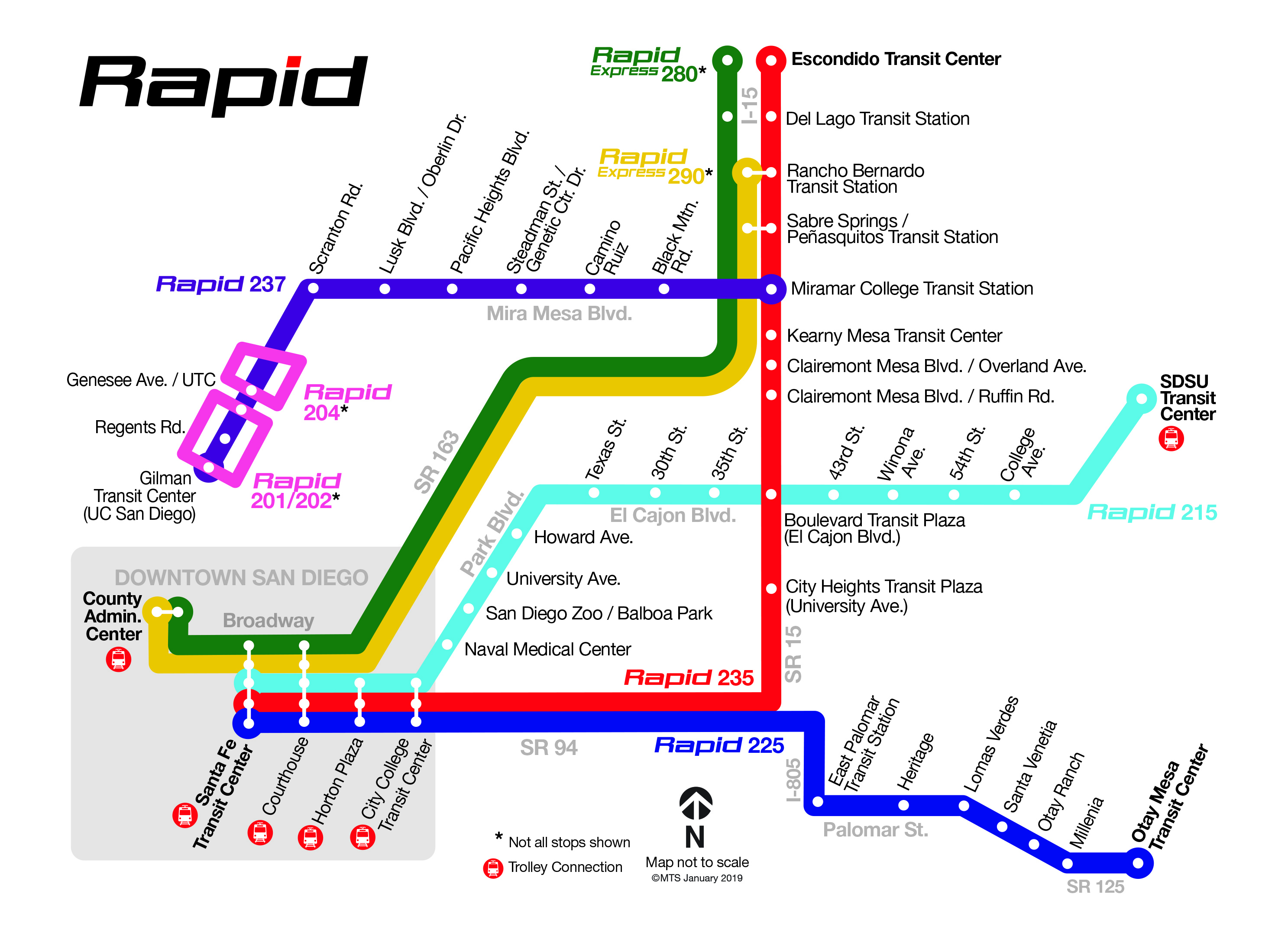
- Miramar College Transit Station: ~41 minutes (neighborhood profile, map)
- Black Mountain Rd. (neighborhood profile, map)
- Camino Ruiz: ~32 minutes (neighborhood profile, map)
- Steadman St. (neighborhood profile, map)
- Pacific Heights Blvd. (neighborhood profile, map)
- Oberlin Dr. (neighborhood profile, map)
- Scranton Rd.: ~19 minutes (neighborhood profile, map)
- Regents Rd. ~10 minutes (neighborhood profile, map)
Consider neighborhoods along the UC San Diego Blue Line trolley (map)
- UTC Transit Center: 8 minutes, est.(neighborhood profile, map)
- Executive Drive: 5 minutes, est. (neighborhood profile, map)
- Nobel Drive: 4 minutes, est. (neighborhood profile, map)
- Balboa Avenue: 13 minutes, est. (neighborhood profile, map)
- Clairemont Drive: 15 minutes, est. (neighborhood profile, map)
- Tecolote Road: 17 minutes, est. (neighborhood profile, map)
- Old Town Transit Center: 19 minutes, est. (neighborhood profile, map)
- Washington Street: (neighborhood profile, map)
- Middletown: (neighborhood profile, map)
- County Center/Little Italy: (neighborhood profile, map)
- Santa Fe Depot: (neighborhood profile, map)
- America Plaza: (neighborhood profile, map)
- Civic Center: (neighborhood profile, map)
- Fifth Avenue: (neighborhood profile, map)
- City College: (neighborhood profile, map)
- Park & Market: (neighborhood profile, map)
- 12th & Imperial Transit Center: (neighborhood profile, map)
- Barrio Logan: (neighborhood profile, map)
- Harborside: (neighborhood profile, map)
- Pacific Fleet: (neighborhood profile, map)
- 8th Street: (neighborhood profile, map)
- 24th Street: (neighborhood profile, map)
- Bayfront/E Street: (neighborhood profile, map)
- H Street: (neighborhood profile, map)
- Palomar Street: (neighborhood profile, map)
- Palm Avenue: (neighborhood profile, map)
- Iris Avenue: (neighborhood profile, map)
- Beyer Boulevard: (neighborhood profile, map)
- San Ysidro Transit Center: (neighborhood profile, map)
Bus Routes
- 101: UTC, Del Mar, Solana Beach, Encinitas, Carlsbad, Oceanside NCTD
- 30: UTC, La Jolla, Pacific Beach, Old Town, downtown San Diego
- 41: VA Hospital, UTC, Clairemont, Fashion Valley
- 60: Kearny Mesa, City Heights
- 105: Old Town
- 150: UTC, VA Hospital, Old Town, downtown San Diego
- 204 SuperLoop: UTC area, Executive Drive, Judicial Drive, Nobel Drive
- 237: UCSD – Rancho Bernardo Transit Station
- 921: UTC, Mira Mesa
- 979: North University City, Sorrento Valley Station
- 985: UCSD – N. Torrey Pines Rd.
Rider Information
- San Diego Metropolitan Transit System (MTS), including all city bus routes and trolley routes
- OneBusAway – MTS mobile app for real-time bus information
The cost to rent a room, apartment or home near the Skaggs Graduate School in Jupiter, Florida, can vary greatly depending on where you live and how far away from the beach you live. Housing closer to the beach is quite expensive. The Skaggs Graduate School is located on the Wertheim UF Scripps Institute campus in a neighborhood called Abacoa. There are many apartment complexes in Abacoa and the surrounding area that are walking or biking distance to the Graduate School.
Usually a one-bedroom apartment in the area will cost $2,200 to $2,500 per month, depending on the square footage and the location of the unit. A two-bedroom apartment will cost about $2,500 to $3,000 per month. Many postdocs and students will join together to rent a 2- or 3-bedroom apartment and share the costs.
High tourist season in Jupiter, Florida, is from January to April. Housing costs during this time of the year will increase dramatically. Hotels and apartment rental costs can easily double during the height of the tourist season. It is always best to request long-term rentals rather than monthly rentals for cost savings.
Where to Stay the First Few Days
Many visitors choose to stay in a hotel for their first few nights in the U.S. There are many hotels to choose from in this area, but if you choose one of the hotels below and mention you are a Scripps Research visitor or employee, you may be eligible for a discount.
Walking distance to Wertheim UF Scripps campus
Courtyard Marriott Jupiter/Palm Beach
Walking distance to Wertheim UF Scripps campus
Housing Search Resources
Scripps Research has arranged with Keyes Realty to provide you with the following support and services at no charge: finding housing whether you want to rent or buy and providing information about the area, including the school system.
A representative from Keyes will contact you directly, or for more information you can contact:
Denise Talboy
VP, Global Relocation & Corporate Services
1535 Three Village Road
Weston, FL 33326
[email protected]
Office: 800-749-5393 x 10255
Cell: (954) 600-4551
Fax: (954) 893-1372
Room for Rent or a Roommate
These websites will let you search for a private room within a shared house, or a shared room within a house. If you have an apartment or house already but are looking for a roommate to share the lease, some of these websites can help you with that as well. As with any situation where you may be meeting a stranger, be sure to ask many questions, talk specifically about the type of living situation that works for you, and be careful before making a decision. Sometimes it helps to bring a friend to get their input as well.
Local Activities & Resources
Participation in cultural activities is an important part of life in America. For J-1 scholars, it is also part of the goals for the Department of State’s Exchange Visitor Program, as it promotes“exposure and interchange between exchange visitors and Americans so as to increase their understanding of each other’s society, culture, and institutions.” We encourage all international students and scholars to spend some time outside the classroom or lab and experience the many interests in your area.
Without leaving the Scripps Research campus, you can get help with your career goals or join one or more clubs:
- Career and Professional Development Office (CPDO): The International Services Office is under the umbrella of the CPDO, which assists all graduate students and postdocs in California and Florida in meeting their career goals.
- Network for Women in Science (NWiS): Club to support and promote women in science
- Society of Fellows: Club for Scripps Research graduate students and postdoctoral fellows
Local Attractions & Events
Event Calendar
- June/July: San Diego County Fair
- August: Hillcrest CityFest
- September: Adams Avenue Street Fair
- October: Little Italy Festa | Miramar Airshow
Without leaving the Wertheim UF Scripps campus, you can get help with your career goals or join one or more clubs:
- Career and Professional Development Office (CPDO): The International Services Office is under the umbrella of the CPDO, which assists all graduate students and postdocs in California and Florida in meeting their career goals.
- Network for Women in Science (NWiS): Club to support and promote women in science
- Society of Research Fellows: Club for graduate students and postdoctoral fellows
Local Attractions & Events
Museums, Theaters and Music
Outdoor Adventures
Event Calendar
- February: ArtiGras Fine Arts Festival | JupiterJubilee
- March: Spring Training Games at Roger Dean Stadium | Tropic Fest | Turtle Fest | Art Fest by the Sea in Juno Beach
- May: SunFest in WPB
- October: Oktoberfest
- November: Feast of Little Italy | Juno Beach Craft Festival on the Ocean
- December: Holiday Boat Parade
Safety Information & Emergency Contacts
Even though San Diego and Jupiter are beautiful and generally safe cities, accidents and emergencies can happen, and it’s best to be prepared by entering the phone numbers below in your cell phone and/or carrying the following information in your wallet or purse. That way, you will have the correct phone numbers at your fingertips, whether you have a problem at the airport, an accident in your lab or an emergency need to travel. If you would like a card to carry in your purse or wallet with emergency contact information for Scripps Research, please feel free to email us.
Emergency Contact Information
- If you have an emergency during office hours (Monday through Friday, 8 a.m. to 5 p.m. PST), call the International Services Office at (858) 784-8120.
- If you have an emergency on evenings, holidays or weekends, call Campus Security at (858) 784-2000. Identify yourself as an international student or scholar and Campus Security will get you in touch with an international student and scholar advisor.
- If you experience a crime or accident on campus, call Campus Security from a campus phone by dialing 77, or call Campus Security from a cell phone by dialing (858) 784-2000.
- If you experience a mental health emergency, please call 988.
- As always, if you experience a crime or accident off campus, call 911.
Earthquake Preparedness
Strong earthquakes are not common in the San Diego area, but they may happen. In general, there is a 60 percent chance of an earthquake happening in Southern California that is 6.7 or higher on the Richter scale. For more information about earthquakes, visit the webpage for the US Geological Survey. When you live in Southern California, it’s best to be prepared.
The City of San Diego maintains a website with important information about what to do to prepare for an earthquake, during an earthquake and after an earthquake. We encourage all international students and scholars to review the information on the City of San Diego website and create an “Earthquake Preparedness Kit” for your home.
What to Do Before an Earthquake
- Identify safe spots at home and work such as sturdy tables and desks or small rooms and hallways.
- Establish an out-of-area contact who can coordinate family members’ locations and information in case you become separated.
- Make sure everyone in the home knows phone numbers and addresses.
- Take a first-aid class from your local American Red Cross chapter. Keep your training current.
- Eliminate hazards in your home:
- Bolt bookcases, china cabinets and other tall furniture to wall studs.
- Remove any unsecured items hanging over beds. Don’t hang a mirror over your bed.
- Install strong latches on cupboards.
- Strap the water heater to wall studs.
- Prepare a family disaster supplies kit and keep one in your home and one in your car. You can buy an Emergency Kit online or gather it yourself.
- Flashlight
- Batteries
- Radio
- Water
- Three-day supply of nonperishable food
- Medicine
- An extra set of keys
- Extra clothes
The American Red Cross has excellent information on their website. It is recommended that you prepare a kit of items you and your family would need to survive for 72 hours following a disaster. Seventy-two hours is usually the longest time it will take for help to arrive, depending on the conditions of roadways and how extensive damage is to the rest of the community.
After a Severe Earthquake
If you need to temporarily leave your home or the area because of an earthquake or any natural disaster, the International Services Office needs to know your location. Please call (858) 784-8120 or email the information as soon as possible. In the case of a natural disaster, the U.S. government may require the ISO to report the location of all international students and scholars.
Wildfire Information
Wildfires are not uncommon in California, especially when we go through seasons of drought. It is good to be prepared, particularly if you live near a wooded area or a mountainside with wild brush and plants. However, fires can start anywhere and spread quickly because of our dry climate.
The following website has a great deal of information to help keep you and your family safe, including a “pre-evacuation checklist” and a list of items for your “emergency supply kit.” Please review this information if you are coming to California.
In addition, the California Environmental Protection Agency (EPA) has information on their website about air quality conditions, and how smoke from fires can affect your health.
Emergency Contact Information
- If you have an emergency between 8am EST – 5pm EST, please call the International Services Office in Florida at (561) 228-2362.
- If you experience a crime or accident on the Wertheim UF Scripps campus, call Campus Security from a campus phone by dialing 1-2757, or from a cell phone by dialing (561) 228-2757.
- If you experience a mental health emergency, please call 988.
- As always, if you experience a crime or medical emergency off campus, call 911.
Hurricane Preparedness
All international students should review the Hurricane Preparedness Guide foundhere.
June 1 marks the beginning of Florida’s hurricane season, which lasts until the end of November. You should start preparing in the spring for potential hurricanes during the upcoming season. In the event of a hurricane, you will receive multiple campus-wide emails sent to your scripps.edu and ufl.edu email addresses. The Graduate School will keep you informed, but it only works if you actually read the messages sent. It is important you pay attention and plan in advance. If the Graduate School closes, you and your family members are not permitted to seek shelter on the Wertheim UF Scripps campus.
In the event of a hurricane, you may need to go for several days without electricity/power after the hurricane hits. To prepare for this, please be sure to do the following things early. If you wait until just before a hurricane arrives, you will find that most of these supplies are no longer available in local stores and shops, as supplies quickly deplete. We suggest creating an emergency supply shelf in your kitchen, and just keep these supplies until the end of the hurricane season.
Food and Water Preparation
One gallon of water per day for each member of your household. You should stock enough for three days now; you can get more as a hurricane approaches, but at least you will have some if the stores run out.
Enough food in the form of canned and nonperishable items for three to seven days; include formula for infants. Supplies should include items that require no refrigeration, water or cooking (for example: crackers, peanut butter, nuts and canned goods). Be sure you have a manual can opener. For more information on hurricane preparedness, clickhere.
Important Items to Store
- Portable battery-powered radio and extra batteries
- Flashlight and batteries
- Ample supply of required prescription drugs and a first-aid kit
- A supply of cash; ATM machines and credit cards may not work
- Special items for infants, such as formula, diapers, bottles, pacifiers, etc.
- Fill your car with gas even if you don’t plan to evacuate. Gasoline supplies will take some time to return to normal.
- Fill your bathtub with water for bathing and to flush the toilet. Be sure you have a bucket.
Shelter and Evacuation
- In the event of an upcoming storm/hurricane, international students must submit the Evacuate or Shelter in Place Plan form. To submit the form, please clickhere.
- Hurricane shutters: You should inquire now with your landlord who is responsible for hanging up the hurricane shutters on your apartment/home. Will you be required to do it yourself or is it done for you? Hanging hurricane shutters can be a difficult and time-consuming process. If you are required to do it yourself, be sure now that you have the required supplies (gloves, bolts, wing nuts, access to a ladder, etc.). Stores will run out of these supplies as the hurricane approaches.
- Evacuation and Flood Zones: Check the evacuation and flood zone maps to determine if your housing is in a potential evacuation or flood area. Make a plan on where you will go if you have to evacuate. Do you have friends who don’t live in an evacuation zone? Do you have access to transportation? For more information on evacuation and flood zones, clickhere.
- Hurricane shelters: Determine the closest hurricane shelters from where you live. Some shelters will fill up faster than others. Be sure you know where an alternate shelter is located. For a list of shelters, please clickhere. Please scroll to the bottom of the page to see a list of shelters in the area.
- If you choose to evacuate outside the Jupiter area, the International Services Office needs to know your location. Please call or email the information as soon as possible to [email protected]. In the case of severe weather events, the U.S. government may require the ISO to report the location of all international students and scholars.
Please be sure to read the publications cited above so you know what to do before, during and after the storm hits. For information about being prepared for natural disasters and how you can get help from the U.S. government, there is a great deal of information on the Federal Emergency Management Agency (FEMA) website.
Wildlife Precautions
Florida is a beautiful state, with many sights to see and unusual plants and animals. However, some animals and sea life can be dangerous, so we encourage all international students and scholars who visit Florida to review the information below.
Sea Creatures
- Sharks: There are many different types of sharks in Florida waters including bull sharks, lemon sharks, nurse sharks and hammerhead sharks. Most attacks take place along the beaches of Volusia County (Daytona Beach area) and are not deadly. Sharks tend to attack people who are alone, splashing, wearing shiny jewelry, and swimming in murky water. To reduce the odds (roughly 1 in 10 million) of being attacked by a shark, you should do the following: avoid swimming in murky water, avoid swimming at dusk and dawn (feeding time), stay in a group, minimize splashing, don’t swim where you see baitfish or fishermen, don’t go into the water if bleeding and don’t wear jewelry.
- Jellyfish: There are many species of jellyfish, but only some have stings that cause a bad reaction in humans. They range in size from tiny to several feet in diameter. Contact with their tentacles (even those that have broken off) can cause red, raised streaky welts that can last from 1-2 weeks and cause severe pain, tingling, itching, nausea, headache and, in rare cases, death. Do not touch jellyfish that have washed up on the beach as even dead jellies can sting. If you are stung by a jellyfish, leave the water immediately. Call the Florida Poison Information Center Network at 1-800-222-1222 or 911 if you begin to have trouble breathing, feel faint or have chest pain. Florida lifeguards display a purple flag to warn swimmers of “Dangerous Marine Life.” It is best not to swim if the purple flag is up. Ask the Life Guard for help or information if one is available.
- Baby Jellyfish/Sea Anemones: “Swimmer’s Itch” (also known as “Sea Lice”) are tiny, invisible creatures that release stinging cells, usually in areas where a bathing suit rubs against the skin. They can also get tangled in your hair. The resulting rash causes extreme itching which usually lasts for 7-10 days. Wash out all swimsuits with soap and fresh water, or they may continue to spread the rash. This is most common in Florida in early summer.
- Algal Blooms: The algae that cause Florida red tides can cause skin rash, coughing, sneezing and watery eyes. A Florida red tide can make water turn brown or red and kill fish and birds in the area. For updated red tide condition reports, or for more detailed information on harmful algal blooms, call the Aquatic Toxins Hotline at 1-888-232-8635.
Land Creatures
- American Alligators and Crocodiles: Alligators live mainly in freshwater swamps and marshes, but also in rivers, lakes and ponds. They should be treated with extreme caution. They will generally swim away if approached. However, if they think their young are at risk or they feel threatened, they are capable of striking out. Never feed alligators, don’t swim alone, and don’t swim between dusk and dawn when alligators are most active. The most dangerous alligators are over eight feet long and the most dangerous month is the mating season in May. Alligators should not be confused with crocodiles, although they can look very similar. Crocodiles only live in the southernmost tip of Florida, whereas alligators can be found across Florida. Crocodiles are potentially dangerous too, although the American species tends to be much less aggressive than the African and Australian ones.
- Snakes: Florida has six venomous species of snakes but it is relatively rare to see them. They include the Eastern diamondback, the pygmy rattlesnake, the Eastern coral snake and the cottonmouth, or water moccasin. Cottonmouth snakes are drawn to water. Along with these native Floridian snakes, there are also Burmese pythons. These live in the Everglades in southern Florida and have bred from irresponsible pet owners releasing them into the wild. There are estimated to be somewhere between 30,000 and 300,000 pythons in the Everglades.
- Fire ants: These insects have a painful and irritating venomous bite. Their sting causes a red bump which can turn into a white abscess and cause an infection if scratched. The bites are usually very itchy, especially the following day. Some people can be allergic to fire ant bites, which can be life-threatening in some severe cases.
- Spiders: You can avoid spiders by wearing gloves when working in places where they might be living, such as gardens and wood sheds. Be careful when putting on old clothing or shoes and shake them out before wearing. The brown recluse spider is one of the most dangerous animals in Florida. It is small but has a venomous bite that can put you in the hospital. Southern black widow spiders are more common and should also be avoided. Female widow spiders can be identified by the distinctive red hourglass marking on the underside of their abdomen.
- Florida Black Bears: The Florida black bear is the largest land animal in Florida. An endangered species, they live in wooded areas and are rarely seen. Sadly, many are killed by cars in automobile accidents. The surge of tourists into the state has made black bears bold about raiding garbage cans and invading campgrounds. However, attacks on people are rare.
- Florida Panthers: Florida panthers are the larger of Florida’s two native wild cat species (panthers and bobcats). This animal is a subspecies of cougar and was chosen in 1982 as the Florida state animal. It is protected as an endangered species and rarely seen, as there are only about 200 of them left in the wild. The panther’s only natural predators are alligators and humans.
Social Security Numbers
A Social Security number (SSN) is the closest thing we have to a national identification number. If you have never obtained an SSN in the U.S., you may need to obtain one for salary, tax, credit history or banking purposes.You must have an SSN if you are paid in the U.S., and you cannot apply for aDriver’s License in Florida or California until you have a Social Security number. Please Note: If you are in F-1 or J-1 visa status, you must be registered/validated in SEVIS prior to applying for an SSN. SEVIS registration/validation will occur after your check-in meeting with your international student or scholar advisor.
An SSN is valid for life. If you have previously had an SSN but do not have the card or remember the number, you will need to apply for a duplicate card.
An SSN is used to report wages to the government and to determine eligibility for Social Security benefits. An SSN is only issued to people who have a visa status that allows for monetary payments in the U.S. An SSN is not issued for purposes of general identification (driver’s licenses, tax returns, bank accounts, phone service, etc.). In general, dependents cannot qualify for an SSN unless they have a work permit. Dependents and others who do not qualify for an SSN may apply for an ITIN number instead.
In general, non-immigrants cannot qualify for an SSN unless they have a work document, such as a DS-2019 or an I-797 approval, or a work permit, such as an F-1 OPT work permit.
To apply:
- Visit the Social Security Webpage called Request Social Security number for the first time.
- Complete the online application. Make sure you enter an address where you will be for at least a month. There is no cost to apply.
- Make an appointment online at the closest Social Security Office. Appointments are limited at certain times of year and there may be some delay. Be sure to attend the appointment given.
- Prepare required documentation proving immigration status, work eligibility, age and identity (see list below).
- When you go to Social Security, bring the four documents proving immigration status listed below.
Four (4) Documents Proving Immigration Status—All Documents Must Be Originals
- Valid Passport
- I-94 record printed from their website
- Visa document
- If J-1 status: DS-2019, Certificate of Eligibility for Exchange Visitor Status
- If F-1 status: I-20, Certificate of Eligibility for Nonimmigrant Student Status
- If H-1B status: I-797 approval notice
- If you have an “Employment Authorization Document” (EAD) based on any status (F-1, J-2, H-4, pending immigrant, etc.), bring the card to present.
- Letter of Confirmation
- If J-1: Letter of invitation/job offer (received when invited to Scripps Research)
- If F-1 Enrolled Student at Scripps Research: 2 letters given to you by the International Services Office at orientation. One confirms your F-1 status and the other confirms that you will be paid a graduate student stipend.
- If H-1B: Employment Verification letter (use the Employment Verification Request)
Processing Times
After submitting an SSN application, it can take about 2 to 4 weeks to receive the Social Security card at the mailing address provided on the application. It is important that you provide a valid mailing address on the SSN application. An incomplete or incorrect address will cause delivery issues and result in return of your card to the Social Security Administration.
Make sure to report your Social Security number by December 21st in any year, either by presenting the card in person to Human Resources (California residents) or contacting the ISO for instructions on how to upload the card securely from your computer on OneDrive (Florida or California residents). In California, you may go to the front desk of the Administration Building to show your new Social Security card. Please do not ever send your Social Security number or a copy of your Social Security card to anyone by email, as it is not secure.
It is best to get the SSN as soon as possible as you may not have correct deductions on your paychecks if the Payroll Office does not have your SSN. Please review your paycheck carefully and contact the Payroll Office with any questions.
Important information to remember:
- Keep your Social Security card in a safe place.
- Do not carry your Social Security card with you or put it in your wallet.
- Do not laminate your Social Security card.
- Protect your identity. Be careful about sharing your SSN. If asked for the number, you should ask why your number is needed, how it will be used and what will happen if you refuse to provide it. Clickhere for more information.
State Driver’s License
If you will be driving in the U.S and purchasing a car, it is recommended that you apply for a U.S driver’s license. If you will occasionally rent and drive a car, you can use a valid license from another country, as long as it can be identified as a valid driver’s license if you were stopped by the police. If the license cannot be read by an English-speaking person, it could still be used in conjunction with an International Driver’s Permit (IDP) if one is obtained in your home country prior to coming to the U.S. However, the IDP alone is not accepted as a license to drive.
In general, the test to obtain a license includes a visual test, a written test with multiple choice questions, and a driving test in a car that takes about 30 minutes or less. Most international visitors feel that obtaining a license in the U.S is much less expensive and much simpler than other countries. In addition, a state driver’s license is often used as a form of identification because it is an official document with your name and date of birth.
Who is eligible for a driver’s license? Any F-1, J-1, or H-1B visa-holder in lawful status, as well as other non-immigrants with a valid employment authorization document (EAD), may apply for a driver’s license or ID card, per state or territorial law.
What kind of license should I apply for? In the state of California, you can apply for a REAL ID, a Federally Noncompliant License, or a first-time Learner’s Permit.
- A REAL ID is a driver’s license or identification card that is also a federally accepted form of identification. It can be used to board a domestic flight within the U.S. and enter secure federal facilities, such as military bases, federal courthouses, and other secure federal locations.
- Those who are not eligible for the REAL ID may choose to apply for a federally, non-compliant driver’s license that will still allow them to drive within the state of California and most of the U.S. If you have never been issued a driver’s license before, even in your home country, and you are driving for the first time, you will need to apply for the Learner’s Permit.
- To learn more about which card is right for you, visit the DMV’s “What is Real ID?” website. Click here to learn more about REAL ID Information for Non-U.S. Citizens.
When should I apply? You must complete a check-in process at the International Services Office and have received your Social Security card (if paid in the U.S) prior to applying for a driver’s license.
Where should I apply? After completing the online application, select a DMV office to visit in person to submit the required documents and complete the written test. You can go to any DMV in California but the one closest to Scripps Research is the San Diego Clairemont DMV. You can search for other DMV locations on the DMV website.
When will the driver’s license be issued? Upon acceptance of your application and successfully passing all tests—including written, driving and vision—a temporary permit will be issued prior to receiving the official license in the mail. It is very important that you provide a valid mailing address on the driver’s license application. An incomplete or incorrect address will cause your license to be returned to the DMV office.
Application process
Per the California Department of Motor Vehicles (DMV) website, to apply for an original driver’s license, you will need to do the following:
- Make an appointment before visiting a DMV office (walk-ins are only accepted at Driver’s License Processing Centers).
- Complete application form DL 44 (only a form signed in the original will be accepted)
- Give a thumb print
- Have your picture taken
- Provide your Social Security number. It will be verified with the Social Security Administration while you are in the office.
- Verify your birth date and legal presence (see the list on the “documents needed” tab)
- Provide proof of residency document if applying for a new driver’s license. Clickhere for more information.
- Provide your full name as shown on your documents
- Pay the application fee
- Pass a vision exam
- Pass a traffic laws and sign test. There are 46 questions on the test and you must answer at least 38 questions correctly. You have three chances to pass. It is best to study the driver’s handbook and take the practice tests that are available on the DMV website.
Additional resources
Automobile insurance
According to California law, the owner of a car must maintain insurance coverage. For information on insurance requirements in California refer to their website. The minimum insurance coverage required by law is called “liability insurance.” Liability coverage pays the sum for which you become legally responsible if you injure someone or damage their car, up to the limit you purchase. The following other types of coverage are optional:
- Uninsured motorist: Protects you and your passengers if you are injured by an uninsured or hit-and-run driver, but only if the other driver is legally liable because of negligent driving. (Some insurance companies automatically include this coverage in their policies.)
- Collision: Pays for your losses if your car is damaged in a collision or single car accident. This coverage is valuable if the collision cannot be proven to be someone else’s fault.
- Comprehensive: Pays for your loss if your car is stolen or damaged by fire, hail, hurricane, vandalism or most other non-collision causes.
State identification card (ID)
If you are not planning to drive, you can apply for a state identification card (ID). The ID card looks similar to a license and can be used as a form of identification. Information can be found here.
Documents needed
The types of documents you need to submit will depend on the type of license you are applying for. Please click on the appropriate link below, based on which license or document you will be applying for.
- Non-U.S. Citizens applying for a REAL ID
- Non-U.S. Citizens applying for a Federally Noncompliant Driver’s License
- First-time drivers who are applying for their first Learner’s Permit
- Individuals applying for regular Identification (ID) Card
- List of Acceptable Proof of Identity Documents
- List of Acceptable Proof of Residency Documents
A Florida driver’s license permits you to drive, register and insure your vehicle in Florida. You are permitted to drive with a valid out-of-country driver’s license for 30 days after arriving in the U.S. Beyond this period, you must have a Florida driver’s license to drive in Florida (FL).
Steps for driving your own car in Florida:
- Obtain a Florida driver’s license
- Purchase automobile insurance
- Title and register your vehicle (obtain license plate)
Who is eligible for a driver’s license? Individuals in F-1, J-1, or H-1B visa status, as well as other non-immigrants with a valid employment authorization document (EAD), may apply for a driver’s license or ID card at the Florida Department of Highway Safety and Motor Vehicles (FLHSMV).
When should I apply? You must complete a check-in process at the International Services Office (ISO) and have applied for your Social Security card (if paid in the U.S.) prior to applying for a driver’s license. Please wait at least 10 days after checking in with the ISO before applying for the Florida driver’s license.
Where should I apply? The closest Florida Department of Highway Safety and Motor Vehicles (FLHSMV) office is located at 3185 PGA Boulevard, Palm Beach Gardens, FL 33410. Tel: 561-355-2264. Monday – Friday, 8:15 am – 4:30 pm. Appointments are required. To schedule an appointment, use the online appointment scheduling website.
When will the driver’s license be issued? Upon acceptance of your application and successfully passing all tests—including written, driving and vision—a temporary permit will be issued prior to receiving the official license in the mail. It is very important that you provide a valid mailing address on the driver’s license application. An incomplete or incorrect address will cause your license to be returned to the DMV office.
Application process
- Complete the Traffic Law and Substance Abuse Education exam. (Only people who DO NOT have an out-of-state or out-of-country driver’s license are required to complete this exam.) Please find a list of approved organizations who offer the exam at the FLHSMV website. The results are automatically sent to the FLHSMV, but please print a confirmation/certificate to bring with you.
- Study for the written knowledge test. Download a copy of the Florida Driver Handbook.
- Schedule online appointments for the written knowledge AND driving exams online. The vehicle you bring for your driving test must have a valid registration, proof of insurance, and pass a vehicle inspection. During the driving test, the examiner will observe your ability to control the vehicle and obey traffic laws. It is important to study the Florida Drivers Handbook in advance of taking the written test and the behind-the-wheel driving test.
Documents to submit for driver’s license application
- Passport with visa stamp
- I-94 record printed from their website
- J-1 status – DS-2019, Certificate of Eligibility for Exchange Visitor Status
- F-1 status – I-20, Certificate of Eligibility for Nonimmigrant Student Status
- H-1B status – I-797 approval notice
- 2 forms of residential address (Lease, mortgage, utility bill, paystub, bank statement, etc.)
Required Tests
- Driving Test (all countries except Canada, France, Germany, South Korea and Taiwan)
- Written Test (all countries except Canada, France, South Korea and Taiwan)
- Electronic Eye Exam (all countries)
Automobile insurance
It is important to shop around for the best rates for Florida auto insurance. There are many online resources that will provide free quotes that have licensed Florida insurer policies and are approved by the Florida FLHSMV.
In addition to PIP (Personal Injury Protection), PDL (Property Damage Liability) and BIL (Bodily Injury Liability) insurance coverage, Florida auto insurance companies will also offer optional coverage such as collision, comprehensive, and uninsured and underinsured motorists coverage. The insurance rate you are given is based on many factors, including your driving record, your age, where you live and the kind of car you drive. If your driver’s license is in good status, you will be eligible for better rates and if you live in a busy city, your insurance rates will be higher than smaller, less congested towns. All auto insurance providers do not figure their rates in the same way, so you will likely receive different quoted rates for the same driver.
- PIP (Personal Injury Protection) insurance covers your injury-related expenses regardless of who was at fault in the accident. Covered benefits include some compensation for necessary medical expenses, lost wages, lost services and funeral expenses.
- BIL (Bodily Injury Liability) insurance is required for certain drivers. Drivers with previous accidents or violations may be required to carry this type of coverage. This coverage helps pay for serious or permanent injury or death to others when you cause a crash with your automobile.
Vehicle Registration
You must also register your vehicle in the state of Florida. Go here for a complete list of required documents needed to register your vehicle. The FLHSMV has a different office where your complete registration.
State identification card
If you are not planning to drive, you can apply for a Florida state identification card (ID). You must apply for an original ID card in person at a FLHSMV office. To schedule an appointment go to the DMV’s online appointment scheduling website.
Tax Resources
The tax system in the U.S. is very complex. According to the Internal Revenue Service (IRS), all international students and scholars who were present in the U.S. in the previous calendar year must file a federal income tax return by April 15 of the current calendar year.
The following resources are provided for informational purposes. The International Services Office or Scripps Research does not verify or endorse any specific tax expert, service, product or resource.
All international students and scholars should plan to declare their income (or lack of income) to the federal government every year by filing a tax return on or before April 15. Tax returns include all income earned during the previous calendar year (January-December). In order to determine what type of tax form you will use, you will need to determine if you are a “resident” or a “non-resident” for tax purposes.This is completely unrelated to whether you are a “resident” or “non-resident” under immigration law. To determine your residency status for tax filing purposes, you must review the “substantial presence” test information on the IRS website. You may also find it helpful to review the information offered through the Volunteer Income Tax Assistance (VITA) program, called “Publication 4011.”
At the beginning of each year, you will receive documents in the mail or via electronic means that are used to calculate any tax responsibility you may have for earnings during the previous calendar year. If you received no income, you may only need to file a form 8843 for federal tax requirements. According to the IRS, filing a tax return is required whether or not you worked in the U.S., gained income in the U.S. or received a scholarship. The good news is that if you earned income in the U.S., you may be eligible for a tax refund if more tax was taken than what you owe.
In the case of California residents, a state income tax return must also be filed by April 15 of the current calendar year.Florida residents are not required to file a state income tax return. Many Americans find the system difficult to navigate, so they decide to hire a tax accountant to assist in filing an accurate and complete tax return. Many other Americans use a tax software package to help them file their federal and state income tax returns.
Staff at Scripps Research cannot advise on tax matters. Scripps Research does not have staff that are trained or licensed to answer questions or provide advice concerning tax matters. Tax law is a separate area of law which is complex and often requires assistance from a tax expert (most commonly, a certified public accountant or registered tax return preparer). For most international students and scholars, it is possible to file taxes without personal assistance by using an online tax preparation software, like one of those listed below. However, for those who have complex financial situations, or who need help in person to file either their state or federal tax return forms, there are also tax preparation accountants and services listed below in the section labeled “Nationwide Tax Filing Resources.”
Take caution to avoid scams! Many people experience an increase in false phone calls and emails during the tax season (January–April each year), with people claiming to be calling from the IRS or the Social Security Administration. U.S. government agencies do not communicate by phone or email. Any such calls are almost certainly a scam. If you are unsure, please check with ISO before proceeding to provide any personal information.
We have recently found there is also an increase in scam calls from individuals claiming to represent the Chinese government or other governments.
The IRS gives you many choices on how to file your tax return, as does the California FTB (if you earned income in California). To determine what income tax forms you need to use, you will need to determine if you are “nonresident for tax purposes.” This is related to the cumulative length of time you have been in the U.S. and the visa status(es) you have had during that time.
All of the methods below are acceptable ways to prepare your tax return:
- You can download forms directly from the IRS (and from the CAFTB, if you earned income in California), which can be used to prepare your tax return yourself.
- You can hire a tax accountant or a tax service provider to prepare the tax return for you.
- You can use any tax filing software designed “for nonresidents for tax purposes.”
The most common forms used by nonresident taxpayers to file federal tax returns are the 1040NR and the 1040NR-EZ. In addition, California nonresident taxpayers may file a 540NR. If you did not receive any money from a U.S. source, you may only need to file Form 8843. If you have been paid by a U.S. source, you may be affected by a tax treaty. For more information about tax treaties, read publication 901.
The IRS requires that you have certain tax documents in order to complete your tax return. You will need to receive these tax documents before you can begin. There are one or more types of tax reporting documents you will receive from Scripps Research, depending on whether you are paid a salary, a stipend, a fellowship/scholarship or a combination. You will receive tax reporting documents in the mail from Payroll sometime between the end of January and early March. If you are at Scripps Research, check your mailing address by logging into UKG (UltiPro). To do this, sign into theScripps Research Apps page and click on the link for UltiPro. If you are no longer at Scripps Research and need to change your address, or have other questions about tax documents that would come from Scripps Research, please email the Payroll/Records team. If you have questions about tax documents that would come from Scripps Research, please email Payroll.
If you have been a student or employee somewhere else during the tax year, please contact your previous school or employer to make sure they have your correct address and to confirm when you can expect the tax documents. You will need tax documents from all employers or scholarship sources in the previous year before completing your tax return. In addition, if you received income as a student or scholar in another state during the previous tax year, you will need to file state tax return forms in every state in which you worked during the previous calendar year, unless that state does not require state income tax. Other forms from other sources, such as banks and investment accounts, may also be emailed or posted to an online account. This usually happens within the first two months of the year.
Examples of documents you may need include:
- W-2 form: Persons receiving wages during any calendar year should receive a year-end report (called the W-2 form) from their employer no later than February 1 each year. The W-2 form summarizes the total amount of wages earned during the year and the amount of money withheld for any taxes (federal, state and local).
- 1042-S: International students receiving taxable/reportable scholarship income should receive a Form 1042-S. You will receive this form from Scripps Research in March each year. If you believe you should have received this form, or you have questions about this form, please contact the Payroll Office.
- 592-B: California international students receiving taxable/reportable scholarship income should also receive a Form 592-B to report state taxes. Florida does not require state income tax.
- 1095-A, B or C: This is a statement related to whether you maintained health insurance that meets the Affordable Care Act (ACA) requirements.
- Other types of financial documents: These documents usually begin with “1099” and are issued for other types of taxable income.
Recommended for “Residents for Tax Purposes”:
- H&R Block: Tax preparation service with approximately 12,000 company-owned and franchise retail locations in all 50 states, Puerto Rico and other U.S. territories, and on U.S. military bases around the world.
- Jackson Hewitt:Tax preparation service with more than 6,500 offices across the country and Puerto Rico, including year-round neighborhood storefronts and seasonal high-traffic kiosks primarily in select Walmart stores.
- Liberty Tax Service: Tax preparation service with 4,000+ locations throughout the U.S. and Canada.
- Volunteer Income Tax Assistance (VITA): Free assistance for lower-income individuals, located mainly at public libraries.
Recommended for “Non-residents for Tax Purposes”:
The Office of Graduate Studies and the International Services Office provide free access to Sprintax for filing your federal tax return. Nonresident taxpayers in California can also use Sprintax to file a state tax return for a fee. Please visit the Graduate Studies webpage for a link to Sprintax free software. Go to “Taxes and Personal Finances” under “Student Resources” and review the column on the right entitled “Tax Services and Resources for Nonresidents.”
In addition, below are some examples of online tax preparation software packages specifically for nonresident taxpayers which are relatively inexpensive and allow you to accurately complete tax forms and print and mail your income tax return, using specific step-by-step instructions.
- Link for free access to Sprintax found on this webpage (please do not share this link outside Scripps Research)
- Complete Collection of Sprintax tax information (click “Translated Resources” at the top for information in several languages, including Spanish, Portuguese and Korean)
- Free California State Tax Filing Software (review to see if you are eligible to use this)
Tax Accountants with nonresident tax expertise
GW Carter, Ltd
4445 West 77th Street, #123
[email protected]
Visit their website
Gary R. Engler, CPA
Los Angeles, CA 90024
(310) 440-5557
[email protected]
Visit their website
Internal Revenue Service (IRS)
To order forms: (800) TAX-FORM
For tax questions: (800) 829-1040
For non-resident aliens: (215) 516-2000
For resident aliens: (800) 829-1040
California
540NR: California Nonresident or Part-year Resident Income Tax Return
CA Local IRS Office (federal taxes)
880 Front Street
San Diego, CA 92101
(844) 545-5640
Local California State Franchise Tax Board Office (CA state taxes)
7575 Metropolitan Drive, Suite 201
San Diego, CA 92108
(800) 852-5711
Florida
FL Local IRS Office (federal taxes)
625 N Flagler Drive
West Palm Beach, FL 33401
(561) 616-2002
United Way Tax Assistance Services
Common Forms and Resources for Nonresident Taxpayers: these forms and other resources can be found on the IRS Forms Page.
- Form 1040NR: U.S. Nonresident Alien Federal Income Tax Return
- 1095-A, B or C: Health Care Information Forms for Individuals
- Form 8843: Statement for Exempt Individuals and Individuals with a Medical Condition
- Publication 17: Information on Your Federal Income Tax
- Publication 519: U.S. Tax Guide for Aliens
- Publication 901: Information on U.S. Tax Treaties
Additional information:
- Health Coverage Tax Information (Form 1095)
- Foreign Students, Scholars, Teachers, Researchers and Exchange Visitors
- Suspicious Emails and Identity Theft
- Tax Information for Foreign Students and Scholars
- Taxation of Nonresident Aliens
If you have confirmed that you are a Resident for Tax Purposes, you will need to file taxes as a U.S. resident. There are many online programs that you can use for more complex filing that charge a fee, such as TurboTax. Programs that charge a fee usually include services to answer your questions.
In addition, the IRS offers free online programs for filing federal taxes for simple tax returns. If you live in California, the California State Tax Franchise Board also has free online filing services for simple state taxes. In both cases, information is offered in several languages.
If you are currently an international student or scholar at Scripps Research, you can also find additional information and resources on the Graduate Studies Program webpage called Tax and Personal Finances.
Transportation
It is important to think about transportation prior to arrival in the U.S. If you choose a place to live that is walking or biking distance from Scripps Research, there is little or no cost. In general, the Scripps Research campus in California and the Graduate School on the Wertheim UF Scripps campus have minimal bus access, but with planning, you can live on a bus route that will get you to work with relatively low cost. However, if you need to use a car to get to work and you cannot share a ride with a colleague, plan to spend a substantial amount of money, not only in buying a car and paying for gas but also in paying for car insurance, which is required in the U.S.
Buying a car can be a confusing, stressful process—especially for an international student or postdoc new to the country. Owning a car in the U.S. can also be expensive. There are ownership costs (purchase price, taxes, depreciation, finance charges, registration, insurance, license fees, parking, etc.) as well as operating costs (gas, oil, annual inspections, engine maintenance, tires, etc.). It is important to weigh the costs and benefits when deciding to buy a new or used car. Please review the information on the following websites for more information on what you need to know when buying a car.
Cars are often put up for sale by departing postdocs and students on Scripps Research’s Classified Listserv. If you are interested in buying a used car, this might be a good option for you.
There are two common ways to purchase a new or used vehicle in the U.S.:
- Cash: You can often get the best price for a car by offering to pay the full amount “in cash.” In this case, “in cash” means a cashier’s check from a bank. This is the ideal payment option. Be suspicious of anyone asking you to bring the full amount in actual cash (bills).
- Financing: Whether buying a new or used car through a dealer, compare the cost of different methods of financing. Loans may add 20-30 percent to the total price of the car. Before signing any document, make certain you understand all the details of the sale and payments required. Keep copies of all documents. International visitors may find it difficult to qualify for financing (getting a car loan) due to their lack of credit history in the U.S. Therefore, it is better to try to bring the money or loan you will need from your own country. If a loan provider is willing to work with you, the loan provider may ask for additional documentation, such as a finance qualification form, a letter from your employer to confirm your income, a copy of your lease or utility bills, and proof of lawful presence in the U.S.
Zipcar is a car-sharing service, with several locations at the nearby UC San Diego or Florida Atlantic University campuses. If you bike, carpool or take public transportation, you can use campus Zipcars for short personal or business-related trips during the day or in the evening. Zipcar charges users to rent vehicles by the hour, in addition to monthly membership fees. Visit Zipcar to learn more.
The San Diego International Airport is about 15 miles south of Scripps Research. It can take 20 to 90 minutes to get to Scripps Research from the airport, depending on traffic. Options for transportation:
- Shuttle vans and buses are available at the San Diego airport. Please see the website for a list of companies and their locations in the airport.
- Taxi service is also available at the San Diego airport, but is quite expensive. Before taking a taxi, request information from the taxi driver about the approximate cost.
- Many people in San Diego use Uber or Lyft for rides from the airport or for local transportation, but you must have a smartphone with an app to use these services.
- Bus Service: There is only one bus that stops near the Scripps Research campus in California. It is a North County Bus 101, which connects with San Diego buses at University Town Center (UTC). To use a trip planner, explore the North County Bus System or the San Diego Metropolitan Transit System (MTS) websites.
- There is train service connecting San Diego with local beach towns along the coast, as well as major cities in California, such as Los Angeles and San Francisco. For train routes, schedules and prices, visit the Amtrak website.
- There are many car rental companies in San Diego that are internationally known; however, one local car rental company recommended by international scholars because of its lower prices is Dirt Cheap Car Rental.
West Palm Beach Airport (PBI) is a 20-minute drive from the Graduate School on the Wertheim UF Scripps campus. Ft. Lauderdale Airport (FLL) is about one hour away, and Miami International Airport (MIA) is about two hours away by car or train. You can take the Tri-Rail trainfrom both the MIA and FLL airports north to West Palm Beach to Mangonia Park Station. From there you can take a taxi, Uber or Lyft to Jupiter or have someone meet you at the train station.
The public transportation system in Jupiter, Florida, and the surrounding areas is not very well developed, but you can find information about what is available by visiting their website. Tri-Rail operates passenger rail services from south Palm Beach County into Miami-Dade County. Brightline Train runs between Miami and Orlando.
Many people in Jupiter also use Uber or Lyft for local transportation, but you must have a smartphone with an app to use these services.
Travel Procedures
Travel policies and procedures change often. Please visit the State Department US Visas webpage and consult with an ISO advisor before making travel plans.
The law requires all foreign nationals to carry visa documents with them at all times. Therefore, you should always have your documents with you or at minimum, a photocopy of your immigration documents. We do not recommend that you present an unlocked cell phone to any officer in order to show photos of immigration documents. The documents to carry include your passport, I-94 record and immigration document (DS-2019, I-20, EAD, etc.). It is particularly important to have original documents with you when travelling in a state that borders Mexico or Canada.
All international students and scholars at Scripps Research should submit a Travel Request in VIVA at least 2 weeks prior to travel outside the US. While a Travel Request should be submitted close to your travel date, we encourage you to speak with your advisor in the ISO as soon as you start to make travel plans, in order to discuss any challenges that may affect travel now or could affect travel at a future date.
Please log into the VIVA database system to submit the Travel Request, following the steps below. Once the ISO receives your request, we will review all your documents and advise you on additional documents or steps you must take for your particular travel plans.
All international students and scholars should seek approval from their PI/supervisor, prior to making any travel plans. In addition, currently enrolled Scripps Research graduate students must also seek approval from the Office of Graduate Studies (which governs your studies) prior to submitting a Travel Request. In both cases, it is important to confirm whether you will be paid while absent and for how long.
To submit a travel request:
- Go to viva.scripps.edu.
- Click on the “login” link and enter your Scripps Research email ID and password.
- Click on “Forms for Internationals” on the left.
- Click on “Travel Request”, complete the form and click “Submit”.
Note: the maximum length of planned absence if approved by the PI/supervisor for a J-1 or F-1 visa holder is 30 days. If there is an unforeseen circumstance that can be documented that causes an extension of this absence, such as a delay in receiving a visa to enter the US, it is important to carry evidence of the reason for the extended absence upon entry to the US, in case you are questioned by Customs and Border Protection (CBP).
Scripps’ Students Traveling with Post-completion OPT
Travel requests for graduated Scripps Research students do not require approval from the Office of Graduate Studies. However, travel can be risky once you have graduated, and particularly if you are either waiting for an F-1 OPT EAD or you have an EAD but no employment. Once you leave the U.S., obtaining a new F-1 visa stamp and/or being re-admitted into the U.S. is never guaranteed. Please contact the ISO for an in-depth discussion of your specific circumstance and any risks that may be involved.
If your visa stamp in your passport has expired, you will need to apply for a new visa in order to re-enter the US. Please note the following policies that were implemented in 2025 in relation to travel and visa issuance:
- As of June, 2025, you must report all social media you have used in the past 5 years on your visa application and set your privacy setting to “public.” Posts on social media are being reviewed.
- As of September 2, 2025, there will be no more visa interview waivers. That means that every visa applicant must have an interview with a consular officer.
- As of September 6, 2025, you can no longer apply for a new or renewal of your visa in any country except your country of citizenship or legal residence. Nationals of countries where the U.S. government is not conducting routine nonimmigrant visa operations must apply at the designated embassy or consulate on this list, unless their legal residence is elsewhere.
- Most US Embassies and Consulates have reduced staffing. This means long wait times for visa appointments and longer wait times to receive a new visa in many countries. This is especially true during the peak season of May-September and December each year. Visa appointment wait times can be found on the Department of State website. This does not tell you how long it will take to get the visa stamp in the passport, once you have your interview.
- As of 3/26/2026, 39 countries have been added to various types of travel bans over the past year. Citizens of these countries may be banned from receiving a US visa of any type or in some cases, only specific types. This list can change at any time. For a summary, scroll down on this webpage.
An exception to the requirement to have a valid visa to enter the US exists for most people visiting Canada or Mexico for less than 30 days. Most people qualify for Automatic Revalidation. Please feel free to contact an advisor at ISO for more information. If you are traveling to our neighboring countries, please check if you will need a visa to enter those countries. For visas to Canada, please check here. For visas to Mexico, please check here. No one can apply for a new or renewal of their visa in Canada or Mexico unless they are a citizen or legal resident of Canada or Mexico.
Updating Biographical Information
To comply with federal regulations, update the ISO by email if there is any change in your funding/salary or lab location. In addition, notify the ISO of any change in name (through marriage), residential address, telephone number or email address within 10 days of change.
The Department of Homeland Security (DHS) may consider you out-of-status if address changes are not reported in a timely manner. Follow these simple steps:
- Go to viva.scripps.edu.
- Click on the “login” link and enter your Scripps Research email ID and password.
- Click on “Forms for Internationals” on the left.
- Click on “Update Local Address and Contact Information,” complete the form and click “Submit.”
Anyone who has an appointment or is a student at Scripps Research must also report any change of address through UKG (UltiPro). To do this, sign into the Scripps Research Apps page and access your personal information by clicking on the icon for UltiPro (Ultimate Software). Once in, click “Name, Address, and Telephone” on the left column and then click the “edit” icon at the top right of the page to edit your personal information.
If you are in H, O, TN, pending permanent resident status, or you are a permanent resident, you must also notify U.S. Citizenship and Immigration Services of your address change by submitting form AR-11 here.
Visas for Family & Other Visitors
U.S. immigration law allows “dependent status” visas (F-2, J-2, H-4, etc.) for the spouse of a principal visa holder (F-1, J-1, H-1B, etc.) and children under the age of 21. A “spouse” is any married partner for whom there is a marriage certificate, including same-sex spouses. Other family members or friends, including cohabitating partners, “common law” partners and other partners who are unmarried, do not qualify for dependent statuses. For those who do not qualify for dependent status (including parents, grandparents, unmarried partners and friends), using a visitor visa to come to the U.S. is usually the best option.
Certain foreign nationals are eligible to enter the U.S. without a visa. This is called a “Visa Waiver for Tourism” or “VWT.” However, it is only an option for people with specific countries of citizenship; the status cannot be extended once granted; the status cannot be changed to any other status inside the U.S.; and the maximum stay allowed is 90 days. Visit the Department of State website for a list of citizens who would be eligible for a VWT status and additional information.
Please keep in mind that since the visitor will not be questioned until they arrive in the U.S., there is always a small risk that the Customs and Border Protection (CBP) officer at the port-of-entry could deny admission to the U.S. if he or she feels that the visitor has an intention to work, study or do research; an intention to immigrate; or the person cannot show sufficient financial support to prove they will not need to work illegally while inside the U.S. This type of status may only be used for tourism and visiting friends.
Visitors who are eligible for a VWT but would like to stay in the U.S. for more than 90 days, and all other visitors who are not eligible for a VWT, must apply for a B-2 visa. The B-2 visa stamp may be issued by the U.S. embassy or consulate for up to ten years of repeated entry into the U.S. but upon entry to the U.S.,the maximum stay granted will be 6 months. The length of stay granted will be decided at Customs and Border Protection (CBP) inspection at the U.S. port-of-entry and will depend on the visitor explaining his or her travel intentions and the length of stay requested; proof of sufficient funds to stay in the U.S. for the time period requested; and possibly other factors that the CBP officer will determine. Since some visitors may not be able to explain themselves well in English, it is sometimes helpful if the person inviting them to the U.S. sends them a letter, making an invitation and explaining the circumstances. This letter can be presented at the U.S. embassy or consulate when applying for a B-2 visa and again at passport inspection when entering the U.S.
The ISO does not provide letters because the U.S. embassy or consulate will only review support letters from the person who will be providing support. However, it can be helpful to get an Employment Verification Letter from Human Resources, so that the visitor can show that the international student or scholar has the financial background to support him/her while here. A form to request this letter is found on the right column of the HR Services webpage.
The B-2 classification is also appropriate for cohabitating partners (both same-sex and opposite sex). It is helpful to request the B-2 classification specifically for a cohabitating partner at the U.S. embassy or consulate abroad so that the B-2 visa in the passport contains an annotation of this category. To do this, evidence must be presented of a long-term relationship, similar to a marriage. An annotation on the B-2 visa can facilitate admission to the U.S. of up to one year, which is a request made at the port-of-entry to the U.S. If needed, the stay can be extended for periods of up to six months through departure and re-entry to the U.S. or by filing a petition inside the U.S. (which is not recommended because of extremely long processing times). Extensions can be requested for cohabitating partners for the duration of the principal partner’s non-immigrant status in the U.S. For embassies or officers at the port-of-entry who may be unfamiliar with this law, it might be helpful to offer a copy of the citation in the Foreign Affairs Manual.
You can help your family members/friends obtain a B-1/B-2 visitor visa at the U.S. embassy or consulate, or a Visa Waiver for Tourism (VWT), at the U.S. port-of-entry by writing them a letter inviting them to visit you.
Items to consider including in the letter:
- State who you are and why you are in the U.S. (e.g., “I am a research scholar using a J-1 visa to do research in the U.S.” or “I am a doctoral student using an F-1 visa to obtain a PhD in the U.S.”).
- State who you are inviting, giving the name and relationship to the person you would like to have visit you.
- State a particular time for the visit (perhaps during a school break, particular holiday, maternity leave or special event).
- State how long you plan to have the person with you.
- You may want to include some information about the plans for the visit (such as going on a road trip to visit nearby cities, going to a tourist destination, etc.).
- Include any financial or other resources you plan to contribute (e.g., “I will cover all expenses for food and housing”).
- Include your contact information for any questions.
General Invitation
In general, anyone who applies for a visitor visa has to prove that they have strong ties to their home country and they plan to go home after the visit. This may include proof that they have an employer and that the employer has given them paid or unpaid leave and expects them back. Proof of property ownership, bank accounts and other ties to the home country may be also be necessary. In the end, the visitor visa is granted primarily based on whether the visa applicant can prove their non-immigrant intent. Unfortunately, it usually has little to do with a person’s desire for them to visit. In addition, the visa applicant has to prove that they have sufficient funds for a stay in the U.S. and will not need to work while here. Finally, it can be helpful to show proof of travel insurance to cover any medical emergency while traveling in the U.S. This is particularly true for older visitors.
If the person you would like to invite would qualify for a WB status, a similar version of this letter can be shown at passport inspection, to assist those who are not fluent in English and might otherwise have difficulty explaining the nature of their visit.
SAMPLE:
Date
To: U.S. Consular Officer/CBP Officer
Re: Granting B-2 Tourist Visa/Status for ____[name of visitor]
Date of Birth: [visitor birth date]
To Whom It May Concern:
This is to confirm that I am an international student/scholar at The Scripps Research Institute in La Jolla, California. I would like to invite my partner/parent/grandparent/etc. to visit me in the U.S. I currently study/do research in the Department of _____ and I have $____ in annual funds to support myself from [list financial resources]. My financial resources are sufficient to offer room and board during the time that my partner/parent/grandparent/etc. will visit me [if applicable]. Please see copies of my financial documents for your consideration, as well as the financial documents for my visitor.
I would very much appreciate your assistance in granting my partner/parent/grandparent/etc. a B-2 tourist visa for a stay in the U.S. of _____ months [state length of stay, up to six months] so they can visit me during my stay in the U.S. [or so that they can help care for a new baby, can attend an important event, etc.]
If you have any questions, please do not hesitate to contact me at [student phone number and email].
Thank you for your assistance.
Sincerely,
[sign here]
Name
Address
Phone Number
Invitation for Student Commencement
In general, inviting friends and family for graduation Commencement is similar to all other types of invitations but it can be helpful to provide evidence that the invitation is for Commencement, including a copy of the Commencement announcement or invitation; a copy of the related page on the Scripps Research website; or a memo from Graduate Studies, confirming that the student has completed all degree requirements and has been asked to participate in Commencement.
If the person you would like to invite would qualify for a WB status, a similar version of this letter can be shown at passport inspection, to assist those who are not fluent in English and might otherwise have difficulty explaining the nature of their visit.
SAMPLE:
To: U.S. Consular Officer/CBP Officer
Re: Granting B-2 Tourist Visa/Status for ____[name of visitor]
Date of Birth: [visitor birth date]
To Whom It May Concern:
I am a student at The Scripps Research Institute in La Jolla, CA. I began my doctoral program in biomedical sciences on [I-20/DS-20XX program start date] and expect to graduate by [I-20/DS-20XX program completion date].
I plan to participate in Commencement on [Date] and I would very much like to have my [parents/family etc.] at the event. It is a very important milestone and the end of _ years of study and hard work. While they are here, I can provide [list support, such as room and board]. I enclose information about Commencement for your information. In addition to Commencement, I hope my [parents/family etc.] can remain for [time period] in order to spend a vacation period with me. Your assistance in granting a B-2 visa for [Name of visitor] will be greatly appreciated. If you have questions, please do not hesitate to contact me at [student phone number and email].
Thank you very much for your help.
Sincerely,
[sign here]
Name
Address
Phone Number
Warning about Scams
The United States Internal Revenue Service (IRS) will never contact you via email. Any unrequested email appearing to originate from the IRS should not be opened. Never give personal information in an email (Social Security number, ITIN, passwords, date of birth, etc.). For more information, read about Suspicious Emails and Identity Theft. Anyone who wants additional information about telefraud scams generally, or preventing identity theft or fraudulent use of their identity information may obtain helpful information via USCIS website, the FTC phone scam website and the FTC identity theft website. You can report scams to the Federal Trade Commission (FTC). Or you can call 1-877-FTC-HELP.
There are ongoing reports that some taxpayers receive emails or phone calls, allegedly from some office related to federal or state taxes. These emails and phone calls are a scam; do not engage with the phone caller or click on a link in an email. The IRS never requests PINs, passwords or similar information for credit cards, banks or other financial institutions by email or phone. The emails are a phishing scam and the phone calls are also designed to lure unsuspecting victims to provide personal financial information. Please be aware that the IRS and the California State Franchise Tax Board will only communicate by paper letters, if communication is needed.
If you receive an email that appears to be a scam regarding your personal tax information, do not respond. Instead, please forward it to [email protected] and note that you believe you received an illegitimate email phishing for your personal information. Likewise, hang up if someone tries to get your information over the phone, allegedly on behalf of a government agency. Government agencies do not make phone calls.

International Services Office

International Scholars

International Students