
TSRI Study: Protein Monitors Lung Volume and Regulates Breathing
December 22, 2016
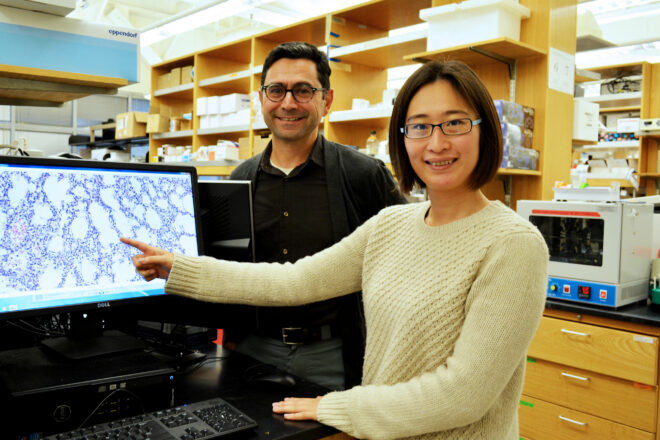
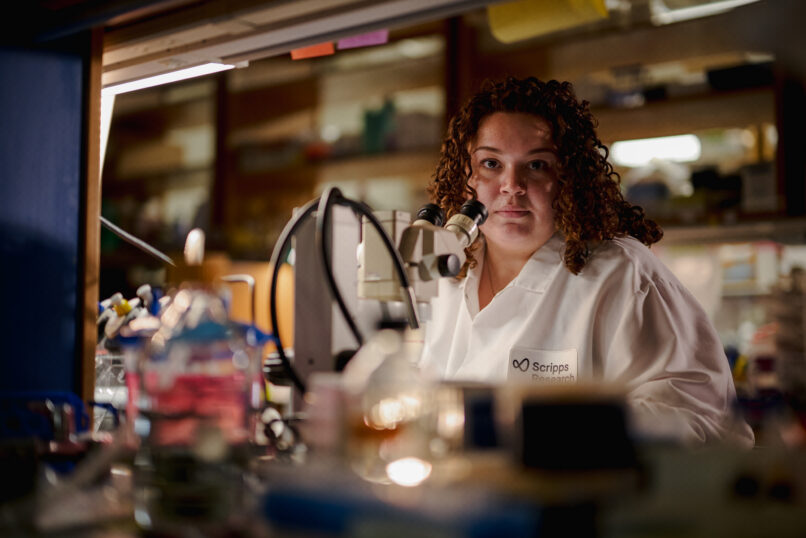
Research Associate Keiko Nonomura (right) points to mouse lung tissue imaged in the new study, led by TSRI Professor Ardem Patapoutian (left). (Photo by Madeline McCurry-Schmidt.)
LA JOLLA, CA – December 22, 2016 – A protein originally discovered at The Scripps Research Institute (TSRI) appears to be involved in how the body controls breathing, according to a new study led by scientists at TSRI and Harvard Medical School. The study, published in Nature, shows how the Piezo2 protein, previously shown to be the principal sensor of touch and proprioception, also plays a critical role in sensing lung expansion.
“The discoveries here could provide important clues on how to treat patients with respiratory disorders,” said senior author Ardem Patapoutian, a professor at TSRI and a Howard Hughes Medical Institute (HHMI) investigator.
Using genetically modified mouse models, the researchers found that newborn mice lacking the Piezo2 channel show severe respiratory distress that leads to death. The researchers said this study might help shed light on sudden infant death syndrome (SIDS) in human babies, which is thought to be associated with dysfunctional airway sensory neurons.
Adult mice lacking the Piezo2 channel in sensory neurons exhibit significantly increased tidal volume (amount of inhaled air in lungs) as well as an impaired Hering-Breuer reflex, an inhibitory respiratory reflex that prevents lung over-expansion.
Piezo2 Sends Messages from the Lungs to the Nervous System
The Piezo2 ion channel was originally discovered as a novel mechanosensor (sensor of mechanical stimuli such as pressure or stretch) in Patapoutian’s lab in 2010. Follow-up studies showed that the Piezo2 channel present in sensory neurons is required for sensing touch sensation and muscle stretch in mice. These studies led researchers to wonder if Piezo2 plays a role as a general stretch sensor in other organs such as lungs.
“Previous studies suggested the existence of lung inflation sensors; however, their molecular identity or physiological importance has not been clarified,” said Patapoutian.
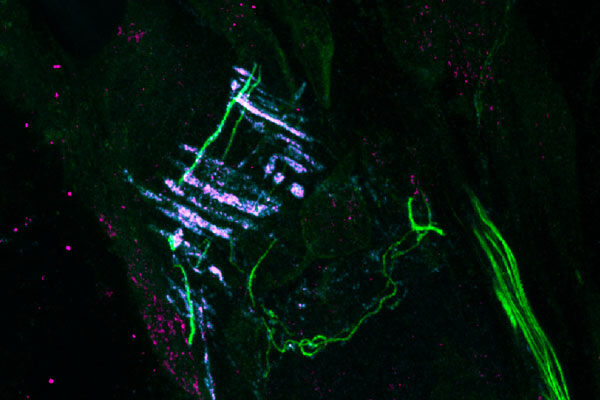
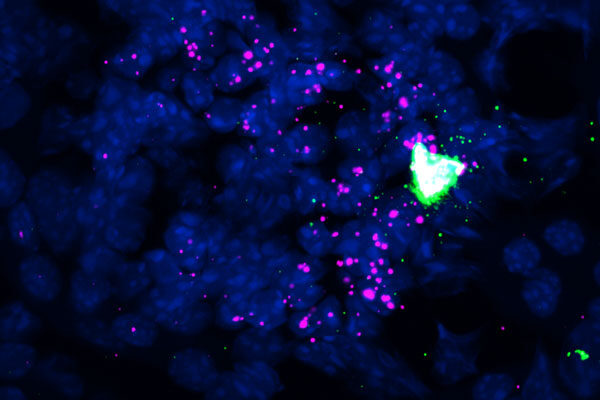
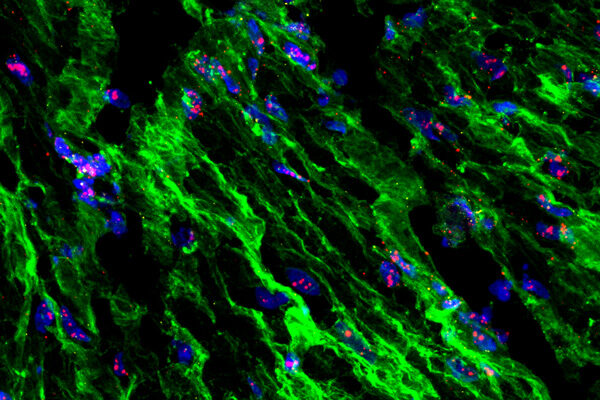
The researchers tackled this question by generating and characterizing Piezo2 “knockout” mice, in which the Piezo2 channel is deleted throughout the animal or only from sensory neurons (more specifically, vagal sensory neurons that are known to control breathing). They found that Piezo2 is essential for establishing proper breathing and lung expansion in newborn mice. Piezo2-deficient newborn mice showed unexpanded lungs and significantly shallow breathing.
“The lungs communicate with the brain via sensory neurons. The Piezo2 channel in sensory neurons generates a message about lung volume changes, and Piezo2-containing sensory neurons deliver this message to the brain,” said TSRI Research Associate Keiko Nonomura, co-first author of the study with TSRI Research Associate Seung-Hyun Woo. “Piezo2-deficient mice cannot generate an accurate message about their lung volume changes. As a result, these mice cannot receive proper output from the brain.”
Strikingly, according to recently published papers, Piezo2-deficient human infants also show shallow breathing and require medical attention.
“Piezo2-deficient newborn mice develop normally until birth. The problem only arise once the mice are born and try to breathe on their own” added Nonomura.
Consequences in Adult Mice
The researchers were surprised to see an unexpected consequence of deleting Piezo2 in sensory neurons of adult mice. When the Piezo2 channel was deleted either in all sensory neurons or only from vagal sensory neurons, adult mice could still breathe, but they inhaled significantly more air than Piezo2-intact mice.
Under normal conditions, animals stop breathing when they are forced to breathe in more air, but Piezo2-deficient adult mice lacked the Hering-Breuer reflex and continued breathing when they were forced to breathe in more air.
Why this difference between adults and newborns? The researchers found that Piezo2 performs different functions in newborns and adults because establishing autonomous breathing in newborns is more complex.
“At birth, newborn respiratory system undergoes drastic structural changes as liquid-filled compressed fetal airways are being cleared and inflated with air,” said Patapoutian. “Therefore, newborn airways experience larger mechanical changes, compared to adult airways, which have already established normal breathing.”
These data, for the first time, define the importance of mechanosensory transduction in adult respiration. This research is also relevant for understanding respiratory diseases, such as chronic obstructive pulmonary disease (COPD) and sleep apnea, which appears to be tied to disruption of the airway sensory feedback system.
The team said future studies could also use similar genetic manipulations to better understand the role of Piezo2 in other physiological processes such as heart rate control and bladder function.
In addition to Nonomura, Woo and Patapoutian, authors of the study, “Piezo2 senses airway stretch and mediates lung inflation-induced apnoea,” were Rui B. Chang and Stephen D. Liberles of Harvard Medical School; Astrid Gillich of HHMI and the Stanford University School of Medicine; Zhaozhu Qiu, previously of TSRI and the Genomics Institute of the Novartis Foundation, now at Johns Hopkins University; Allain G. Francisco of HHMI and TSRI; and Sanjeev S. Ranade, previously of HHMI and TSRI, and now at the Gladstone Institutes.
This research was supported by the National Institutes of Health (grants R01DE022358 and R01HL132255), a Giovanni Armenise-Harvard Foundation Grant and the Howard Hughes Medical Institute.