
Ryan Shenvi, PhD
Professor
Department of Chemistry

Research Focus
Chemical synthesis is the transformation of matter, converting one material with one set of properties into new materials with new properties. Fundamental advances in synthesis support material, agricultural and pharmaceutical sciences. The scientific community has been restricted, however, in the exploration of relatively simple molecules with simple structures due to the insufficiency of chemical tools to handle high complexity molecules.
Molecular complexity (e.g. information content and information density) relates to selectivity of binding within a complex environment, like a cell, tissue or organism: simple keys will fit many locks; the more complex the key, the greater the specificity. Of all the varied molecules that might exist—a theoretical set referred to as ‘chemical space’—few are easily accessible and the most complex molecules are the least explored.
The limited amount of data associated with complex molecules and their reactions affects our ability to predict their behavior and properties. Therefore, our group has developed tools—experimental and computational—to better access, explore and predict the behavior of complex molecules. We then apply these chemical tools and complex molecules towards biomedical goals.
Among our biomedical applications, we are best known for our work on kappa-opioid receptor ligands like salvinorin A and GB18. This latter molecule was discovered as a CNS-active component of the traditional medicine and rituals of the Gimi people of Papua New Guinea and assigned by our lab as a potent opioid receptor antagonist. Our work transformed this compound into a series of potent, selective and G protein-biased agonists (via collaboration with Professor Laura Bohn). We also have active programs in 14-3-3 protein-client molecular glues, GABAa receptor antagonists and species-selective SDH inhibitors.
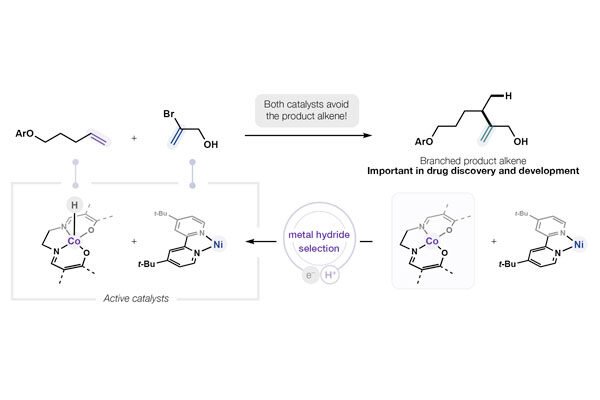
Among our efforts in chemical reaction development, we are best known for our work in metal hydride atom transfer (MHAT), which we hypothesized as the operative mechanism in a variety of base metal (Fe, Mn, Co)-catalyzed chemical reactions observed in the 1980s. This elementary step would occur in an "outer-sphere" fashion, i.e. with no bond forming between the metal atom and the reacting substrate in the transition state. Since our publication of two JACS papers in 2014, our work in this area has been cited over 3600 times and the MHAT paradigm has driven basic research from our lab and many others. More recently, we have shown how "outer-sphere" elementary steps can be concatenated to form chemical bonds in new ways. This work complements the "inner-sphere" reactions of precious metal catalysts like palladium that have been wielded since the 1970s to form simple, unsaturated molecules. These "outer-sphere" reactions, in contrast, rely on inexpensive metals like iron and better handle complex, saturated molecules.
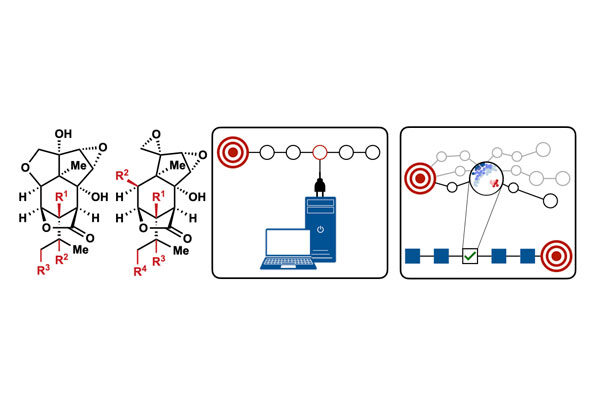
Recently, our work in complex molecules like cellular metabolites (aka natural products) have stimulated interest in how actionable predictions can be made with computational assistance. Techniques like machine learning (ML) typically rely on very large data sets to build statistical models that lead to predictions outside the original training set. However, these data are typically not available for complex, under- or unexplored molecules. Therefore, we have turned to high-level theory like density functional theory (DFT) or equivalent neural network potentials (NNPs) to simulate training sets. To avoid "garbage-in-garbage-out" predictions, we rigorously benchmark theory against competitive elementary steps that lead to a quantifiable ratio of products. This workflow can turn ca. 5 experiments into ca. 30 transition state models, which then fuel parametrization and statistical modeling to reach hundreds of predicted outcomes. If done correctly, this strategy can save hours of wet lab time by simulating reactions before they are ever run.

Select Publications
-
Gan, Xu- C.; Kotesova, Simona; Castanedo, Alberto; Green, S A.; Møller, Søren Lau Borcher; Shenvi, Ry A. Iron-Catalyzed Hydrobenzylation: Stereoselective Synthesis of (-)-Eugenial C. 2023, 145, 15714-15720.
-
Shenvi, Ry A. Hidden Lives. Early Childhood Care as an Academic: The Slow Burn. 2023, 62, e202301979.
-
Hill, Sarah J.; Dao, Nathan; Dang, Vuong Q.; Stahl, Edward L.; Bohn, Laura M.; Shenvi, Ry A. A Route to Potent, Selective, and Biased Salvinorin Chemical Space. 2023, 9, 1567-1574.
-
Shevick, Sophia L.; Freeman, Stephan M.; Tong, Guanghu; Russo, Robin J.; Bohn, Laura M.; Shenvi, Ry A. Asymmetric Syntheses of (+)- and (-)-Collybolide Enable Reevaluation of -Opioid Receptor Agonism. 2022, 8, 948-954.
-
Woo, Stone; Shenvi, Ry A. Synthesis and target annotation of the alkaloid GB18. 2022, 606, 917-921.
-
Landwehr, Eleanor M.; Baker, Megh A.; Oguma, Takuya; Burdge, Hannah E.; Kawajiri, Takahiro; Shenvi, Ry A. Concise syntheses of GB22, GB13, and himgaline by cross-coupling and complete reduction. 2022, 375, 1270-1274.