Chemists develop simpler method to make molecular building block for drug development
August 27, 2026
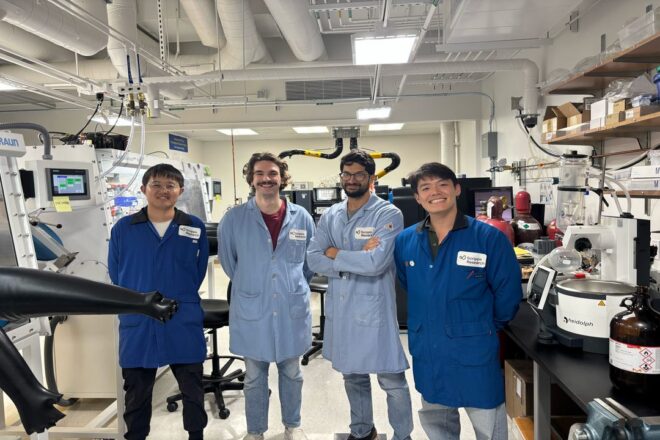
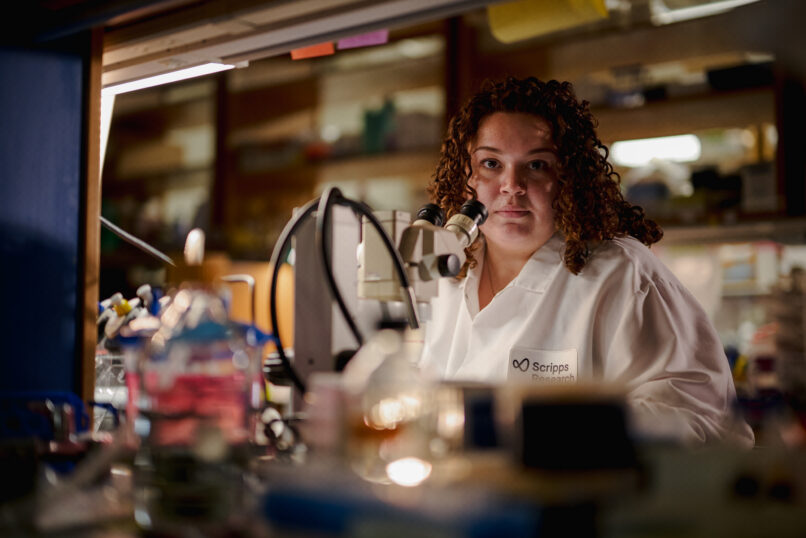
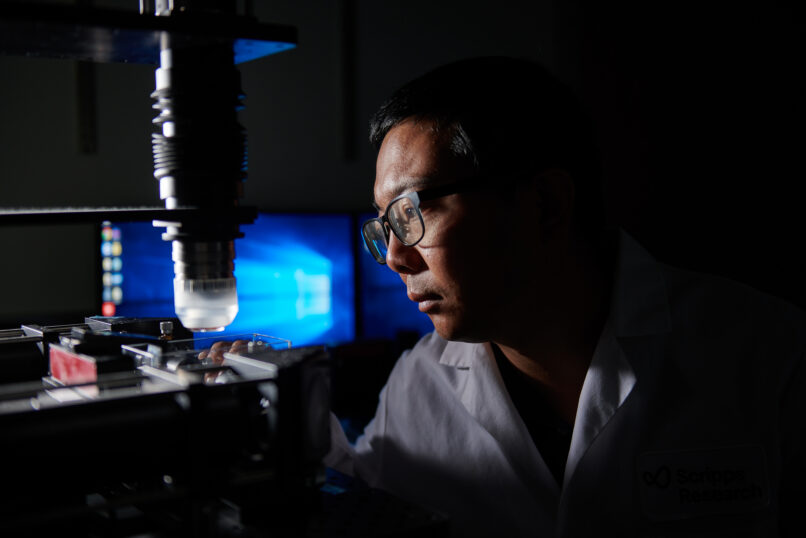
Left to right: Lingran Kong, Brandon Orzolek, Ryan Shenvi and Kevin Zong. Credit: Scripps Research
LA JOLLA, CA—Chemical structures called cyclopropanols are among the most useful building blocks in chemistry. Each includes three carbon atoms squeezed into a three-membered ring, leaving their bonds bent and strained, ready to spring open into a wide range of other structures. In addition to its unique reactivity and application as intermediates for assembling complex molecules, this motif is also found in commercially available drugs like grazoprevir for hepatitis. Despite their prevalence in both chemical and biological settings, ways of making cyclopropanols have been unchanged for decades.
Now, chemists at Scripps Research have discovered a new way to build cyclopropanols from scratch, assembling the ring’s three carbons one at a time in a single flask. The method, published in Science on August 27, 2026, is not only operationally simpler than previous methods and uses more accessible starting materials, but it also leads to an isomer, or alternative configuration, of cyclopropanol that older methods can miss.
“Cyclopropanols have seen use for decades as intermediates and targets of chemical synthesis,” says Ryan Shenvi, a professor at Scripps Research and senior author of the study. “Here we find a better way to access them, but we also uncover a surprising mechanism with broader implications.”
Many molecular building blocks have traditionally been made using cross-coupling reactions. In a conventional, “inner-sphere” approach, the two molecules being joined bind directly to a precious transition metal, which stitches them together. That approach, however, often relies on expensive precious metals such as palladium and struggles when the reaction site is crowded with bulky molecules.
Shenvi’s lab has studied ways to utilize base metal-catalysis to harness “outer-sphere” chemistry, an alternative mechanism in which the new bond doesn’t form at the metal center. Instead, the molecules react with the chemical groups already attached to the metal. Such reactions can use cheaper, more abundant metals like iron while also tolerating more crowded molecules.
In the new work, postdoctoral fellow Lingran Kong and graduate student Kevin Zong applied this outer-sphere reactivity to the synthesis of cyclopropanols, using an iron catalyst to drive the process. A key ingredient was an iron carbene: a highly reactive intermediate with only two strong bonds to carbon instead of the usual four.
The iron generated the first carbene from a simple precursor, and then Kong and Zong added a pyridyl ester: a common chemical motif that contributed one more carbon. On its own, the iron carbene has the wrong chemical properties to react with an ester, but the embedded pyridyl group captures the iron carbene and hands it off to the ester.
That reaction assembles two of the ring’s three carbons. The same iron catalyst then makes a second carbene—this one from dichloromethane, a cheap and common solvent—which adds the third carbon and closes the ring.
The payoff is a simpler and easier-to-control reaction than in the past. For example, a widely used reaction to build cyclopropanols generally leads to a “trans” version of the chemical, with the alcohol and its neighbor on opposite faces of the triangular ring. The new reaction leads to the harder-to-obtain “cis” version.
“These cis cyclopropanols are not as readily accessible as their trans counterparts, so people have looked into them less,” says Zong. “I hope this is a method that not only makes them easier to access, but opens up a new frontier for reactivity.”
The mild conditions also mean that more fragile chemical groups can be attached to the cyclopropanol without being destroyed.
“If people use other methods to make cyclopropanols, they cannot tolerate, for example, an ester or a ketone, which are very common in organic compounds,” says Kong. “Our method can tolerate these functional groups.”
With this flexibility, the reaction paves the way toward research on new cyclopropanols that have been hard to produce. Studying how the three pieces actually come together, the team also uncovered an underlying mechanism that they believe applies well beyond cyclopropanols.
“Usually, you have a sense of the mechanism first, and then you use that hypothesis to put molecules together in new ways. Here it happened the other way around,” says Shenvi. “But now, we think we can leverage this new mechanism for all sorts of other reactions, not just this first example.”
The team notes that finding workable conditions for the reaction took help from Scripps Research’s Automated Synthesis Facility, directed by study co-author Brandon Orzolek. There, the team screened 96 catalyst ligands in combination with four metals in two weeks—work that had taken three or four months for roughly 50 ligands in an earlier project.
“A lot of the conditions we found in this paper wouldn’t have been obvious to us,” says Zong. “There’s a specific chiral ligand we ended up using, even though our product isn’t chiral. Lingran and I would not even have thought to try if it weren’t for the facility.”
In addition to Shenvi, Kong and Zong, authors of the study, “Iron-catalyzed [1+1+1] cyclopropanation by sequential coupling of an ester to two carbenes,” are Brandon J. Orzolek of Scripps Research and Marcus Hopfengärtner of Friedrich-Alexander-Universität Erlangen-Nürnberg.
This work was supported by funding from the National Institutes of Health (GM122606), the National Science Foundation (CHE 2400341) and the Postdoctoral Exchange Fellowship Program of the Office of China Postdoctoral Council.

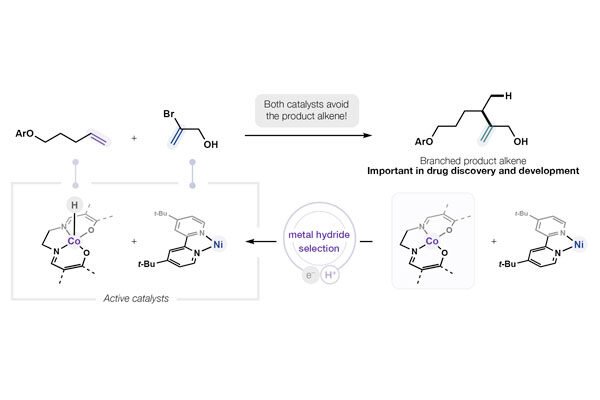
New technique for synthesizing branched molecules could accelerate the development of future medicines
Scripps Research chemists solve a longstanding problem in the construction of branched molecular frameworks, unlocking a faster path to the complex structures found in drugs and materials.


Ryan Shenvi: Ethnomedicine to improve learning, memory and mental health
Professor Ryan Shenvi is based in the Department of Chemistry at Scripps Research, where his lab reconstructs useful molecules typically found in remote corners of the world. Listen as we talk about traditional remedies of indigenous cultures, formulating medicines from industrial waste and Charles Dickens’ drinking habits.