
New research offers fresh insights for how to make better vaccines
Scripps Research scientists and collaborators show how to fine-tune molecular structures within vaccines to better protect against diseases like HIV.
August 12, 2026
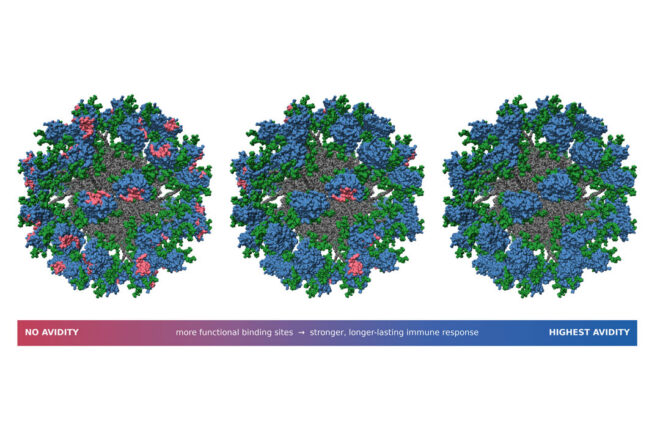
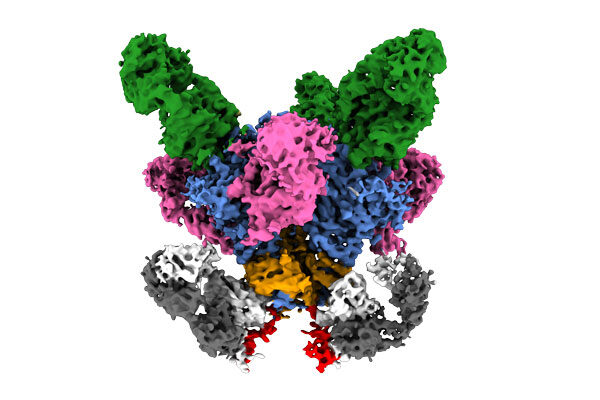
Three of the six vaccine nanoparticles used in the study, engineered to display different numbers of functional B cell binding sites: none (left), about half (center), or all (right). The particles show the HIV antigen in blue, its glycan shield in green, the protein core in grey, and inactive binding sites in pink. Credit: Scripps Research
LA JOLLA, CA—A vaccine’s molecular structure plays a key role in determining how the immune system responds and prepares to protect the body from future exposure to a specific pathogen. To develop a vaccine that offers long-term protection from HIV, it’s essential to promote a long-lasting immune response, where immune cells and antibodies prepared to combat the virus persist within the body. This has inspired scientists to find ways to alter vaccine structure to increase the duration and persistence of the immune response.
Now, in a pair of preclinical studies each published in Science Translational Medicine on August 12, 2026, scientists across Scripps Research, the University of Texas Medical Branch and IAVI found that increasing the “avidity”—or overall binding strength—of vaccine nanoparticles to specific white blood cells promotes stronger and more durable immune responses in mice.
The first study examined how avidity affects the durability of the immune response, while the second study looked at how avidity influences which immune cells are most successful during that response. By demonstrating how higher overall binding strength could improve immune performance, these findings may help researchers design the next generation of vaccines for HIV and other infectious diseases.
“We’re trying to dial all the knobs we can in terms of vaccine design to get the strongest possible immune responses to stop HIV,” says the co-senior author of both studies, Scripps Research professor William Schief, who’s also the vice president of protein design in infectious disease research at Moderna, Inc. and an executive director of vaccine design at IAVI’s Neutralizing Antibody Center. “Both of these papers show that nanoparticles with higher overall binding strength lead to stronger immune responses at basically every stage of the overall response. This makes overall binding strength a promising aspect to explore to make better vaccines.”
Previous work led by Schief and his colleagues demonstrated the ability to produce mature, functional broadly neutralizing antibodies that block many different HIV strains from infecting cells in non-human primates. The researchers believed that a key to success in this prior study was the use of a nanoparticle at the last vaccination. But the study did not look at the durability of the immune response or how to optimize it. Schief’s team suggested that increasing overall binding strength of the nanoparticles may be one way to do so.
In particular, the new studies looked at how strongly a vaccine nanoparticle binds to the intended precursor B cells—white blood cells that can mature into cells that release antibodies—within the body. This overall binding strength combines two factors: the repetitiveness and the binding strength of individual B cell attachment points within a single nanoparticle. Historically, it’s been difficult to tell the relative impact of each of these features in determining the overall binding strength.
Schief and his team had some tricks up their sleeves to deconstruct the specific contributions of repetitiveness and attachment point binding strength, using carefully engineered vaccine nanoparticles.
Members of Schief’s lab engineered a set of six types of vaccine nanoparticles with a range of repetitiveness: the most repetitive had 60 functional attachment points, while the least had zero. They were able to keep other key factors, like nanoparticle size, constant.
With these nanoparticles in hand, Robert Abbott, an assistant professor at the University of Texas Medical Branch and co-senior author of both studies, set out to vaccinate mice with each of them, to figure out how repetitiveness influences the overall immune response at various stages. His team used mice with precursor B cells that have been adapted to bind the specific attachment point on the nanoparticles—which is designed to guide B cells to develop toward producing antibodies against HIV.
In the first study, Abbott’s team found that increased attachment point repetitiveness led to a longer lasting and more durable overall immune response. This included prompting greater production and persistence of memory B cells, long-lived plasma cells and antibodies in the bloodstream—all important for long-term protection. The team also confirmed that the improved immune responses were driven by the nanoparticle’s repetitive structure rather than simply an increased total number of the stimulating attachment points.
In addition to repetitiveness, the researchers assessed how attachment point binding strength affected immune responses. This was done by using an additional set of mixed repetitiveness nanoparticles engineered by Schief’s lab and mice with different precursor B cells that had either medium or high binding strength to the nanoparticles. They found that while binding strength is also important in driving many of these immune responses, repetitiveness played a more dominant role.
In the second study, the researchers wanted to dig in further to understand precisely how overall binding strength alters what happens within germinal centers, the factories where activated precursor B cells mature. They found that precursor B cells that bind highly repetitive nanoparticles are preferentially allowed to mature within germinal centers compared to their counterparts that bind less repetitive nanoparticles. Higher attachment point binding strength also improved B cell success, but not to the same degree as repetitiveness.
“So basically, higher overall binding strength allowed the B cells targeting that attachment point to compete better against other B cells, which is really exciting,” says Christopher Cottrell, an author on both studies who is an institute investigator at Scripps Research.
Importantly, these results depended on the level of competition among B cells. Normally, there is a diverse population of precursor B cells that compete to bind to the vaccine nanoparticle. But in a model where the intended precursor B cell population is maintained, but the population of other precursor B cells is reduced, the repetitiveness of the attachment points no longer made any difference. This may explain why some vaccines with low repetitiveness have performed well in early preclinical models with less diverse precursor populations but ultimately failed when tested in humans.
While more work must be done to determine whether these findings hold in humans, they provide guidance for researchers aiming to create new and improved vaccines for HIV and beyond.
In addition to Schief, Abbott and Cottrell, authors of the study, “Antigen avidity potentiates the durability of the vaccine immune response,” include Oleksandr Kalyuzhniy, Danny Lu, Nushin Alavi and Nicole Phelps of Scripps Research; and Nicole Weidner, Mauricio Padilla, Layne Pruitt, Kristyn Gonzales, Maisha Aniqua, Kristy Waldrep, Emma Keller, and Meredith Weglarz of the University of Texas Medical Branch.
In addition to Schief, Abbott and Cottrell, authors of the study, “Immunization with mosaic nanoparticles reveals that antigen avidity shapes the clonal hierarchy of the B cell response,” include Oleksandr Kalyuzhniy, Danny Lu, Nushin Alavi and Nicole Phelps of Scripps Research; and Mauricio Padilla, Nicole Weidner, Layne Pruitt, Kristyn Gonzales, Maisha Aniqua, Kristy Waldrep, Emma Keller, and Meredith Weglarz of the University of Texas Medical Branch.
This work was supported by funding from the National Institute of Allergy and Infectious Diseases (grants 5DP2AI154410, 5R00AI14576, UM1 Al100663, UM1 AI144462 and F31AI191954-01); the University of Texas Medical Branch (startup funding, McLaughlin fellowships); and Gates Foundation grants to the IAVI Neutralizing Antibody Center under the Collaboration for AIDS Vaccine Discovery (NAC INV-007522, and INV-008813, INV-034657, and INV-064772).