Joan Pulupa joins Scripps Research faculty to study the organization of DNA in brain cells and its links to neurodegeneration
Using smell-sensing neurons and advanced microscopy, Pulupa’s lab will explore how genome organization affects brain cells, and what it may reveal about neurodegenerative conditions.
July 2, 2026
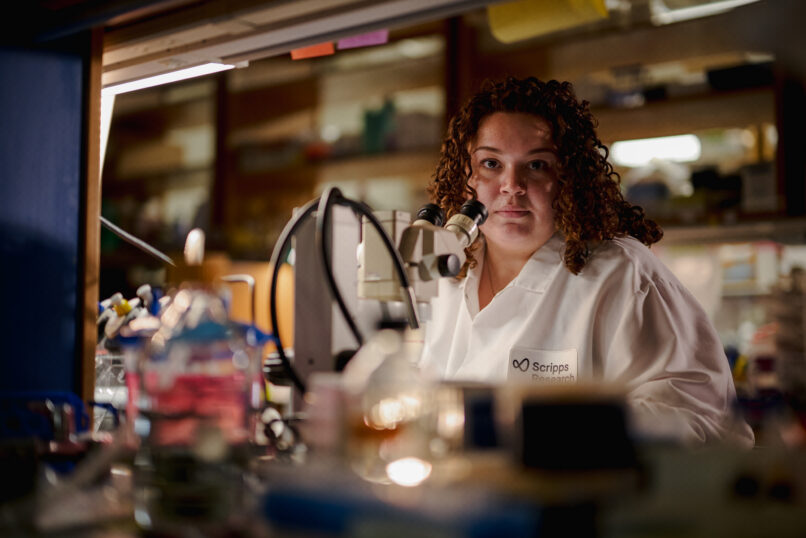
Joan Pulupa. Credit: Timothy White
LA JOLLA, CA—Molecular biophysicist Joan Pulupa will join Scripps Research in January 2027 as an assistant professor to study how DNA is organized inside neurons and the role this organization plays in determining which genes are turned on or off.
Specifically, Pulupa’s lab will focus on the relationship between genome organization and transcription—the process cells employ to read genetic instructions and make RNA—in developing neurons. This is especially important, as neurons can live for decades and must maintain stable patterns of gene expression throughout life.
“We still don’t understand the fundamentals of genome organization,” says Pulupa. “That’s central to studying both disease and development in the nervous system.”
Pulupa studies the nerve cells involved in smell, called olfactory neurons, which provide a well-suited model for exploring the influence of genome organization on gene regulation. During development, these cells undergo major shifts in DNA arrangement that are tied to specific alterations in gene expression, allowing scientists to study these processes as they unfold.
Because loss of smell can be among the first signs of neurodegenerative conditions such as Alzheimer’s disease and Parkinson’s disease, olfactory neurons may also offer insight into neuronal gene regulation changes related to illness. In fact, disruptions in genome organization can appear before clinical symptoms are evident.
More broadly, Pulupa’s research may help scientists clarify what happens when genome organization and gene regulation break down—processes that have been linked not only to neurodegeneration, but also cancer and autoimmune disease.
To watch genome organization form in living cells, Pulupa will implement live-cell microscopy, super-resolution imaging and related approaches. She’s especially excited to use Scripps Research’s minimal photon FLUX (also known as MINFLUX): a microscope that can reveal cellular structures and protein dynamics at extremely fine scales. For Pulupa, microscopy brings distant biological questions into closer view.
“My brother is a physicist and studies the Sun, which is so far away,” she says. “Microscopy makes it possible to see a hidden world inside ourselves, and that’s what drives me.”
Pulupa comes to the institute from Columbia University, where she’s currently a postdoctoral research scientist. As she prepared to launch an independent lab, Pulupa was drawn to Scripps Research’s scientific strengths as well as its culture of cross-disciplinary research.
“‘Collaboration’ isn’t just a phrase here; you can see it in the shared papers, shared grants and even the shared students,” she notes. “These labs really working together was a green flag for me.”
Pulupa earned bachelor’s degrees in physics and biology from Goucher College and completed her PhD at The Rockefeller University. She previously was a Leading Edge Fellow, a Junior Fellow of the Simons Society of Fellows, and a Howard Hughes Medical Institute Gilliam Fellow for Advanced Study. Pulupa is also the recipient of a Postdoctoral Career Transition Award from the National Institute on Deafness and Other Communication Disorders.
Viome, Scripps Research collaborate on colorectal cancer testing
GenomeWeb