
A double “off-switch” helps cells respond to stress
Scripps Research scientists reveal how cells turn down protein production and conserve energy—a critical mechanism in aging, cancer and neurodegeneration.
August 11, 2026
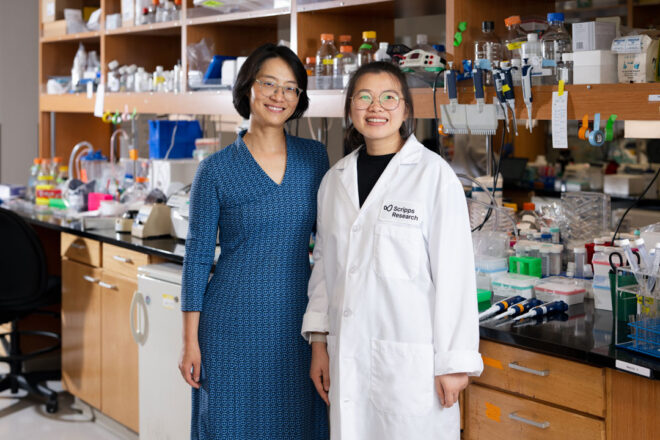
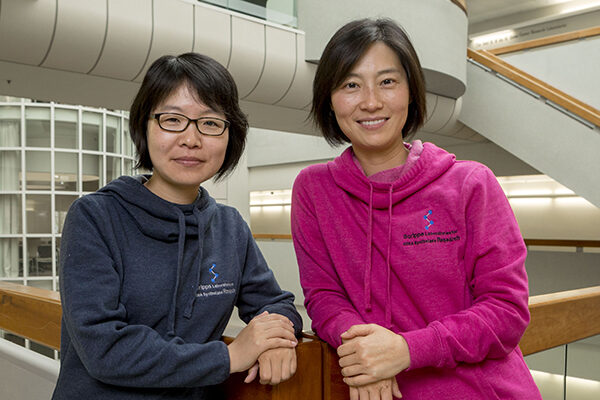
From left, professor Xiang-Lei Yang and postdoctoral associate Huimin Zhang. Credit: Scripps Research
LA JOLLA, CA—Scientists at Scripps Research have discovered that two seemingly unrelated cellular enzymes become locked together during times of stress, simultaneously shutting down both of their normal jobs. The finding, published in Nature Communications as an open-access article on July 8, 2026, reveals a previously unknown mechanism cells use to throttle back protein production when they’re short on energy.
The work could eventually help reveal how cells’ protein-making machinery becomes dysregulated in cancer, neurodegeneration and aging.
“This mechanistic work really elegantly illustrates the cross-talk between cellular metabolism and protein production,” says Xiang-Lei Yang, professor and holder of the Ernest W. Hahn Endowed Chair at Scripps Research, and senior author of the study. “There are broad biological implications in understanding this connection better.”
Yang’s team was originally trying to understand a protein called SerRS that appeared in screens of genes important for blood vessel development. SerRS was known for playing a part in the cell’s protein production machinery, so the scientists wondered how it regulated blood vessels. In 2014, the lab discovered a key relationship between SerRS and a second protein, SIRT2, which is involved in metabolism, aging and energy balance. When the two proteins interacted, they acted as a brake on blood vessel growth.
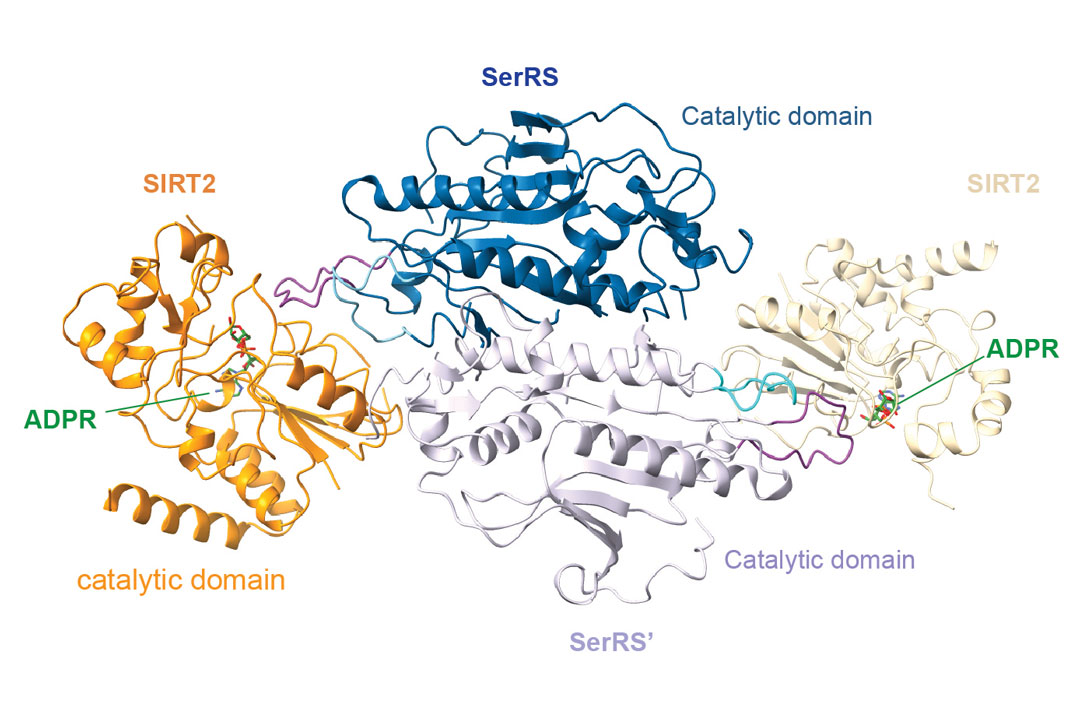
In the new work, Yang’s lab group, led by co-first authors Qian Zhang and Huimin Zhang, set out to capture what the SerRS-SIRT2 complex actually looked like. The team collaborated with Scripps Research professor Gabriel Lander to use cryo-electron microscopy, a technique in which proteins are flash-frozen as they interact so their structures can be analyzed. The resulting picture revealed a surprise: the proteins weren’t cooperating with each other, but instead, were inhibiting, or shutting each other down. SerRS physically blocks the pocket SIRT2 needs to do its job, while SIRT2 blocks the surface SerRS needs.
SerRS is required for cells to make new proteins, and SIRT2 is necessary for modifying certain proteins—including those that control which genes are turned on in a cell, and those that make up a cell’s internal scaffolding. When SerRS and SIRT2 are bound together, all these processes slow down, the researchers showed.
“We fully demonstrated that the proteins interact and that their interaction is inhibitory for both,” says Yang.
But that wasn’t all: Working with researchers Elizabeth Billings and Bill Webb at the Scripps Center for Metabolomics and Mass Spectrometry, the team also revealed an unexpected third molecule that was needed to lock SerRS and SIRT2 together. The molecule, a metabolite called ADP-ribose (ADPR), is produced by cells when they sense stress (such as toxins, radiation or aging).
“If we hadn’t solved the structure, we would have had no idea this regulation existed,” Yang says. “Usually, you understand the biology first and then get a structure to explain it. Here it went the other way—the structure is what revealed that our understanding of these proteins was incomplete.”
The researchers showed that within minutes of stress exposure, an existing molecule is chopped up to make ADPR. In response to rising ADPR levels, the SerRS-SIRT2 complex forms more readily, and protein production drops. This conserves the cell’s energy and resources. Because it relies on locking together existing proteins—rather than waiting for the cell to produce a new set of molecules from scratch—the process can happen almost immediately.
To explain how an inhibitory interaction can turn into a partnership, a fourth player is needed to release the inhibition. “Instead of bringing in an activator, this mechanism works by disinhibiting an inhibitor,” Yang says. “That gives the cell a way to respond to stress that’s fast, reversible and has a built-in threshold.”
Yang’s team is still working to connect these new findings back to the lab’s original discovery in blood vessels, tracing whether a lock-and-release mechanism between SerRS and SIRT2 is what controls the brake on vessel growth they first identified in 2014. They also hope to eventually learn how the process might go awry in disease.
In addition to Yang, Qian Zhang and Huimin Zhang, and Lander, authors of the study, “A metabolite-bridged complex between SerRS and SIRT2 couples NAD⁺ metabolism to translation control,” are Jie Yang and Marscha Hirschi of Scripps Research; and Sheng Li of UC San Diego.
This work was supported by the National Institutes of Health (R35 GM139627).