Researchers map key human proteins that power coronavirus replication, pointing to new treatment strategies
September 5, 2025
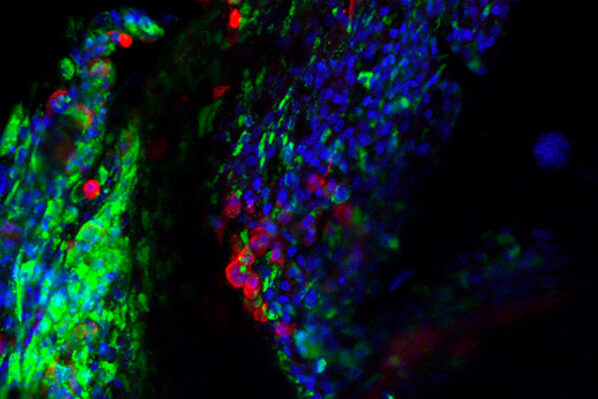
Microscope image of human epithelium cells (blue) infected with SARS-CoV-2 (red), showing the virus spreading from one cell to another. Credit: Laura Martin-Sancho
LA JOLLA, CA—Despite vaccines and treatments, SARS-CoV-2—the virus that causes COVID-19—continues to pose a global health threat, driven by new variants and its ability to hijack human cells in ways that still aren’t fully understood. Now, scientists at Scripps Research have pinpointed dozens of human proteins that SARS-CoV-2 needs to complete its full life cycle, from entering a cell to replicating and releasing new viral particles.
Published in PLOS Biology on June 12, 2025, these findings could open the door to new drug strategies that target our own proteins rather than the virus itself, potentially leading to new treatments effective against SARS-CoV-2 and other coronaviruses, even as the pathogens continue to evolve.
To find out which human proteins SARS-CoV-2 relies on, the research team used a technique called genome-wide small interfering RNA (siRNA) screening. This method can individually inhibit human genes in cells that are naturally susceptible to SARS-CoV-2, revealing which proteins the virus requires to replicate. The team uncovered 32 proteins essential for the earliest stages of infection, 27 proteins that the virus uses later, as well as cellular pathways it exploits—some previously known and others newly discovered.
“Since the beginning of the pandemic, our lab has long been focused on antivirals that target SARS-CoV-2, but what this work underscores is the importance of shifting toward understanding how the virus interacts with the host,” says Sumit Chanda, a professor of immunology and microbiology at Scripps Research and co-senior author of the study. “By identifying the human proteins that coronaviruses rely on, we can now think about developing the next generation of pan-coronavirus therapies—treatments that could be effective not just against today’s SARS-CoV-2, but even a future SARS-CoV-3. Because these strategies target the host, they’re also less likely to be undermined by viral mutations and drug resistance.”
Among the proteins identified, two emerged as especially promising drug targets. The first, perlecan, is a large protein studded with sugar chains found in the extracellular matrix—the supportive meshwork that surrounds and organizes our cells. The research team discovered that SARS-CoV-2’s spike protein can latch directly onto perlecan’s sugar chains, helping the virus attach to and enter human cells. Blocking that interaction could prevent infection from taking hold.
“Perlecan could be acting almost like a co-receptor for the virus,” says co-senior author Laura Martin-Sancho, who was formerly a staff research scientist at Scripps Research and is now an assistant professor of molecular virology at Imperial College London. “If we can target that interaction, we may be able to stop infection right at the door.”
The second protein, Baculoviral IAP Repeat Containing 2 (BIRC2), is part of a cellular inflammation pathway. In cultures of human cells and in mice infected with SARS-CoV-2, drug compounds known as second mitochondria-derived activators of caspases (Smac) mimetics—originally developed to trigger cell death in cancer and to “wake up” dormant HIV so it can be targeted by the therapy—successfully inhibited BIRC2, slashing viral levels in an animal model.
“With BIRC2, the really striking part is that our lab had been working with Smac mimetics for years in HIV research,” adds Chanda. “To suddenly see them show antiviral activity against SARS-CoV-2 was a big surprise.”
Importantly, the team tested the same human proteins against three other coronaviruses: SARS-CoV-1, MERS-CoV and a seasonal coronavirus. Of the 47 proteins tested, 17 were consistently used by all three viruses, including proteins that help viruses fuse with cells, copy themselves, and exit to infect new cells. This suggests that blocking human proteins that the viruses depend on could form the basis of drugs effective against past, current and potentially future pandemic coronaviruses. Because host-directed antivirals target human proteins rather than viral proteins, they’re less likely to be undermined by the virus’s rapid mutation rate.
“If we have such antivirals ready ahead of time, we could deploy them early in a future coronavirus outbreak,” points out Chanda. “That gives us a higher barrier to resistance and the potential to block multiple viruses with a single therapy.”
Next, the researchers plan to explore whether the same host proteins are also used by other respiratory pathogens such as influenza and RSV. They’ll also continue testing the safety and efficacy of promising compounds in future studies.
Authors of the study, “Global siRNA screen identifies human host factors critical for SARS-CoV-2 replication and late stages of infection,” include Yuan Pu, Laura Riva, Paul D. De Jesus, Daniel Fuentes and Ignacio Mena of Scripps Research; Xin Yin of the Chinese Academy of Agricultural Sciences; Shuofeng Yuan of the Li Ka Shing Faculty of Medicine; Lars Pache of the Sanford Burnham Prebys Medical Discovery Institute; Christopher Churas, Thomas Clausen, Jeffrey D. Esko, Trey Ideker and Dexter Pratt of the University of California San Diego; Stuart Weston, Grace Biddle, Simon Doss-Gollin, Meagan Deming and Matthew B. Frieman of the University of Maryland School of Medicine; Lacy M. Simons, William J. Cisneros and Judd F. Hultquist of Northwestern University Feinberg School of Medicine; Ha Na Kim, John M. Whitelock and Megan S. Lord of the University of New South Wales; and Adolfo García-Sastre of the Icahn School of Medicine at Mount Sinai.
This work was supported by funding from the National Institutes of Health (grants U19 AI118610 and U19 AI135972); the Health and Medical Research Fund Research Fund Fellowship (grant 07210107); the Open Philanthropy Project (grant 2020-215611 [5384]); Dinah Ruch; Susan and James Blair; the JPB Foundation; and the James B. Pendleton Charitable Trust.



Virologist gives update on H5N1, mpox, and preparing for an uncertain future
Roughly two years ago, virology expert and Scripps Research professor Sumit Chanda sat down with Science Changing Life to discuss all things pandemic preparedness and COVID-19. But the world is in a very different place now, with infectious disease threats like H5N1, mpox and Dengue virus on the rise. Chanda joins us once again to share the latest in the virology space, how scientists can be better communicators, and his advice for making sure we’re as prepared for an uncertain future as we can be.


Combating microbial threats: A century of science changing life
Every day, scientists at Scripps Research are discovering and developing new treatments to combat today’s infectious disease threats—and tomorrow’s. Many of these researchers played a significant role in the COVID-19 pandemic, including identifying new antibody treatments and uncovering the virus’s structure. Meanwhile, they're also applying these key learnings to better prepare the global population for whichever microbial threat emerges next.

Sumit Chanda: How can we prepare for the next pandemic?
Professor Sumit Chanda is an infectious disease expert and immunologist, where he works both in the Department of Immunology and Microbiology and at Calibr, Scripps Research’s nonprofit drug discovery and development division. He has devoted his career to understanding how the immune system responds to numerous viruses, such as influenza, Dengue virus and SARS-CoV-2. Listen as we discuss everything from pandemic preparedness to drug discovery, as well as his unrelenting drive to uncover new treatment options—including for COVID-19.