Targeting a gene that controls tissue growth, scientists reveal regenerative path for treating diabetic foot ulcers
March 15, 2021
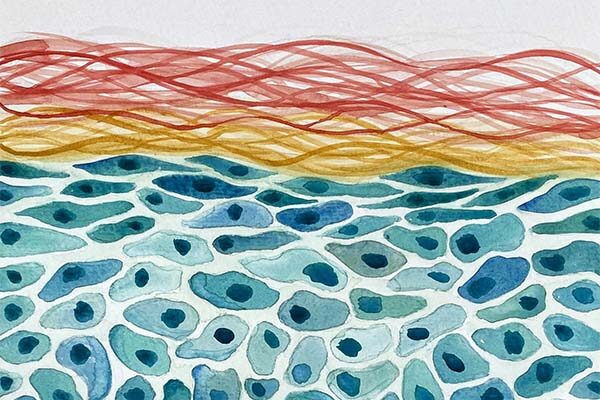
Watercolor depiction of the skin's epidermal layer, created by by Kayla Nutsch of the Bollong lab. In a new study, wounds healed quickly as skin cells bounced intro production mode after being treated with a newly discovered regenerative drug compound.
LA JOLLA, CA—A discovery involving multiple teams from across Scripps Research has revealed a powerful new approach for treating diabetic foot ulcers, which affect millions of people in the US and often lead to serious complications.
By targeting a gene that controls tissue growth and regeneration, the scientists were able to boost cell division at the site of injury and repair chronic wounds quickly. The new research appears in Nature Chemical Biology.
Given the growing prevalence of diabetes and limited options for treating foot ulcers—which can lead to amputation, in severe cases—it’s clear that more effective treatments are needed, says chemist Michael Bollong, PhD, assistant professor at Scripps Research and senior author of the study.
“We developed a way to activate multiple aspects of wound healing using a small-molecule drug that can be applied topically, without affecting other tissues,” Bollong says. “Essentially, we were able to trick the cells into proliferating and closing the wound, restoring the outer layers of skin.”
Bollong’s group worked in concert with laboratory of Scripps Research President and CEO Peter Schultz, PhD, and drug discovery teams at Calibr, which screened more than 800,000 molecules to find one that stimulated key regenerative pathways. The drug, PY-60, acts on a previously unknown regulator of tissue growth.
The researchers tested their approach in animal models and on “human skin equivalents,” which are skin samples from people that are further cultivated in a petri dish. They hope to begin clinical trials within the next year.
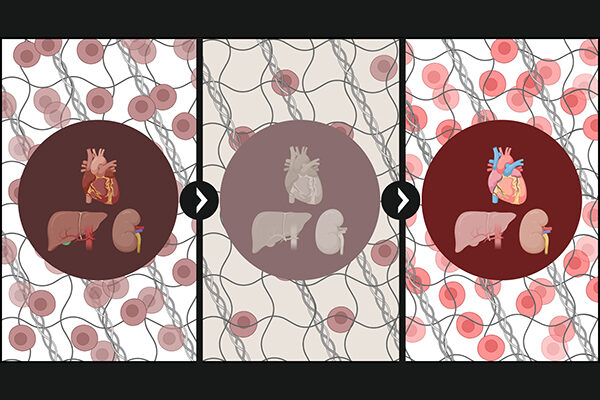
Beyond treating chronic wounds, Bollong says the approach may lead to new regenerative therapies for heart disease, liver conditions and inflammatory bowel disease, or IBD. “We believe the future of this type of regenerative therapy is incredibly bright,” Bollong says.
In the near term, however, the focus is diabetic foot ulcers, which affect roughly 15 percent of people with diabetes. More than half of those diagnosed with a diabetic foot ulcer will not survive the next five years, Bollong says, and the only existing regenerative therapy was developed more than two decades ago and has limited efficacy.
At the core of the new approach is a gene known as YAP, which is known to control organ size and tissue regeneration. YAP is regulated via a pathway called Hippo—often a target of cancer drugs due to its ability to influence cell growth.
Through their research, the scientists found a previously unknown player in the Hippo pathway—a protein that works with YAP to communicate cell density; when an organ or other tissue reaches a certain concentration, the cells will stop growing. But by targeting this protein with the new drug molecule, tissue cells bounce back into production mode. The healing process happens quickly and without producing negative side effects; in experiments, the outer skin layer doubled in a week.
“We found the results of the study to be incredibly compelling,” Bollong says. “We hope this regenerative approach can eventually be added on to existing standards of care for diabetic foot ulcers.”
The study, “YAP-dependent proliferation by a small molecule targeting annexin A2” was authored by Sophia Shalhout, Peng-Yu Yang, Edyta Grzelak, Kayla Nutsch, Sida Shao, Claudio Zambaldo, Jonathan Iaconelli, Lara Ibrahim, Caroline Stanton, Stormi Chadwick, Emily Chen, Michael DeRan, Sijia Li, Mitchell Hull, Xu Wu, Arnab Chatterjee, Weijun Shen, Fernando Camargo, Peter Schultz and Michael Bollong.
The research was supported by the Skaggs Institute for Chemical Biology and Calibr, the drug discovery and development division of Scripps Research.


New regenerative lung therapy begins phase 1 trials | CMR316 & IPF treatment
The Calibr-Skaggs Institute for Innovative Medicines, part of Scripps Research, has begun testing a new regenerative lung therapy called CMR316. This inhaled treatment could change the way we treat lung diseases like idiopathic pulmonary fibrosis (IPF) and potentially even chronic obstructive pulmonary disease by stimulating stem cells to restore damaged lung tissue. In this phase 1 clinical trial, they're checking the safety and effects of this once-weekly drug in both healthy volunteers and IPF patients.



Regenerating tissues to treat disease
Regenerative medicine involves harnessing the body’s own capacity to repair tissues and organs. In this Front Row lecture, Associate Professor Michael Bollong shared how he's identifying and targeting the pathways controlling regeneration. By combining traditional drug discovery tools with modern biological techniques, Bollong and his lab are developing novel medicines that can intervene in the processes that cause a spectrum of human diseases and medical conditions, including heart disease, inflammatory disease and fibrosis.