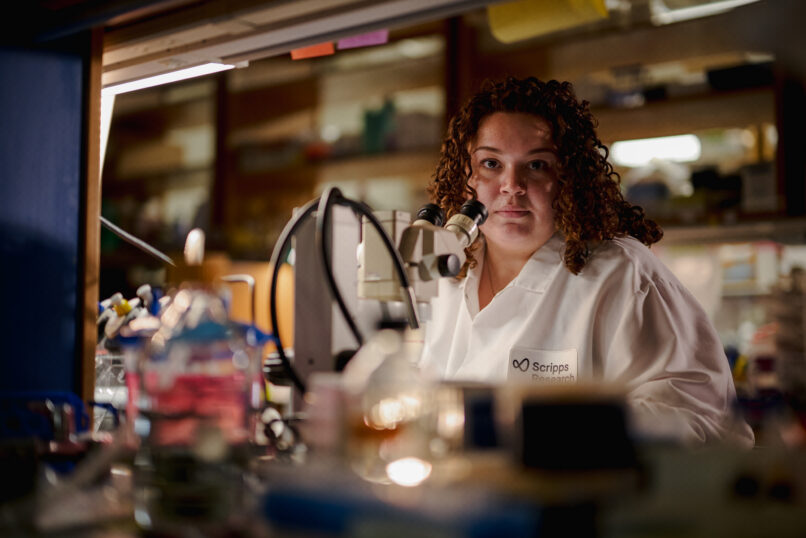

FDA accepts IND application for novel immunotherapeutic for prostate cancer in development by Calibr at Scripps Research
August 20, 2019

La Jolla, CA – Calibr, the drug development division of Scripps Research, announced today that the U.S. Food and Drug Administration (FDA) has cleared its investigational new drug application (IND) for CCW702, a novel immunotherapeutic for the treatment of patients with metastatic castration-resistant prostate cancer. “CCW702 has the potential to be effective in patients who have failed prior treatments and have exhausted their treatment options, because it works differently than traditional chemotherapeutics and androgen deprivation therapies,” says Travis Young, PhD, vice president of Biologics at Calibr, who led the pre-clinical development of the molecule. “We are truly excited about the opportunity to evaluate the safety and anti-tumor activity of this molecule in patients.”
CCW702 is a first-of-its-kind molecule designed to redirect a patient’s own immune system to eliminate malignant cancer cells. The molecule uses a unique design that combines the specificity of a validated imaging agent for prostate cancer with the potency of immunotherapy. In preclinical work, this design proved highly effective at completely eliminating tumors in animal models of prostate cancer.
The launch of this clinical study—Calibr’s fourth overall and second being run independently by the institute—is another major milestone for the new model being pioneered at Scripps Research, where innovative discoveries are translated into new medicines within the nonprofit enterprise. CCW702 began as a research project in the laboratory of Peter Schultz, PhD, at Scripps Research and progressed to the IND stage by Calibr through support from the Wellcome Trust. The molecule is manufactured using unnatural amino acid technology pioneered in Schultz’s laboratory in collaboration with Ambrx Inc.
“This program exemplifies the relationship between Scripps Research and Calibr in the ability to bring high-risk, high-reward programs forward into clinical trials to create impact for patients and value for the institute that stimulates and supports further research,” says Schultz, president and CEO of Scripps Research. “This model has the potential to be transformative in the way new medicines are developed.”
Clinical development of CCW702 will be led by Calibr’s new Chief Medical Officer Pamela D. Garzone, PhD. Her leadership will be critical as Calibr advances additional programs into the clinic over the next 18 months, with another IND filing expected by the end of the year.
About Scripps Research
A leading nonprofit biomedical research institute, Scripps Research is ranked #1 the world by Nature for scientific innovation. US News and World Report consistently ranks our graduate school in the top ten in the United States. Our unique structure merges foundational studies in biology, chemistry and computer science with translational research to produce the next generation of drugs and advances in digital and precision medicine. On campuses in California and Florida, scientists in the institute’s five academic research departments work hand-in-hand with researchers of the Scripps Research Translational Institute and Calibr, its drug discovery division. We train the next generation of scientific leaders, expand the frontiers of human knowledge and accelerate the development of new medicines to improve lives around the planet.
About Wellcome
Wellcome exists to improve health for everyone by helping great ideas to thrive. We’re a global charitable foundation, both politically and financially independent. We support scientists and researchers, take on big problems, fuel imaginations and spark debate.


Calibr-Skaggs advances CLF065, a regenerative GLP-2 therapy, into two Phase 2 IBD studies
CLF065, a long-acting, once-weekly GLP-2 receptor agonist, advances in two inflammatory bowel disease indications. The studies aim to bring a regenerative treatment option to patients living with IBD, who currently have few therapies that repair the damaged intestinal lining at the root of their disease.

Advancing the vision: An experiment in rethinking the nonprofit biomedical research model
In his Front Row lecture, President and CEO Pete Schultz highlighted the progress Scripps Research has made in pioneering a new model for non-profit biomedical research. He described how integrating basic science and translational research under one roof is accelerating next-generation medicines—from new immunotherapies for cancer and innovative medicines for infectious disease to regenerative treatments for heart, lung and intestinal tissues. At a time of uncertainty in federal science funding, this model isn't only advancing human health but also helping to generate sustainable support for innovative scientific research and for training the next generation of scientific leaders.

Viome and Scripps Research partner to develop first at-home RNA screening test to prevent colon cancer before it strikes
First-of-its-kind 1,000-patient clinical study will use RNA-based stool and saliva tests to detect colon polyps — early warning signs of colorectal cancer — before they become cancerous.Study aims to enhance colorectal cancer prevention by identifying polyp molecular signals, offering improved sensitivity over at-home DNA tests, which have limited ability to detect precancerous lesions.