Mobile health technologies accurately measure new cardiovascular ‘vital signs’
July 2, 2018
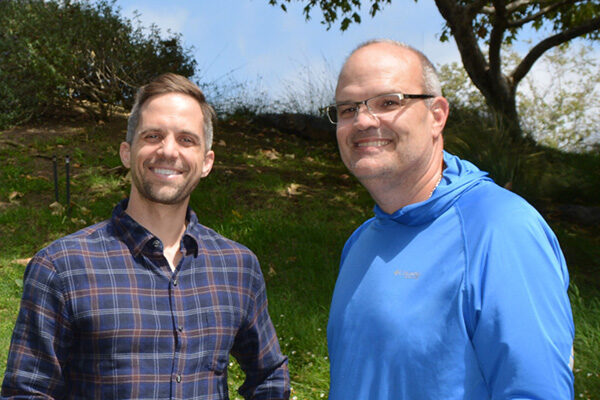
Brian Modena (left), assistant professor of Molecular Medicine at Scripps Research and a clinical researcher at the Scripps Translational Science Institute and Steven Steinhubl (right), director of digital medicine at the Scripps Translational Science Institute and senior author on the study.
The emergence of mobile health technologies, such as activity trackers, sleep monitors, electronic blood pressure devices and others offer the new ability to track both traditional cardiovascular risk factors (e.g. blood pressure) and other factors that increase a person’s risk for cardiovascular disease (e.g. poor sleep), at home, and at high sampling rates.
A study by researchers at the Scripps Translational Science Instituteprovides new evidence that these cardiovascular risk factors can be accurately measured and tracked independently outside of a physician’s office using new mobile health technologies, while requiring minimal training of participants. The study was published in the journal Hypertension.
“Identifying new ways of monitoring cardiovascular risk factors is critical to reducing the burden of this disease and strains on healthcare systems across the globe,” says first author and principal investigator Brian Modena, assistant professor of Molecular Medicine at Scripps Research and a clinical researcher at the Scripps Translational Science Institute.
“Our study combined multiple health tracking devices to holistically assess cardiovascular risk factors outside of the clinical setting along with demographics, medication adherence and stress levels,” Modena added. “These measurements were found to closely match national averages or prior studies performed in very controlled clinical settings, supporting their accuracy and reliability.”
Cardiovascular health has traditionally been assessed by measuring vital signs such as weight, blood pressure and heart rate. However, other factors such as sleep duration, physical activity levels, pulse wave velocity (a measure of arterial wall stiffness) and various lifestyle risk factors also influence or predict cardiovascular outcomes.
The study was conducted in collaboration with Withings, a consumer electronics company, that identified eligible study participants via a company database of owners of Withings health tracking devices. A total of 255 individuals were enrolled and asked to measure blood pressure, heart rate, pulse wave velocity and weight 2 days a week for 17 weeks. All measurements were transmitted wirelessly through a smartphone app to a secure database.
This was also the first study to successfully assess and track pulse wave velocity outside of a controlled clinical setting using new ‘smart’ weight scales. Pulse wave velocity is an important indicator of cardiovascular risk that is being increasingly used in clinic practice to predict risk of cardiovascular disease.
“With high adherence, satisfaction and participant engagement, this proof-of-concept study required minimal study personnel and no participant training, thereby making it likely scalable to much larger populations,” says Steven Steinhubl, director of digital medicine at the Scripps Translational Science Institute and senior author on the study.
Other authors on the study, “Advanced and Accurate Mobile Health Tracking Devices Record New Cardiac ‘Vital Signs’,” were Otmane Bellahsen of Nokia; Angela Chieh of Withings-Nokia Health; Danielle Dufek of University of California, Berkeley; and Nima Nikazad, Nathan Parikh, Gail Ebner and Eric Topol of The Scripps Research Institute.
The study was supported by funding provided by Withings, the National Institutes of Health NCATS Clinical Translational Science Awards (grants 5KL2TR001112 and 5UL1TR001114), and an NHLBI award (grant 1K23HL144418-01). It was also supported by the All of Us Research Program (grant 1U24OD023176).
I’m a cardiologist. Here are 10 science-based ways to prevent heart disease.
The Washington Post
Heart disease experts in their own words: ‘This is solvable and this is preventable’
STAT News
Regenerating tissues to treat disease
Regenerative medicine involves harnessing the body’s own capacity to repair tissues and organs. In this Front Row lecture, Associate Professor Michael Bollong shared how he's identifying and targeting the pathways controlling regeneration. By combining traditional drug discovery tools with modern biological techniques, Bollong and his lab are developing novel medicines that can intervene in the processes that cause a spectrum of human diseases and medical conditions, including heart disease, inflammatory disease and fibrosis.
Fixing the misfolded proteins that cause dementia and heart failure
All proteins have a correct way of “folding” themselves into their 3D structures. When this folding process goes awry, including processes leading to protein misassembly, a number of devastating diseases can result. In this Front Row lecture, Scripps Research professor Jeffery Kelly shared how he's developing novel therapeutic strategies to target these protein misfolding diseases, which lead to deterioration of the heart and brain. His multi-disciplinary research has already led to the development of an FDA-approved drug available in the pharmacy called tafamidis (Vyndaqel® and Vyndamax®): a medicine that slows the progression of the neurodegenerative disease familial amyloid polyneuropathy and the degenerative heart disease called TTR cardiomyopathy.