
James Paulson, PhD
Professor Emeritus
Department of Immunology and Microbiology

Research Focus
Glycan binding proteins regulating immune responses
We study immune cell receptors that recognize glycans as ligands, aiming to understand their roles in regulating immune responses and how to target them to modulate immune responses for disease treatment. At least three families of glycan-binding proteins known to mediate key aspects of cell trafficking and cell signaling in the immune system, the selectins, galectins, and Siglecs. Among them, the Siglec family is best known for regulating immune cell signaling. The Siglecs now comprise fourteen members that are expressed on the surface of various white blood cells (e.g. B cells, NK cells, eosinophils, monocytes etc.), and all recognize sialic acid (NeuAc) containing carbohydrate ligands. Our goal is to elucidate the roles of Siglec receptors in immune function and to define the biochemical basis for how the interaction with their carbohydrate ligands modulate their function.
The best understood for its function is CD22 (Siglec-2), which is known to be a negative regulator of B cell receptor (BCR) signaling. We have learned that co-presentation of a high-affinity ligand of CD22 with a protein antigen results in the recruitment of CD22 to the BCR of a B cell that recognizes the antigen. This results in the suppression of B cell activation and apoptosis. The animals are thus tolerized since the B cells recognizing the antigen are no longer present in the B cell repertoire. This finding has relevance to the development of therapeutics aimed at preventing unwanted B cell responses, with potential applications in preventing the development of anti-drug antibodies or suppressing/preventing autoimmune disease.
Influenza virus recognition of host cell receptors
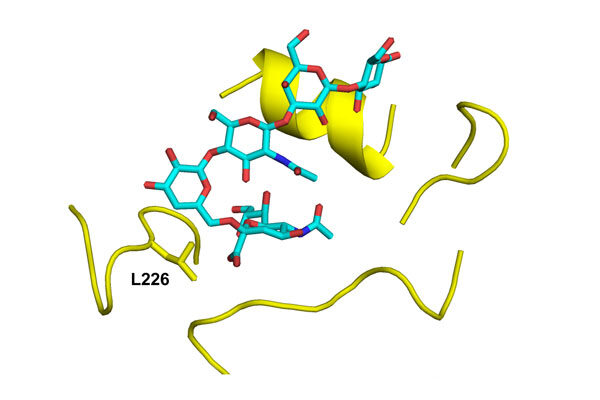
Another major area of investigation is influenza virus recognition of receptors in the human airway. Influenza viruses recognize sialic acid-containing glycans on airway epithelial cells as receptors for host attachment, a process mediated by the surface glycoprotein on the virus called the hemagglutinin. Avian (and swine) influenza viruses are the source of new human pandemics. Over the years, we have found that human viruses recognize different sialic acid-linked receptors than their avian virus progenitors. Avian viruses recognize a2-3 linked sialic acids (NeuAca2-3Gal) while human viruses recognize a2-6 linked sialic acids (NeuAca2-6Gal). This change in specificity must occur for the virus to transmit in the human population. Our research has most recently focused on defining the glycans that serve as influenza virus receptors in the human airway, and to help assess the risk of new avian virus strains from acquiring the ability to recognize human-type receptors.