
New design strategy expands nanoparticle vaccine approach to influenza viruses
Scripps Research scientists developed a blueprint for stabilizing key influenza proteins and are using them to make next-generation vaccine candidates.
September 1, 2026

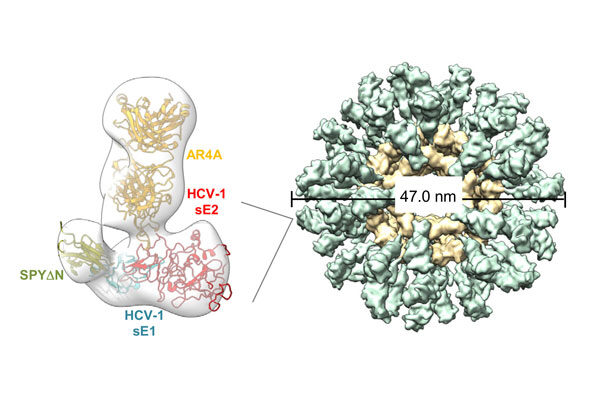
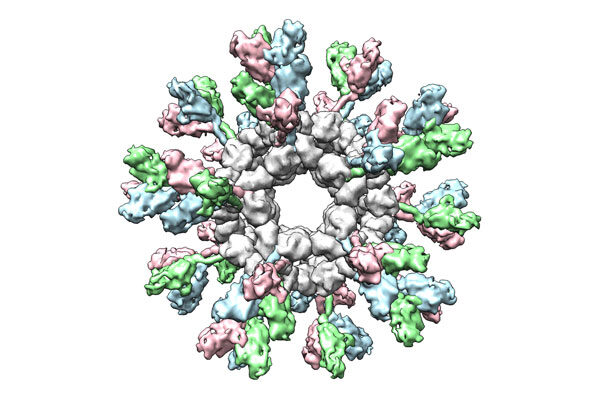
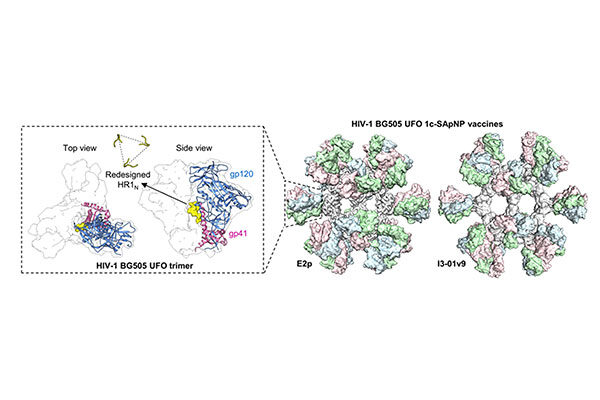
Image shows a stabilized CA09 influenza HA trimer, with the 60-mer self-assembling protein nanoparticle (SApNP) HA-E2p-L4P on the left and HA-I3-01v9b-L7P on the right. Credit: Scripps Research
LA JOLLA, CA—Influenza viruses constantly shapeshift to evade recognition by the immune system. This shapeshifting occurs in critical proteins like hemagglutinin (HA), which controls how the virus attaches to human cells before entering them. Influenza viruses can evade immunity in two major ways: through the gradual accumulation of mutations that make HA harder for the immune system to recognize, or through reassortment events that can introduce substantially different viral proteins and potentially lead to flu pandemics. To address this challenge, seasonal flu vaccines remain the primary approach since they can be developed to target the flu viruses that are circulating most predominantly in a given season.
Now, in a Nature Communications study published on August 13, 2026, scientists at Scripps Research offer a blueprint for how to stabilize the various versions of influenza’s HA protein and use it to build nanoparticle vaccine candidates. Influenza is the latest target made compatible with the nanoparticle technology, specifically called self-assembling protein nanoparticles (SApNPs), which work by organizing many copies of viral proteins into clusters that the immune system can more easily recognize. This framework could eventually be applied to inform design of next-generation vaccines across diverse flu viruses.
“Influenza HA is naturally poised to change shape by design because it needs to undergo a dramatic structural change during viral entry,” says senior author Jiang Zhu, a professor at Scripps Research. “What I’m trying to do is to find a magic trigger that, no matter what flu strains come along, mutating that trigger will make a stable antigen that can be used in a nanoparticle vaccine.”
Influenza viruses cause up to 5 million cases of severe illness and claim between 290,000 and 650,000 lives worldwide each year, while four major pandemics since 1918 have caused tens of millions of deaths. Most commercial flu vaccines are produced with an old-school method: growing them in chicken eggs. But vaccine development may now be shifting from egg-based production toward more modern methods that use nucleic acids—like the mRNA found in the COVID-19 vaccines—and proteins, which offer greater flexibility, efficiency and scalability.
On the surface of the influenza virus, groups of three identical HA proteins form bundles known as trimers. Many of these HA trimers are distributed across the viral surface, where they coordinate binding then entry into human cells. Because vaccines train the immune system to recognize viral proteins, scientists must find ways to generate stable versions of these proteins in the lab. But HA trimers often misfold or fall apart when exposed to temperature changes or acidic conditions.
In the new study, Zhu and his team set out to make stabilized versions of the HA trimer. They began with an observation: Across many different flu viruses that infect humans, birds and pigs, which all contain different versions of the HA protein, there was a specific location—the 95th amino acid—that was consistently water-loving.
“At the core of the trimer, there are many oily residues that tend to group together. But then in the middle of this oily group, there’s one pretty big and disruptive water-like amino acid. So, I wondered, will the structure be more stable if we change this to an oily amino acid as well?” says Zhu. “It turns out, once you get rid of this troublemaker, specifically in the HA from the 2009 California pandemic flu strain, the structure suddenly closes and becomes more stable. That’s the magic trigger I’ve been looking for.”
Members of Zhu’s lab swapped out the water-loving amino acid at position 95 for an oily one in a variety of different flu viruses, then systematically tested them compared to the naturally occurring HA trimers. Using biochemical, biophysical and structural approaches, they found that the swap made the HA trimers more stable, or less likely to split apart, when tested across multiple strains, subtypes and lineages. The swap also made some strains more stable when the environment became more acidic.
The team also added other known stabilizing mutations, including one called “HKE” developed by a team at Johnson & Johnson. They found that HKE in some influenza A viruses, and a related mutation called “NS” designed for influenza B viruses, complemented the oily substitution and made the overall HA structure more stable.
Once the team established a framework for developing stable trimers across many different influenza viruses, they displayed up to 20 copies of the trimers on Zhu’s proprietary SApNP technology. The HA trimer-containing nanoparticles were then tested in mice, where they remained in lymph nodes far longer than free-floating trimers and prompted more robust immune responses. The team also evaluated how well their vaccine candidates protected the mice from exposure to the same viral strain, where protection was strong, and different viral strains, where protection varied.
Ongoing work is being conducted with the goal to develop universal vaccines that efficiently cross-protect against diverse influenza viruses.
Zhu’s lab has spent the past decade developing vaccine candidates using the SApNP technology for a variety of targets, including hepatitis C virus, Ebola and other filoviruses, RSV and HIV.
“Publication of this research closes the chapter on a decade-long effort to design optimized antigens for representative virus families and display them on our self-assembling protein nanoparticles,” says Zhu. “More than a collection of individual vaccine candidates, this body of work represents a broader platform technology and development pipeline for structure-guided protein vaccines.”
In addition to Zhu, authors of the study, “Single-component self-assembling protein nanoparticles displaying stabilized prefusion-closed hemagglutinin trimers for influenza vaccine development,” include Yi-Nan Zhang, Xueyong Zhu, Keegan Braz Gomes, Yi-Zong Lee, Connor DesRoberts, Linling He, and Ian A. Wilson of Scripps Research.
This work was supported by the National Institute of Allergy and Infectious Diseases (Sinai-Emory Multi-institutional CIVIC contract 75N93021C00051); the National Cancer Institute (Y1-CO-1020); the National Institute of General Medical Sciences (Y1-GM-1104); the U.S. Department of Energy, Basic Energy Sciences, Office of Science (contract No. DE-AC02-06CH11357); the National Synchrotron Light Source II (contract No. DE-SC0012704); and Uvax Bio, LLC (SFP-2018-1013). Zhu is a co-founder of Uvax Bio, LLC, and holds associated financial interests.