FDA clears IND for clinical trial testing switchable CAR-T therapy in patients with autoimmune diseases, without chemotherapy
April 9, 2025

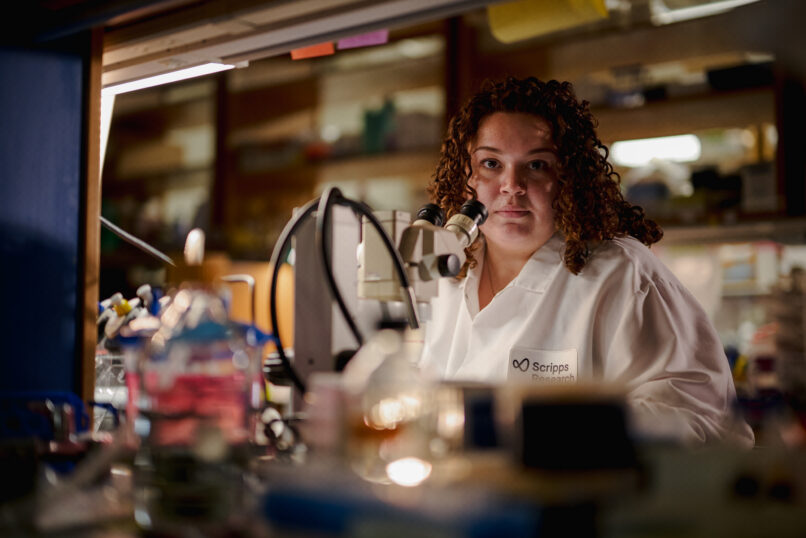
Kiah Zuniga, research assistant at Calibr-Skaggs, helps develop the novel sCAR-T therapy. Credit: Scripps Research
LA JOLLA, CA—Calibr-Skaggs Institute for Innovative Medicines, the drug discovery division of Scripps Research, announced today that the FDA has cleared their investigational new drug (IND) application to study switchable chimeric antigen receptor T cell (sCAR-T) therapy (CLBR001 + SWI019) in patients with autoimmune conditions. Patient recruitment for the phase 1 trial will begin soon (NCT06913608). The phase 1 clinical trial will evaluate the safety and efficacy of CLBR001 + SWI019 in patients with myositis, systemic sclerosis, lupus and rheumatoid arthritis, with the potential to expand to other indications in the future. Calibr-Skaggs’ novel sCAR-T therapy is designed to reduce side effects and patient burden associated with prior lymphodepletion treatments required for traditional CAR-T approaches—an important issue for rheumatologists and patients.
Autoimmune diseases are often chronic conditions that affect up to ~15 million people in the U.S. and up to 12% of the global population. CAR-T cell therapy has demonstrated curative potential in select autoimmune diseases by creating a system-wide immune ‘reset’, improving a patient’s quality of life, and reducing the need for life-long immune suppressants. However, conventional CAR-T cell therapies require lymphodepletion – a chemotherapy procedure used to eliminate existing immune cells to ensure the CAR-T cells can effectively expand. Further, this procedure can lead to increased risk of infection and severe side effects. CLBR001 + SWI019 was designed to avoid these issues by eliminating the need for lymphodepletion, reducing side effects and potentially making treatment accessible to a broader patient population.
“Patients with chronic autoimmune diseases need curative options that do not require life-long immunosuppressive therapy to manage their condition,” says Travis Young, vice president of biologics at Calibr-Skaggs. “Our CLBR001 + SWI019 cell therapy has the potential to transform the treatment paradigm for patients by eliminating chemotherapy-associated risks.”
Calibr-Skaggs’ Chief Medical Officer Chan Beals says, “Successfully establishing safety and efficacy of CLBR001 + SWI019 for conditions like lupus and rheumatoid arthritis could pave the way for broader therapeutic use in other autoimmune diseases, offering new hope to many more patients in the future.”
Patient enrollment for the clinical trial is anticipated to begin soon. Interested participants or referring clinicians can find more information by visiting calibr.scripps.edu or clinicaltrials.gov (NCT06913608).
About CLBR001 + SWI019 Switchable CAR-T
Calibr-Skaggs’ CLBR001 + SWI019 switchable CAR-T cell therapy differs from conventional CAR-T approaches by leveraging two components, a sCAR-T cell (CLBR001) and a protein-based biologic “switch” (SWI019) that targets CD19-positive B cells. CLBR001 + SWI019 has already demonstrated promising results in treating patients with B cell malignancies, with the ability to shorten the duration of adverse effects such as cytokine release syndrome (CRS) and immune effector cell-associated neurotoxicity syndrome (ICANS), and preclinical work has demonstrated the unique ability to work without lymphodepletion. In early-stage trials, CLBR001 cells expanded in patients to higher levels in peripheral blood compared to approved CAR-T cell products, with robust persistence.
About Scripps Research
Scripps Research is an independent, nonprofit biomedical research institute ranked one of the most influential in the world for its impact on innovation by Nature Index. We are advancing human health through profound discoveries that address pressing medical concerns around the globe. Our drug discovery and development division, Calibr-Skaggs, works hand-in-hand with scientists across disciplines to bring new medicines to patients as quickly and efficiently as possible, while teams at Scripps Research Translational Institute harness genomics, digital medicine and cutting-edge informatics to understand individual health and render more effective healthcare. Scripps Research also trains the next generation of leading scientists at our Skaggs Graduate School, consistently named among the top 10 U.S. programs for chemistry and biological sciences. Learn more at www.scripps.edu.
About the Calibr-Skaggs Institute for Innovative Medicines
The Calibr-Skaggs Institute for Innovative Medicines was founded on the principle that the creation of new medicines can be accelerated by pairing world-class biomedical research with state-of-the-art drug discovery and development capabilities. Leveraging the unique scientific framework of Scripps Research, Calibr-Skaggs has created a portfolio of drug candidates based on Scripps Research technologies and is shaping a new paradigm for advancing nonprofit biomedical research to impact patients. Learn more at calibr.scripps.edu.

Calibr-Skaggs advances CLF065, a regenerative GLP-2 therapy, into two Phase 2 IBD studies
CLF065, a long-acting, once-weekly GLP-2 receptor agonist, advances in two inflammatory bowel disease indications. The studies aim to bring a regenerative treatment option to patients living with IBD, who currently have few therapies that repair the damaged intestinal lining at the root of their disease.

What’s next for IBD care: Insights from a surgeon-scientist
The data is clear: inflammatory bowel diseases like ulcerative colitis and Crohn’s are on the rise worldwide. In this episode, we sit down with Dr. Amy Lightner—VP of Clinical Development at Calibr-Skaggs and colorectal surgeon at Scripps Clinic—to explore what drives these diseases, an upcoming phase 2 clinical trial for a new regenerative medicine, and how she balances life between the operating room and the research lab.

Reprogramming the immune system: Precision immunotherapy for cancer and autoimmune disease
Your immune system is your body’s natural defense, capable of identifying what belongs and what doesn’t. But when it falters, it can let cancer grow unchecked or mistakenly attack your own healthy tissues, leading to autoimmune diseases. What if we could reprogram the immune system to tip the balance in our favor, gaining an advantage over both cancers and autoimmune disorders? In this Front Row lecture, Calibr-Skaggs’ vice president of biologics, Travis Young, shared how Scripps Research is using genetic engineering to reprogram patients’ own immune cells to create personalized “switchable” CAR-T cell therapies. This approach represents a new class of precision immunotherapy designed to induce deep and durable remissions in patients with a wide range of cancers, from lymphoma to breast cancer, as well as in chronic autoimmune conditions such as lupus, rheumatoid arthritis and systemic sclerosis. Young explained how this breakthrough strategy works and what it could mean for the future of medicine.

Viome and Scripps Research partner to develop first at-home RNA screening test to prevent colon cancer before it strikes
First-of-its-kind 1,000-patient clinical study will use RNA-based stool and saliva tests to detect colon polyps — early warning signs of colorectal cancer — before they become cancerous.Study aims to enhance colorectal cancer prevention by identifying polyp molecular signals, offering improved sensitivity over at-home DNA tests, which have limited ability to detect precancerous lesions.