‘Scavenger’ cells in the nervous system linked to rare genetic disease
September 30, 2022
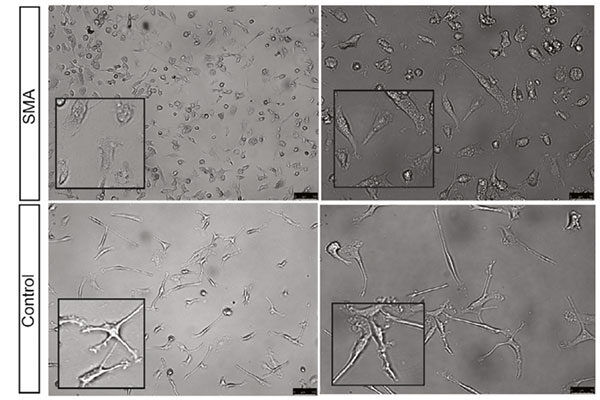
Microglia differentiated from iPSCs obtained from patients with SMA appeared differently from the control microglia, resembling an irregular, amoeba-like shape. Credit: Calibr and Uniformed Services University of the Health Sciences
LA JOLLA, CA—Spinal muscular atrophy (SMA) is a devastating, rare genetic disease that causes muscle weakness and eventually atrophy all throughout the body. Scientists at Calibr, the drug development arm of Scripps Research, and additional partners have now identified how a critical immune cell—known as the microglia—impacts SMA.
Published in Glia in July 2022, the findings provide a foundational understanding of SMA and how the interconnected neuro-immune network influences the disease. These insights could help lead to more effective medicines that target the newly discovered pathways.
“While there are three drugs currently on the market to treat SMA, they can be toxic and aren’t completely effective at alleviating the life-threatening nature of the disease,” says co-first author Zaida A. Gloria, a principal scientist at Calibr. “As our discoveries indicate, we’re beginning to understand the reason is because of just how multi-faceted the disease is. There’s now promise in creating medicines that target these additional pathways, while improving lifespan and overall quality of life for patients.”
SMA is characterized by a deletion or mutation in SMN1, the gene that produces the survival motor neuron (SMN) protein. Without this protein, the muscles that control activities like breathing, swallowing and walking begin to weaken. If left untreated, most patients with SMA don’t survive past two years of age.
While SMA research has historically always centered on enhancing SMN protein expression, the researchers were interested in the supportive roles of other immune cells instead, such as the microglia. The microglia are cells responsible for ‘eating up’ dying cells and debris (a process called phagocytosis); migrating around the central nervous system; and sending chemical messengers to recruit additional helper cells to injury sites.
“The microglia can be thought of as the nervous system’s scavengers and surveyors—they call out to the immune system if something is wrong or needs more attention,” says co-first author Guzal Khayrullina, PhD, Uniformed Services University of the Health Sciences (USUHS) neuroscience graduate. “We wanted to understand how reduced levels of SMN impacts this cell, as very limited research has specifically focused on this question before.”
In the study, the researchers utilized mice with low levels of SMN protein, as well as induced pluripotent stem cells (iPSCs) taken from patients with SMA. iPSCs are made by taking a person’s skin or blood cells and then reprogramming them back into their earlier, native state—before they’ve become specialized into a specific cell type. This was an important component of the study, as there is not much work focusing on microglia differentiated from SMA patient-derived iPSCs.
In SMN-deficient mice, the team found the microglia in the lumbar region of the spinal cord have a rounded shape with reduced processes, which suggests these cells are in an activated state. By studying the microglia differentiated from SMA-patient iPSCs, they also saw that the SMN-deficient microglia had increased cell migration and phagocytosis. Taken together, these activities could potentially impact the SMA disease pathology overall.
“These discoveries solidified our theory that SMA is not just a disease of motor neurons and is likely influenced by multiple different cell and tissue types,” says senior author Barrington Burnett, PhD, associate professor and vice chair for research at USUHS. “We can now explore how the SMN protein regulates the communications between microglia and motor neurons and the contributions of this interaction to the disease progression, and as a result, develop additional therapies that can make currently available treatment options even more effective.”
The researchers plan to further examine the complex nervous and immune system networks involved in SMA, as well as study an additional brain cell type called astrocytes shown to be implicated in the disease.
The study was funded by the Vanier CIHR Doctoral Research Award; Frederick Banting and Charles Best CIHR Doctoral Research Award; Canadian Institutes of Health Research; and the National Institute of Neurological Disorders and Stroke.
In addition to Gloria, Khayrullina and Burnett, authors of the study, “Survival motor neuron protein deficiency alters microglia reactivity,” included Kristen A. Johnson of Calibr; Matthew Stinson, Natalya Belous, Elizabeth M. Bergman, Fritz W. Lischka, Jeremy Rotty and Clifton L. Dalgard of the Uniformed Services University of the Health Sciences; and Marc-Olivier Deguise, Sabrina Gagnon, Lucia Chehade and Rashmi Kothary of Ottawa Hospital Research Institute and the University of Ottawa.



Shannon Miller: Gene editing, CRISPR, and drawing the line between science and fiction
Thanks to revolutionary technologies like CRISPR, we’re now living in an age where it’s becoming possible to rewrite the very building blocks of life itself—our DNA. We sit down with Scripps Research Fellow and CRISPR expert Shannon Miller, PhD, to discover how these gene editing technologies are poised to reverse a range of diseases. Listen in as we explore Shannon’s unique journey into science—beginning not with a single eureka moment, but instead with a passion for creativity and discovery.

Ahmed Badran: Bioengineering our way out of climate change
Ahmed Badran is an assistant professor of chemistry at Scripps Research, where his lab harnesses synthetic biology to address some of biggest global problems. Listen in as we discuss reengineering plant enzymes to capture carbon, plastic-eating bacteria and new classes of antibiotics that spare our gut microbiome.

Ram Krishnamurthy: Astrobiology, origins of life and the search for extraterrestrials
Professor Ram Krishnamurthy is based in the Department of Chemistry at Scripps Research, where his lab investigates the reactions that could have first given way to life on Earth. Listen as we discuss finding biological building blocks on meteorites, NASA’s search for life on other planets, and staying grounded with philosophy and meditation.

Danielle Grotjahn: What mitochondria tell us about disease, stress and cell death
Are the mitochondria truly the powerhouses of the cell? In this episode, assistant professor Danielle Grotjahn shares why she thinks “the stress sensors of the cell” may be a more appropriate name for this cellular organelle–and more. Dr. Grotjahn works in the Department of Integrative Structural and Computational Biology at Scripps Research, where her lab is answering how mitochondrial networks change shape in response to genetic, pharmacological or environmental stress. Listen as we talk about the links between mitochondrial dysfunction and disease, cell death, and the cutting-edge imaging technologies that are enabling Grotjahn and her team to peer into the mysteries of the mitochondria.
For the first time, potential treatment path becomes clear for subtype of Charcot-Marie-Tooth disease
An unexpected finding from Scripps Research has illuminated a promising strategy for treating the inherited neurological disease Charcot-Marie-Tooth, for which there is no approved medicine today.