Video Tag: Chemistry
-
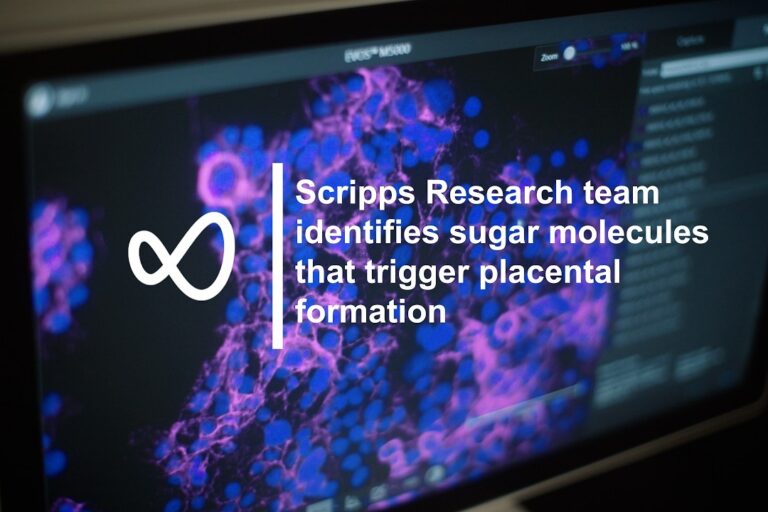
Scripps Research team identifies sugar molecules that trigger placental formation
During the first weeks of pregnancy, the developing placenta in a mother’s womb undergoes a dramatic change. Individual cells merge, forming a continuous barrier that will spend the next nine months ferrying oxygen and nutrients to the growing fetus while keeping the mother's immune system at bay. When this structure fails to form properly, pregnancies are at higher risk of complications, including preeclampsia and restricted fetal growth. Now, scientists at Scripps Research have identified a key player in the placenta’s transformation—a molecule called galectin-3 that binds to sugar molecules on specific cell surface proteins, likely holding placental cells tightly together to fuse.
-

The sweet side of drug discovery: How sugars can help shape the future of medicines
Some of the most powerful medicines we use today come from natural products, which are specialized molecules that plants and microbes have evolved over millions of years. Sugars play a key role in these compounds—determining how a molecule behaves, where it travels in the body and how strongly it activates the immune system. In this Front Row lecture, Scripps Research chemist Yuzhong Liu demonstrated how her lab uses synthetic biology to decode the role of sugars in medicine—helping scientists build next-generation vaccine adjuvants, cancer therapies and safer treatments.
-
Expanding the drug target universe
There are countless proteins that play critical roles in disease, yet they remain challenging to target with therapeutics. In this Front Row lecture, Professor Benjamin Cravatt explained how his large-scale protein profiling research and innovative chemical technologies are helping identify novel drugs for therapeutic targets previously deemed ‘undruggable.’ Cravatt’s translational work, which is at the intersection of chemistry and biology, has also led to the formation of multiple local biotechnology companies that collectively employ hundreds of scientists who are developing first-in-class candidate medicines for diverse diseases ranging from cancer to neurological disorders.
-

Regenerative medicine for the treatment of MS: Enhancing repair to prevent progression
Multiple sclerosis (MS) is a debilitating autoimmune disease that disrupts the central nervous system, causing symptoms like muscle weakness, cognitive challenges and a gradual loss of function that current treatments cannot fully repair. MS arises when the immune system attacks the myelin sheath, the protective layer insulating neurons. In this Front Row lecture, Scripps Research chemistry professor Luke Lairson discussed his research on the body’s natural repair pathways—specifically those that activate endogenous stem cells to restore myelin. His work aims to develop therapies that complement existing therapeutic approaches and halt MS progression.
-
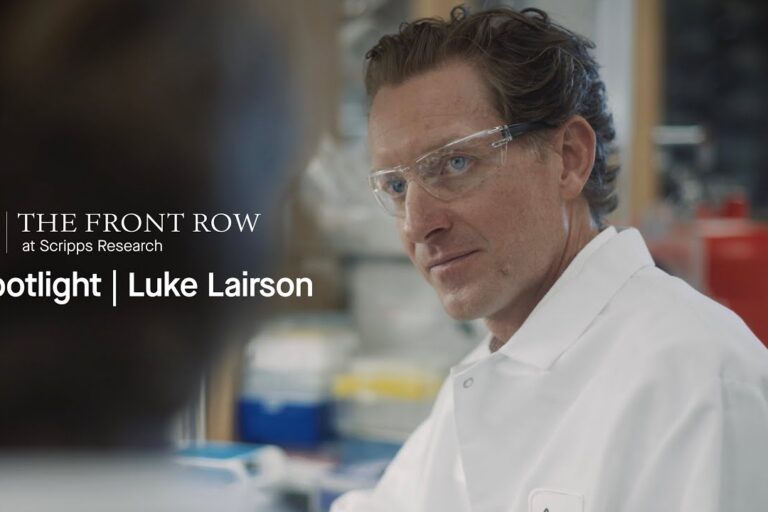
Front Row spotlight with Luke Lairson
Multiple sclerosis (MS) is a debilitating autoimmune disease that disrupts the central nervous system, causing symptoms like muscle weakness, cognitive challenges and a gradual loss of function that current treatments cannot fully repair. MS arises when the immune system attacks the myelin sheath, the protective layer insulating neurons. Scripps Research chemistry professor Luke Lairson will discuss his research on the body’s natural repair pathways—specifically those that activate endogenous stem cells to restore myelin. His work aims to develop therapies that complement existing therapeutic approaches and halt MS progression.
-
Exploring the atomic World: A century of science changing life
Chemistry is known as the “central science,” playing a fundamental role in enabling and integrating other scientific disciplines. Scripps Research is home to some of the world’s leading chemists, who advance our ability to design and produce molecules, develop life-changing therapies, and tackle global sustainability challenges. Former Scripps Research president Richard Lerner was integral to establishing the Institute as a world leader in chemistry and chemical biology. Serving as the institute’s leader from 1987 through 2012, Lerner believed chemistry and biology were inextricably linked, and studying these connections would unlock a new era in science and medicine.
-
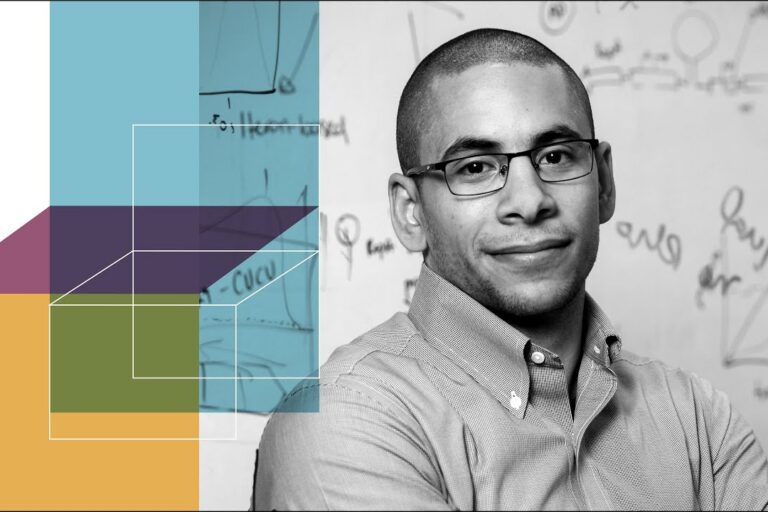
Re-engineering a sustainable world
Since the dawn of life, nature has balanced the composition of our planet’s atmosphere by evolving elegant ways of capturing carbon dioxide. Today, humanity’s overuse of fossil fuels has altered this atmospheric balance to bring about environmental disruptions, and nature is poorly equipped to correct them. In this Front Row lecture, Scripps Research assistant professor Ahmed Badran shared how his lab is developing strategies inspired by plants to help sequester the rising levels of carbon dioxide. His breakthroughs in synthetic biology are guiding revolutionary environmental approaches that could make a lasting impact on the atmosphere and agricultural food systems.
-

Historic honor: Barry Sharpless wins second Nobel Prize in Chemistry
The Scripps Research chemistry community shares their thoughts on K. Barry Sharpless' historic second Nobel Prize in Chemistry. He was awarded the 2022 prize for his groundbreaking research in developing “click chemistry,” an ingenious method for building molecules. Sharpless, the W.M. Keck Professor of Chemistry, shares the prize with Carolyn R. Bertozzi of Stanford University and Morten Meldal of the University of Copenhagen for the development of click chemistry and bioorthogonal chemistry, according to the Nobel Prize committee. Sharpless previously shared the 2001 Nobel Prize in Chemistry for his work on chirally catalyzed oxidation reactions, making him the second scientist ever to win two Nobel Prizes in Chemistry. Frederick Sanger won the Nobel Prize in Chemistry in 1958 and 1980.
-

Decoding sugar messages to create new diagnostics and therapeutics
Sugary molecules called glycans encapsulate our cells, serving as beacons to direct key biological activities, from tissue communication and growth to immune system activation. However, scientists have historically had limited ways to study glycans. In this Front Row lecture, Scripps Research associate professor Mia Huang shared the innovative tools her lab is using to decode the language of glycans. Her expertise in chemical biology is guiding the creation of new ways to diagnose or treat complex conditions, such as cancer and liver disease.