
Ahmed Badran, PhD
Associate Professor
Department of Chemistry

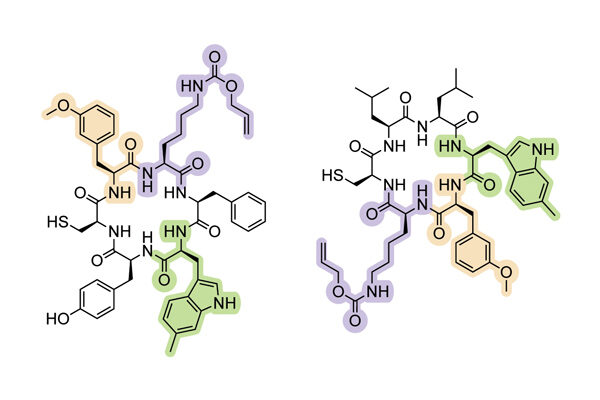
Research Focus
ISSUED & PENDING U.S. PATENTS
Negative selection and stringency modulation in continuous evolution US 10,179,911
Evolution of TALENs US 10,612,011
Evolution of BT Toxins US 2017/0029473 A1
Evolution of Proteases US 2017/0233708 A1
Vector-based mutagenesis system US 2018/0087046 A1
Continuous Evolution for Stabilized Proteins US 2020/0216833 A1
Select Publications
-
Kolber, Natalie S.; Fattal, Ranan; Bratulic, Sinisa; Carver, Gavriela D.; Badran, A H. Orthogonal translation enables heterologous ribosome engineering in E. coli. 2021, 12, 599.
View -
Lopatkin, Allison J.; Bening, Sarah C.; Manson, Abigai L.; Stokes, Jonathan M.; Kohanski, Mich A.; Badran, A H.; Earl, Ashlee M.; Cheney, Nicole J.; Yang, Jason H.; Collins, James J J. Clinically relevant mutations in core metabolic genes confer antibiotic resistance. 2021, 371.
View -
Johnston, Chad W.; Badran, A H.; Collins, James J J. Continuous bioactivity-dependent evolution of an antibiotic biosynthetic pathway. 2020, 11, 4202.
View -
Costello, Alan; Badran, A H. Synthetic Biological Circuits within an Orthogonal Central Dogma. 2021, 39, 59-71.
View -
Stokes, Jonathan M.; Yang, Kevin; Swanson, Kyle; Jin, Wengong; Cubillos-Ruiz, Andres; Donghia, Nina M.; MacNair, C R.; French, Shawn; Carfrae, Lindsey A.; Bloom-Ackermann, Zohar; Tran, Victoria M.; Chiappino-Pepe, Anush; Badran, A H.; Andrews, Ian W.; Chory, Emma J.; Church, George M.; Brown, Eric D.; Jaakkola, Tommi S.; Barzilay, Regina; Collins, James J J. A Deep Learning Approach to Antibiotic Discovery. Cell 2020, 181, 475-483.
View -
Komor, Alexis C.; Badran, A H.; Liu, David R. Editing the Genome Without Double-Stranded DNA Breaks. 2018, 13, 383-388.
View