Cancer researchers receive more than $2 million to eradicate common form of leukemia
April 10, 2018
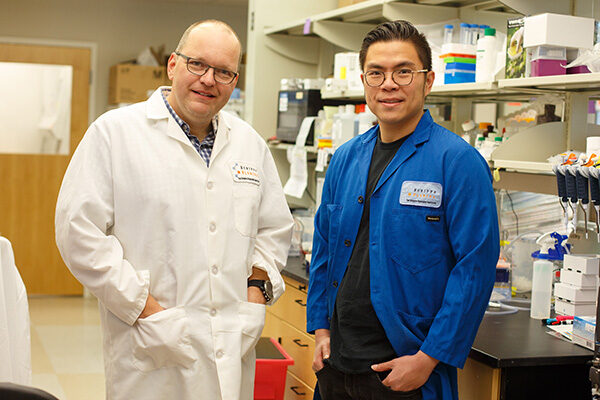
The new research will be led by Christoph Rader (left) with Hans Renata (right) and William Roush (not pictured). (Photo by Scott Wiseman)
“We want to attack the cancer without harming healthy cells and tissues,” Rader says. “To do this, we attach a highly potent drug to an antibody and then use the antibody to lead the drug payload to the cellular target.”
Doctors diagnose more than 20,000 people a year in the United States with chronic lymphocytic leukemia. The blood cancer originates in a type of white blood cells called lymphocytes, born in bone marrow. As the condition worsens over time, the cancerous cells accumulate, crowding out healthy blood cells. When they move into the blood stream, the malignant cells can spread to other organs and disrupt their healthy function. The illness can cause fatigue, fever and infections, swelling of the lymph nodes and weight loss. More than 4,500 people die each year of CLL in the United States.
The central challenge in fighting all cancers is attacking the malignancy without hurting other parts of the body. Antibodies, the immune system’s adaptable targeting system, recognize and bind to specific threats. Using them to attack cancer requires designing ways to attach drug payloads, and then identifying ideal points of attack. Rader’s team discovered a binding site on the surface of CLL lymphocytes, called FCMR, which pulls antibodies into the cells in a matter of minutes.
“This particular target is selectively expressed in CLL,” Rader says, which means antibodies that bind to the cancer won’t attack other, healthy cells.
Attaching the drug payload to the antibody requires a third element, a linking molecule. Working with Scripps Research chemists, including Assistant Professor Hans Renata, PhD, and Professor Emeritus William Roush, PhD, Rader’s group has devised several approaches that perform well.
“This draws on the unique interface of biology and chemistry we have here at Scripps Florida. We are creating new molecules with precise designs that are now able to selectively target CLL cells,” Rader says. “There is a dire need for the development of new, effective and safe therapies against chronic lymphocytic leukemia.”
The grant is number 2R01CA174844-04.
Close encounters: Designing drugs that recruit the cell’s own machinery to fight cancer and beyond
Some of the most devastating diseases are driven by proteins that cannot be targeted with conventional drugs. Scientists are now discovering ways to control disease by recruiting the cell’s own machinery to tackle this challenge. In this Front Row lecture, Associate Professor Michael Erb took the audience inside the cell to explain how his team is developing “proximity” drugs. Erb’s innovation has implications to change how scientists and cells join forces to fight against breast, prostate and blood cancers. Learn how proximity drugs can eliminate proteins, rewire essential cellular pathways, and enable researchers to target previously “undruggable” proteins.
Former Scripps Research grad students made early contributions to now-approved brain cancer drug
La Jolla Light