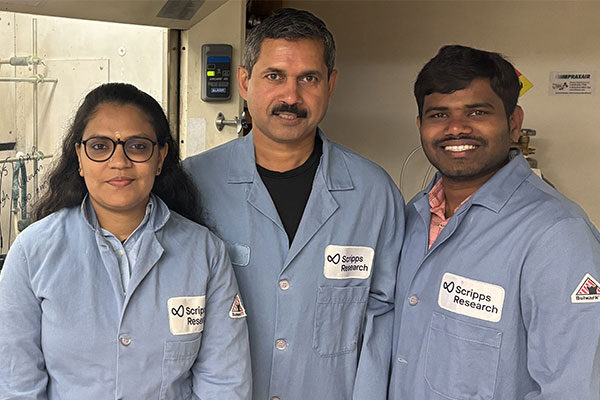
Ashok Deniz, PhD
Professor
Department of Integrative Structural and Computational Biology

Research Focus
Our research is broadly focused around deriving fundamental physical rules governing the properties of complex protein, RNA and other biopolymers at a range of spatial and time scales, with deep implications for biology and disease. We study these fascinating molecular species and tunable materials they can assemble into, and also develop state-of-the-art single-molecule and other biophysical tools for this purpose.
One research focus is on Intrinsically Disordered Proteins (IDPs). While many proteins have well-defined 3-dimensional structures, IDPs have stretches of flexible sequence. IDPs are prevalent in proteomes, and their physics can play key roles in many cellular functions. Our single-molecule studies have shed light on the tunable nature of IDP structural landscapes, with implications for function and diseases such as Parkinson's and Alzheimer's diseases.
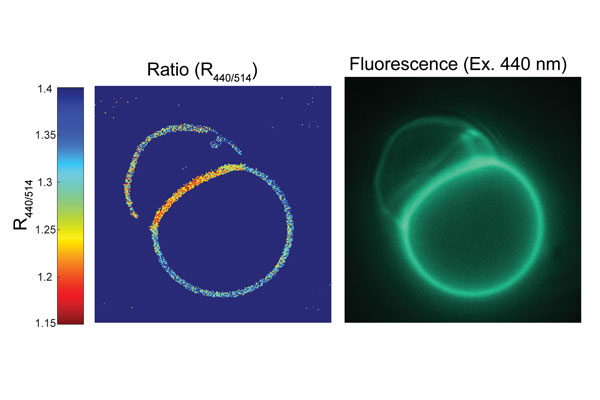
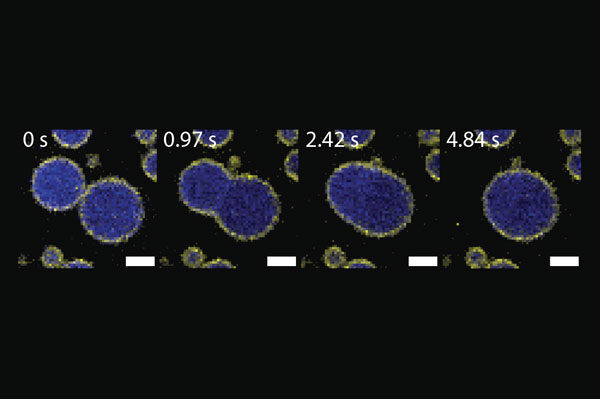
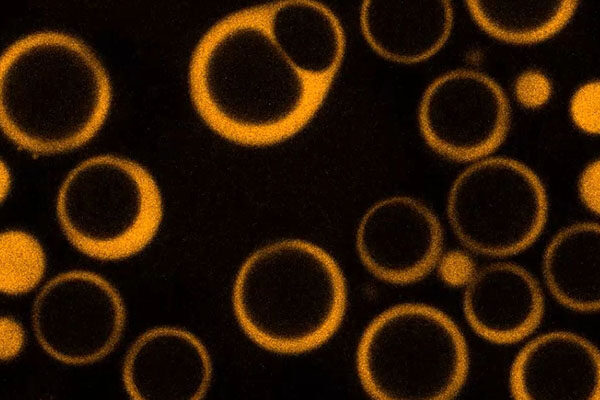
We also have a strong interest in understanding the basic biophysics of larger structures that proteins, RNA and the inorganic polymer polyphosphate can assemble into in cells, specifically dynamic structures known as condensates or membraneless organelles. Such structures (well known examples are the nucleolus, stress granules and polyphosphate granules) can have a range of material properties (liquid-like, viscoelastic, solid) as well as complex structural features that are believed to be mechanistically key in the dynamics and functions in cells.
In parallel, we develop and use single-molecule fluorescence methods to address key issues in molecular and cell biology. Single-molecule methods provide unprecedented views of structural and dynamic complexity in proteins and other biological macromolecules, allowing us to directly test biological models and theories.
Please see the links below for additional information about exciting examples of our work.
Recent
Hidden architecture inside cellular droplets reveals new targets for cancer and neurodegeneration
Scripps Research scientists reveal how first cells could have formed on Earth
Previous
Scientists "Watch" as Individual Alpha-Synuclein Proteins Change Shape
Researchers Observe Single Protein Dimers Wavering Between Two Symmetrically Opposed Structures
Select Publications
-
Gurunian, Anthony; Lasker, Keren; Deniz, Ashok A. Biomolecular Condensates Can Induce Local Membrane Potentials. Small 2026, 22, e09591.
View -
Chawla, Ravi; Tom, Jenna K A; Boyd, Tumara; Tu, Nicholas H.; Bai, Tanxi; Grotjahn, Danielle A.; Park, Donghyun; Deniz, Ashok A.; Racki, Lisa R. Reentrant DNA shells tune polyphosphate condensate size. Nature communications 2024, 15, 9258.
View -
Deniz, Ashok A. Percolation physics and density transition frameworks converge in biomolecular condensation. Proceedings of the National Academy of Sciences of the United States of America 2022, 119, e2210177119.
View -
Scholl, Daniel; Boyd, Tumara; Latham, Andrew P.; Salazar, Alexandra; Khan, Asma M A M; Boeynaems, Steven; Holehouse, Alex S.; Lander, Gabriel C.; Sali, Andrej; Park, Donghyun; Deniz, Ashok A.; Lasker, Keren The filamentous ultrastructure of the PopZ condensate is required for its cellular function. Nature structural & molecular biology 2026, 33, 420-432.
View -
Ferreon, Allan Chris C.; Ferreon, Josephine C.; Wright, Peter E.; Deniz, Ashok A. Modulation of allostery by protein intrinsic disorder. Nature 2013, 498, 390-4.
View -
Deniz, A A.; Dahan, M; Grunwell, J R.; Ha, T; Faulhaber, A E.; Chemla, D S.; Weiss, S; Schultz, P G. Single-pair fluorescence resonance energy transfer on freely diffusing molecules: observation of Förster distance dependence and subpopulations. Proceedings of the National Academy of Sciences of the United States of America 1999, 96, 3670-5.
View