
Juan C. De La Torre, PhD
Professor
Department of Immunology and Microbiology

Research Focus
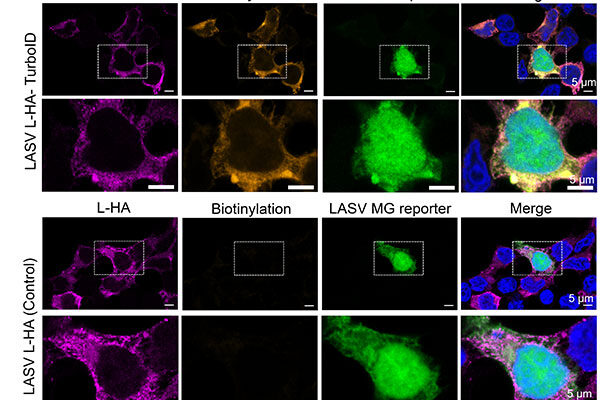
Work in our laboratory focuses on the investigation of the molecular and cell biology of mammarenaviruses (Order Bunyavirales) and their biological implications. Mammarenaviruses are enveloped viruses with a bi-segmented negative-strand RNA genome. The prototypic mammarenavirus lymphocytic choriomeningitis virus (LCMV)provides investigators with a highly tractable experimental model system for the investigation of virus-host interactions and associated diseases. Moreover, several mammarenaviruses cause severe disease in humans and pose important public health threats. We pioneered the development of a reverse genetics system for the prototypic mammarenavirus LCMV and subsequently developed similar systems for the hemorrhagic fever-causing mammarenaviruses Lassa (LASV) and Junin (JUNV) viruses. The development of mammarenavirus reverse genetics has provided us with a powerful approach for the investigation of the viral cis-acting sequences and trans-acting factors that control mammarenavirus replication and gene expression, as well as assembly and budding. Moreover, our ability to rescue infectious mammarenaviruses from cloned cDNAs allows us to examine the phenotypes of recombinant mammarenaviruses with predetermined mutations of interest in the context of the virus's natural infection. These advances in mammarenavirus molecular genetics have allowed us to develop a variety of cell-based assays and tools to identify and functionally characterize virus-host cell protein interactions, as well as the identification and characterization of inhibitors of these interactions, whihc have provided the bases for the development of both direct-acting (DAA) and host-directed (HDA) antivirals to combat human pathogenic mammarenaviruses. In addition, we have leveraged our findings on the molecular and cell biology of mammarenaviruses to generate recombinant (r) forms of LCMV and LASV that are fully attenuated in animal models of LCMV and LASV infections, and able to provide complete protection, upon a single administration, against a lethal challenge with the corresponding wild-type forms of LCMV or LASV. These findings have established the foundations for the development of novel live-attenuated vaccine platforms to combat human pathogenic mammarenaviruses.
Select Publications
-
Sanchez, A. B.; de la Torre, Juan C. Rescue of the prototypic arenavirus LCMV entirely from plasmid. Virology 2006, 350, 370-380.
View -
Emonet, Sebastien F.; Garidou, Lucile; McGavern, Dorian B.; de la Torre, Juan C. Generation of recombinant lymphocytic choriomeningitis viruses with trisegmented genomes stably expressing two additional genes of interest. Proceedings of the National Academy of Sciences 2009, 106, 3473-3478.
View -
Iwasaki, M.; Ngo, N.; Cubitt, B.; Teijaro, John R.; de la Torre, Juan C. General molecular strategy for development of arenavirus live-attenuated vaccines. Journal of Virology 2015, 89, 12166-12177.
View -
Martinez-Sobrido, L.; Emonet, S.; Giannakas, P.; Cubitt, B.; Garcia-Sastre, A.; de la Torre, Juan C. Identification of amino acid residues critical for the anti-interferon activity of the nucleoprotein of the prototypic arenavirus lymphocytic choriomeningitis virus. Journal of Virology 2009, 83, 11330-11340.
View -
Fang, Jingru; Pietzsch, Colette; Witwit, Haydar; Tsaprailis, George; Crynen, Gogce; Cho, Kelvin F.; Ting, Alice Y.; Bukreyev, Alexander; Saphire, Erica O.; de la Torre, Juan C. Proximity interactome analysis of Lassa polymerase reveals eRF3a/GSPT1 as a druggable target for host-directed antivirals. 2022, 119, e2201208119.
-
Urata, S.; Yun, N.; Pasquato, A.; Paessler, S.; Kunz, S.; de la Torre, Juan C. Antiviral activity of a small-molecule inhibitor of arenavirus glycoprotein processing by the cellular site 1 protease. Journal of Virology 2011, 85, 795-803.
View -
Iwasaki, M.; Minder, P.; Cai, Y.; Kuhn, J. H.; Yates, John R.; Torbett, Bruce E.; de la Torre, Juan C. Interactome analysis of the lymphocytic choriomeningitis virus nucleoprotein in infected cells reveals ATPase Na+/K+ transporting subunit Alpha 1 and prohibitin as host-cell factors involved in the life cycle of mammarenaviruses. PLoS Pathogens 2018, 14.
View -
Sakabe, Saori; Cubitt, Beatrice; Martinez-Sobrido, Luis; de la Torre, Juan C. Molecular Engineering of a Mammarenavirus with Unbreachable Attenuation. Journal of Virology 2023, 97.
View